Coif
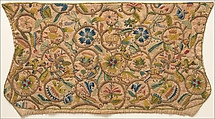
Traditionally, the coif and forehead cloth are understood to be the women’s alternative to a nightcap, worn indoors or beneath a headdress. In the 1530s, one Italian visitor to England explained that the coif fit closely around the head, so the hair was entirely covered, except for a “few tresses…visible over the forehead.” Over the coif, those of lower rank might wear a headdress of white cloth, those of higher rank, a velvet version. The style, he said, gave “a very elegant appearance.”
From this example and further visitor’s reports, we understand how the layers of the coif, forehead cloth, and headdress concealed the hair, which was considered an act of modesty, chastity and virtue. The multiplicity of head coverings also mirrors the interlocking parts, layers, and multivalent meanings early modern dress more broadly.
Artwork Details
- Title: Coif
- Date: 1600–1630
- Culture: British
- Medium: Linen worked with silk and metal thread, spangles; satin, long -and-short, braid, buttonhole, and couching stitches
- Dimensions: Coif: H. 9 x W. 8 1/2 inches (22.9 x 21.6 cm); Forehead cloth: H. 7 x W. 17 1/2 inches (17.8 x 44.4 cm)
- Classification: Textiles-Embroidered
- Credit Line: Gift of Irwin Untermyer, 1964
- Object Number: 64.101.1242
- Curatorial Department: European Sculpture and Decorative Arts
More Artwork
Press the down key to skip to the last item.
Research Resources
The Met provides unparalleled resources for research and welcomes an international community of students and scholars. The Met's Open Access API is where creators and researchers can connect to the The Met collection. Open Access data and public domain images are available for unrestricted commercial and noncommercial use without permission or fee.
To request images under copyright and other restrictions, please use this Image Request form.
Feedback
We continue to research and examine historical and cultural context for objects in The Met collection. If you have comments or questions about this object record, please contact us using the form below. The Museum looks forward to receiving your comments.
Content Notice
The Metropolitan Museum of Art presents over 5,000 years of art from around the world, and our online collection reflects ongoing work conducted over the course of our more than 150-year history. You may encounter objects or images that may be inappropriate for some viewers or information that may be outdated.