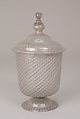
Glass square jar
Tubular everted rim, folded over and in to edge of wide, oval mouth; cylindrical neck; narrow horizontal shoulder; square body with vertical sides but rounded sloping corners at top; square bottom with low kick and pontil scar.
On bottom, four small circles with central dots at corners, flanking two concentric circles around a small knob at center, all in raised relief.
Intact; a few bubbles, some large; dulling and faint iridescence on exterior, reddish brown weathering and iridescence on interior.
Artwork Details
- Title: Glass square jar
- Period: Mid Imperial
- Date: 2nd–3rd century CE
- Culture: Roman
- Medium: Glass; mold-blown
- Dimensions: H.: 3 1/2 in. (8.9 cm)
- Classification: Glass
- Credit Line: Gift of Henry G. Marquand, 1881
- Object Number: 81.10.253
- Curatorial Department: Greek and Roman Art
More Artwork
Research Resources
The Met provides unparalleled resources for research and welcomes an international community of students and scholars. The Met's Open Access API is where creators and researchers can connect to the The Met collection. Open Access data and public domain images are available for unrestricted commercial and noncommercial use without permission or fee.
To request images under copyright and other restrictions, please use this Image Request form.
Feedback
We continue to research and examine historical and cultural context for objects in The Met collection. If you have comments or questions about this object record, please contact us using the form below. The Museum looks forward to receiving your comments.
Content Notice
The Metropolitan Museum of Art presents over 5,000 years of art from around the world, and our online collection reflects ongoing work conducted over the course of our more than 150-year history. You may encounter objects or images that may be inappropriate for some viewers or information that may be outdated.