Glass hexagonal bottle
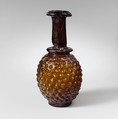
Rim folded out, round, and in, then pressed into flaring mouth; cylindrical neck with concave band below rim; downward sloping shoulder; hexagonal body with vertical sides, then cup-shaped below; low base with rounded edge and flat but uneven bottom. Mold seams run from near top of neck, down sides, and meet off-center on bottom.
Decoration in relief in three registers: on shoulder, six downturned rays or pointed petals; on body, six rectangular panels, each decorated at top with a triangular pediment, framed at sides with posts or slender columns, and bordered below by a plain band; in each panel, a different bird perched on or flying over a nest or rock; above the base, twenty-seven upturned tongues.
Complete except for weathering holes in shoulder and top of body; pitting, severe weathering, and some patches of brilliant iridescence.
Artwork Details
- Title: Glass hexagonal bottle
- Period: Early Imperial, Julio-Claudian
- Date: ca. 25–50 CE
- Culture: Roman
- Medium: Glass; blown in a three-part mold
- Dimensions: H.: 3 in. (7.6 cm)
Diam.: 3/4 x 1 5/8 in. (1.9 x 4.1 cm) - Classification: Glass
- Credit Line: Bequest of Mary Anna Palmer Draper, 1915
- Object Number: 15.43.165
- Curatorial Department: Greek and Roman Art
More Artwork
Research Resources
The Met provides unparalleled resources for research and welcomes an international community of students and scholars. The Met's Open Access API is where creators and researchers can connect to the The Met collection. Open Access data and public domain images are available for unrestricted commercial and noncommercial use without permission or fee.
To request images under copyright and other restrictions, please use this Image Request form.
Feedback
We continue to research and examine historical and cultural context for objects in The Met collection. If you have comments or questions about this object record, please contact us using the form below. The Museum looks forward to receiving your comments.
Content Notice
The Metropolitan Museum of Art presents over 5,000 years of art from around the world, and our online collection reflects ongoing work conducted over the course of our more than 150-year history. You may encounter objects or images that may be inappropriate for some viewers or information that may be outdated.