Blade and Mounting for a Dagger (Tantō)
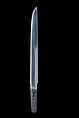
The shape of the tantō has a very slight curvature, with proportions that are wider and somewhat larger than a typical tantō of the early fourteenth century, but which became more common later in the century. The surface texture of this blade combines the appearance of a wood grain with a straight grain. The edge is tempered with a narrow straight line bordered by a double line, characteristics that show the influence of the Yamato School of swordsmiths.
The unsigned mountings, which were made for this tantō in the nineteenth century, are subtle and elegant. The ribbed scabbard is covered in black lacquered shark skin. The metal fittings on the hilt and the scabbard are made of silver and are beautifully chiseled with billowing waves. These are completed by the menuki (grip ornaments), which are gilt copper, and the tsuba (sword guard), which is shakudō (a copper and gold alloy patinated bluish black) inlaid with gold.
Artwork Details
- Title: Blade and Mounting for a Dagger (Tantō)
- Swordsmith: Blade inscribed by Uda Kunimitsu (Japanese, active early–mid-14th century)
- Date: blade, dated November, 1333; mounting, 19th century
- Culture: Japanese
- Medium: Steel, wood, lacquer, ray skin (samé), leather, copper, gold, silver, gold, shark skin, copper-gold alloy (shakudō)
- Dimensions: L. 17 5/8 in. (44.7 cm); L. of cutting edge 12 in. (30.4 cm)
- Classification: Daggers
- Credit Line: Gift of Peter H. B. Frelinghuysen, 1998
- Object Number: 1998.127.2
- Curatorial Department: Arms and Armor
More Artwork
Press the down key to skip to the last item.
Related Content

 Free to download
Research Resources
The Met provides unparalleled resources for research and welcomes an international community of students and scholars. The Met's Open Access API is where creators and researchers can connect to the The Met collection. Open Access data and public domain images are available for unrestricted commercial and noncommercial use without permission or fee.
To request images under copyright and other restrictions, please use this Image Request form.
Feedback
We continue to research and examine historical and cultural context for objects in The Met collection. If you have comments or questions about this object record, please contact us using the form below. The Museum looks forward to receiving your comments.
Content Notice
The Metropolitan Museum of Art presents over 5,000 years of art from around the world, and our online collection reflects ongoing work conducted over the course of our more than 150-year history. You may encounter objects or images that may be inappropriate for some viewers or information that may be outdated.