Transitional Rapier
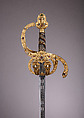
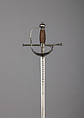
By the early seventeenth century, the rapier, a long slender thrusting sword, began to dominate as the gentleman’s weapon of choice. During the course of the century, however, as civilian fencing techniques became more specialized and refined, the rapier developed into a lighter, trimmed-down weapon known by about 1700 as the smallsword. Smallswords, often richly decorated, remained an integral part of a gentleman’s wardrobe until the wearing of swords in civilian settings went out of fashion at the end of the eighteenth century, at which time pistols were replacing swords as arms most frequently used in personal duels. The majority of smallsword hilts are made of silver or steel, but many also employ a wide variety of luxurious materials, such as gold, porcelain, and enamel. At their best, smallswords combine the crafts of swordsmith, cutler, and jeweler to create an elegant weapon that was also a wearable work of art.
Artwork Details
- Title: Transitional Rapier
- Bladesmith: Tomas Aiala (Spanish, Toledo, active 17th century)
- Date: hilt, ca. 1625–50; blade, 17th century
- Geography: Toledo
- Culture: Hilt, possibly French or Spanish; blade, Spanish, Toledo
- Medium: Steel, wood
- Dimensions: L. 42 5/8 in. (108.2 cm); L. of blade 35 5/8 in. (90.4 cm); W. 4 3/4 in. (12.1 cm); D. 4 3/4 in. (12.1 cm); Wt. 1 lb. 8 oz. (680.4 g)
- Classification: Swords
- Credit Line: Gift of William H. Riggs, 1913
- Object Number: 14.25.1084
- Curatorial Department: Arms and Armor
More Artwork

Related Content
Publications
Books, guides, and catalogues published by The Met.
 Free to download
Research Resources
The Met provides unparalleled resources for research and welcomes an international community of students and scholars. The Met's Open Access API is where creators and researchers can connect to the The Met collection. Open Access data and public domain images are available for unrestricted commercial and noncommercial use without permission or fee.
To request images under copyright and other restrictions, please use this Image Request form.
Feedback
We continue to research and examine historical and cultural context for objects in The Met collection. If you have comments or questions about this object record, please contact us using the form below. The Museum looks forward to receiving your comments.
Content Notice
The Metropolitan Museum of Art presents over 5,000 years of art from around the world, and our online collection reflects ongoing work conducted over the course of our more than 150-year history. You may encounter objects or images that may be inappropriate for some viewers or information that may be outdated.