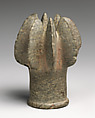
Mace head
The proper cultural attribution of stone mace heads of this type is unclear. Carved stone mace heads were made as early as the middle of the first millennium BCE in the Central Andes, by artisans of the Chavín and Cupisnique cultures. A sculpted mace head was excavated from a burial at Kuntur Wasi in the northern highlands of Peru (Fux, 2013:310, cat. no. 105). Objects stylistically similar to the present mace head have been excavated from burials of the Salinar culture, which dominated Peru’s northern coastal region from 200 BCE–100 CE (Burger, 1998; Strong and Evans, 1952:55–56, pl. IIIE).
The process by which stone objects were crafted in this period is not known, but the shape was probably accomplished by initially chipping the rock with stone tools, followed delicate refinements including polishing the mace head with fine quartz sand as an abrasive. The numerous chips on the edges may be the result of striking other stones during battle.
References and Further Reading
Burger, Richard L., “Mace Head,” in Andean Art at Dumbarton Oaks, Vol. 1, edited by Elizabeth H. Boone (Washington, DC: Dumbarton Oaks Research Library and Collection, 1996), pl. 9, pp. 84–86.
Fux, Peter, ed., Chavín: Peru’s Enigmatic Temple in the Andes (Zurich: Scheidegger & Spiess, 2013).
Strong, William D., and Clifford Evans, Jr., Cultural Stratigraphy in the Virú Valley Northern Peru. The Formative and Florescent Epochs (New York: Columbia University Press, 1952).
Artwork Details
- Title: Mace head
- Artist: Salinar artist(s)
- Date: 500–100 BCE
- Geography: Peru, North Coast
- Culture: Salinar
- Medium: Stone, pigment
- Dimensions: H. 3 1/4 × W. 3 1/4 × D. 3 3/8 in. (8.3 × 8.3 × 8.6 cm)
- Classification: Stone-Implements
- Credit Line: The Michael C. Rockefeller Memorial Collection, Purchase, Nelson A. Rockefeller Gift, 1970
- Object Number: 1978.412.242
- Curatorial Department: The Michael C. Rockefeller Wing
More Artwork
Press the down key to skip to the last item.
Research Resources
The Met provides unparalleled resources for research and welcomes an international community of students and scholars. The Met's Open Access API is where creators and researchers can connect to the The Met collection. Open Access data and public domain images are available for unrestricted commercial and noncommercial use without permission or fee.
To request images under copyright and other restrictions, please use this Image Request form.
Feedback
We continue to research and examine historical and cultural context for objects in The Met collection. If you have comments or questions about this object record, please contact us using the form below. The Museum looks forward to receiving your comments.
Content Notice
The Metropolitan Museum of Art presents over 5,000 years of art from around the world, and our online collection reflects ongoing work conducted over the course of our more than 150-year history. You may encounter objects or images that may be inappropriate for some viewers or information that may be outdated.