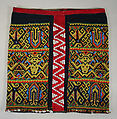
Lawo butu (women’s ceremonial skirt)
Among the Ngada, the beads used to adorn lawo butu were highly valued and reused for generations. According to oral tradition, beads, along with other forms of wealth, originally grew on a single tree planted by two orphans. Cut down by greedy villagers, the tree fell in such a way that nearly all the wealth it carried was lost to the island of Java and only the beads remained on Flores. The beadwork on this example includes depictions of humans, birds, and stylized quadrupeds that may represent horses, which were highly esteemed by the Ngada. The ikat designs are organized into the typical banded pattern seen in textiles throughout the Lesser Sunda Islands.
Artwork Details
- Title: Lawo butu (women’s ceremonial skirt)
- Artist: Ngada artist
- Date: late 19th–early 20th century
- Geography: Indonesia, Flores, East Nusa Tenggara
- Culture: Ngada peoples
- Medium: Cotton, glass beads, chambered-nautilus shell, nassa shell
- Dimensions: H. 74 × W. 30 in. (187.96 × 76.2 cm) as mounted
- Classification: Textiles-Beadwork
- Credit Line: Purchase, The Fred and Rita Richman Foundation Gift, 2006
- Object Number: 2006.2
- Curatorial Department: The Michael C. Rockefeller Wing
More Artwork
Press the down key to skip to the last item.
Related Content

Research Resources
The Met provides unparalleled resources for research and welcomes an international community of students and scholars. The Met's Open Access API is where creators and researchers can connect to the The Met collection. Open Access data and public domain images are available for unrestricted commercial and noncommercial use without permission or fee.
To request images under copyright and other restrictions, please use this Image Request form.
Feedback
We continue to research and examine historical and cultural context for objects in The Met collection. If you have comments or questions about this object record, please contact us using the form below. The Museum looks forward to receiving your comments.
Content Notice
The Metropolitan Museum of Art presents over 5,000 years of art from around the world, and our online collection reflects ongoing work conducted over the course of our more than 150-year history. You may encounter objects or images that may be inappropriate for some viewers or information that may be outdated.