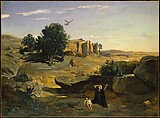
A Woman Gathering Faggots at Ville-d'Avray
Artwork Details
- Title: A Woman Gathering Faggots at Ville-d'Avray
- Artist: Camille Corot (French, Paris 1796–1875 Paris)
- Date: ca. 1871–74
- Medium: Oil on canvas
- Dimensions: 28 3/8 x 22 1/2 in. (72.1 x 57.2 cm)
- Classification: Paintings
- Credit Line: Mr. and Mrs. Isaac D. Fletcher Collection, Bequest of Isaac D. Fletcher, 1917
- Object Number: 17.120.225
- Curatorial Department: European Paintings
Audio
6068. A Woman Gathering Faggots at Ville-d'Avray
NARRATOR—This late landscape depicts one of Corot’s favorite sites--the large pond near Ville d'Avray, a placid village on the outskirts of Paris where the painter had a house.
As in many of Corot’s other depictions of this site, a stand of trees screens the foreground. Through it, we can see the silvery surface of the pond in the middle distance and the group of houses on the opposite shore.The female figure in the foreground seems little more than a pretext for introducing a note of dissonant color into the grey-green tonalities which dominate the picture.
This small work elicited favorable remarks at the Salon of 1870, even though many critics considered Corot's landscapes passé by that time. What struck critics most was how personal and poetic Corot's work had become. One critic wrote "He is no seeker after reality, he is a dreamer, who, through all the changing and varied aspects of nature, pursues always the same poetic,
uniform note. They still say that when he paints Ville d'Avrayhe knows how to be realistic when he feels like it. Well, no; what he sees everywhere is not what is in nature, it is what is in himself. If you sent him to Egypt to paint beside the pyramids, he would find there his silvery tones and mysterious thickets."
More Artwork
Press the down key to skip to the last item.
Related Content

Research Resources
The Met provides unparalleled resources for research and welcomes an international community of students and scholars. The Met's Open Access API is where creators and researchers can connect to the The Met collection. Open Access data and public domain images are available for unrestricted commercial and noncommercial use without permission or fee.
To request images under copyright and other restrictions, please use this Image Request form.
Feedback
We continue to research and examine historical and cultural context for objects in The Met collection. If you have comments or questions about this object record, please contact us using the form below. The Museum looks forward to receiving your comments.
Content Notice
The Metropolitan Museum of Art presents over 5,000 years of art from around the world, and our online collection reflects ongoing work conducted over the course of our more than 150-year history. You may encounter objects or images that may be inappropriate for some viewers or information that may be outdated.