Cornemuse
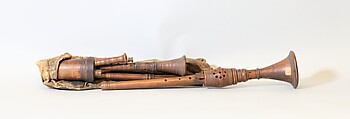
This bagpipe is made of plumwood inlaid with tin/pewter. It is most likely a combination of original craftsmanship and replacement pieces, creating a composite instrument. The finest craftsmanship on this instrument is found on the middle and end section of the drone, suggesting that these are the only original pieces matching the quality of the production found in the late eighteenth century, probably between 1780 and 1800 (Blanc 1987). The rest of the bagpipe is roughly made and mismatched. The lattice work is much wider and irregular, the small drone is too short compared to the chanter (it should reach the tuning holes of the chanter). Finally, the chanter/tenor drone stock is illogically presented: the playing arrangement, with the chanter to the left of the tenor drone (evidenced by the blocked pinky hole on the left side of the chanter, showing that this bagpipe was played with the right hand at the bottom of the chanter), is the only possible arrangement: otherwise the tenor drone obstructs the final hole. However, the internal stock bores are not equal, meaning that the position of the chanter and tenor drone are not interchangeable. This playing arrangement, fitted into the stock, brings what would normally be understood as the ‘back’ of the stock (the least ornate part) to the front. While the blocked pinky hole suggests that this bagpipe might have been played, the illogical arrangement points either to the fact that this was originally made for a player that played with the right hand on top, or that the instrument is made of composite parts that do not quite fit together.
(Cassandre Balosso-Bardin, 2023)
Technical Description
Conical single chanter 420 mm, 7/1 holes, the lowest doubled with one blocked with wax, 2 vent holes, reed missing (typically, cane double reed);
Bass drone in 3 sections 712 mm, tenor drone in 2 sections 255 mm excluding tenon cylindrical bores, both drones with tuning slides, reeds missing (probably single cane reeds);
Cylindrical blowpipe 156 mm with leather flapper valve; sheep or goatskin bag without cover;
Large rectangular flat stock with 2 bored holes for chanter and tenor drone, separate cylindrical stocks for bass drone and blowpipe;
all pipes and stocks inlaid with pewter decoration, chanter stock, chanter and bass drone with lattice-work pattern, both drones with fleur-de-lys pattern; drones curve out at tuning slides;
Yellow silk ribbon tied around chanter stock.
References
Bernard Blanc, 1987. Notes in instrument file #89.4.856, September 24, 1987. Musical Instrument Department Archive, New York: Metropolitan Museum of Art.
Bernard Blanc, 1996. ‘Les cornemuses du Centre : filiation et évolution’. Les cornemuses de George Sand : Autour de Jean Sautivet, fabricant et joueur de musette dans le Berry (1976-1867). Montluçon : Musées de Montluçon.
Artwork Details
- Title: Cornemuse
- Period: 19th century
- Geography: France
- Culture: French
- Medium: wood, pewter, sheep or goatskin
- Classification: Aerophone-Reed Vibrated-bagpipe
- Credit Line: The Crosby Brown Collection of Musical Instruments, 1889
- Object Number: 89.4.859
- Curatorial Department: Musical Instruments
More Artwork
Press the down key to skip to the last item.

Research Resources
The Met provides unparalleled resources for research and welcomes an international community of students and scholars. The Met's Open Access API is where creators and researchers can connect to the The Met collection. Open Access data and public domain images are available for unrestricted commercial and noncommercial use without permission or fee.
To request images under copyright and other restrictions, please use this Image Request form.
Feedback
We continue to research and examine historical and cultural context for objects in The Met collection. If you have comments or questions about this object record, please contact us using the form below. The Museum looks forward to receiving your comments.
Content Notice
The Metropolitan Museum of Art presents over 5,000 years of art from around the world, and our online collection reflects ongoing work conducted over the course of our more than 150-year history. You may encounter objects or images that may be inappropriate for some viewers or information that may be outdated.