Cowroid Seal Inscirbed for Maatkare
During the 1926-1927 excavation season, the Museum's Egyptian Expedition uncovered three foundation deposits along the eastern enclosure wall of Hatshepsut's funerary temple at Deir el-Bahri in Western Thebes. Among the contents were 299 scarabs and stamp-seals. Sixty-five of these are now in the Egyptian Museum, Cairo, and the rest were acquired by the Museum in the division of finds.
Most of the amulets found in the foundation deposits were scarabs, but a hand full were carved in the shape of a cowrie shell. Like this one, the backs of most of these cowroids have been incised with a decorative pattern that suggests the setting of a swivel ring bezel (see 36.3.46). Others (27.3.180) have also been inscribed with the image of a bolti fish (a tilapia), and two have been carved with the image of a falcon, with its wings outstretched and wearing an atef-crown (27.3.164, 27.3.396).
Among the inscriptions on the bases of these scarabs and seals are examples of every title Hatshepsut held, from the time she was "king's daughter" during the reign of her father, Thutmose I; through the time she was queen of her half-brother, Thutmose II; and during her regency and co-reign with her nephew/step-son, Thutmose III.
The inscription on the base of this cowroid records Hatshepsut's throne name, Maatkare, which may be roughly translated as Maat (the goddess of truth) is the life force of Re (the sun god). The two hieroglyphs on either side of the crouching goddess have the meaning "May She Live," or "Living" (ankh.ti).
Most of the amulets found in the foundation deposits were scarabs, but a hand full were carved in the shape of a cowrie shell. Like this one, the backs of most of these cowroids have been incised with a decorative pattern that suggests the setting of a swivel ring bezel (see 36.3.46). Others (27.3.180) have also been inscribed with the image of a bolti fish (a tilapia), and two have been carved with the image of a falcon, with its wings outstretched and wearing an atef-crown (27.3.164, 27.3.396).
Among the inscriptions on the bases of these scarabs and seals are examples of every title Hatshepsut held, from the time she was "king's daughter" during the reign of her father, Thutmose I; through the time she was queen of her half-brother, Thutmose II; and during her regency and co-reign with her nephew/step-son, Thutmose III.
The inscription on the base of this cowroid records Hatshepsut's throne name, Maatkare, which may be roughly translated as Maat (the goddess of truth) is the life force of Re (the sun god). The two hieroglyphs on either side of the crouching goddess have the meaning "May She Live," or "Living" (ankh.ti).
Artwork Details
- Title: Cowroid Seal Inscirbed for Maatkare
- Period: New Kingdom
- Dynasty: Dynasty 18, early
- Reign: Joint reign of Hatshepsut and Thutmose III
- Date: ca. 1479–1458 B.C.
- Geography: From Egypt, Upper Egypt, Thebes, Deir el-Bahri, Temple of Hatshepsut, Foundation Deposit 7 (G), MMA excavations, 1926–27
- Medium: Steatite (glazed)
- Dimensions: L. 2.2 cm (7/8 in.); W. 1.3 cm (1/2 in.); H. 0.5 cm (3/16 in.)
- Credit Line: Rogers Fund, 1927
- Object Number: 27.3.238
- Curatorial Department: Egyptian Art
More Artwork
A slider containing 5 items.
Press the down key to skip to the last item.
Press the down key to skip to the last item.
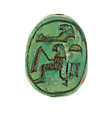
ca. 1479–1458 B.C.
ca. 1640–1550 B.C.
ca. 1479–1458 B.C.
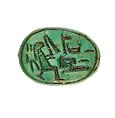
ca. 1479–1458 B.C.
Indus
ca. 2600–1900 BCE
Research Resources
The Met provides unparalleled resources for research and welcomes an international community of students and scholars. The Met's Open Access API is where creators and researchers can connect to the The Met collection. Open Access data and public domain images are available for unrestricted commercial and noncommercial use without permission or fee.
To request images under copyright and other restrictions, please use this Image Request form.
Feedback
We continue to research and examine historical and cultural context for objects in The Met collection. If you have comments or questions about this object record, please contact us using the form below. The Museum looks forward to receiving your comments.