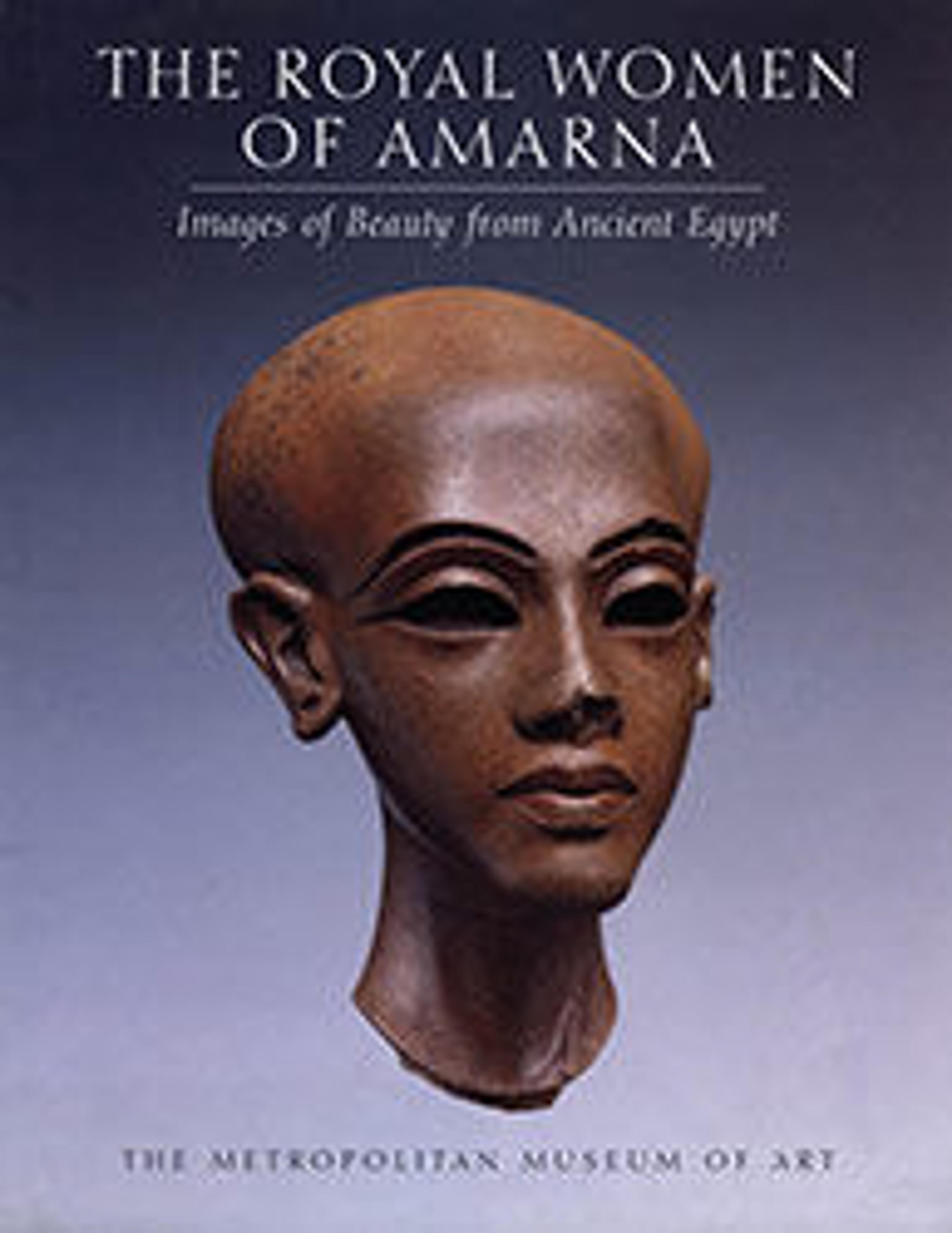
The Royal Women of Amarna: Images of Beauty from Ancient Egypt
During a brief seventeen-year reign (ca. 1353–1336 B.C.) the pharaoh Amenhotep IV/Akhenaten, founder of the world's first known monotheistic religion, devoted his life and the resources of his kingdom to the worship of the Aten (a deity symbolized by the sun disk) and thus profoundly affected history and the history of art. The move to a new capital, Akhetaten/Amarna, brought essential changes in the depictions of royal women. It was in their female imagery, above all, that the artists of Amarna departed from the traditional iconic representations to emphasize the individual, the natural, in a way unprecedented in Egyptian art.
A picture of exceptional intimacy emerges from the sculptures and reliefs of the Amarna Period. Akhenaten, his wife Nefertiti, and their six daughters are seen in emotional interdependence even as they participate in cult rituals. The female principle is emphasized in astonishing images: the aging Queen Mother Tiye, the mysterious Kiya, and Nefertiti, whose painted limestone bust in Berlin is the best-known work from ancient Egypt—perhaps from all antiquity.
The workshop of the sculptor Thutmose—one of the few artists of the period whose name is known to us—revealed a treasure trove when it was excavated in 1912. An entire creative process is traced through an examination of the work of Thutmose and his assistants, who lived in a highly structured environment. All was left behind when Amarna was abandoned after the death of Akhenaten and the return to religious orthodoxy.
Dorothea Arnold, Lila Acheson Wallace curator in charge of the Department of Egyptian Art at the Metropolitan Museum, has provided a landmark art-historical exploration of a period when the confluence of religion, art, and politics resulted in a unique epoch.
James P. Allen, associate curator, Department of Egyptian Art, has elucidated this revolutionary era in the history of religion, a time when the governing principle of life was a "sole god, with no other except him," light itself.
In her brief biographical summaries, the Egyptologist L. Green, lecturer at Scarborough College, the University of Toronto, places the royal women of Amarna in genealogical context.
Met Art in Publication
You May Also Like
Press the down key to skip to the last item.
Citation
Arnold, Dorothea. 1996. The Royal Women of Amarna: Images of Beauty from Ancient Egypt [Catologue for the Exhibition, “Queen Nefertiti and the Royal Women : Images of Beauty from Ancient Egypt” Oct. 8, 1996 - Feb. 2, 1997, at the Metropolitan Museum of Art]. New York (N.Y.): The metropolitan museum of art.