«In China, paintings that tell stories have flourished as powerful vehicles for both didactic messages and self-expression since the fourth century. Such paintings typically offer either continuous, multiscene illustrations presented in long handscrolls, or monoscenic compositions that evoke an entire story with a single iconic episode.
But we also find generic landscape, flower-and-bird, and figure paintings that—despite the absence of narrative imagery—tell vivid stories through appended inscriptions.» The text and the image are each a self-contained work of art, but together they construct a mental landscape that is greater than the sum of its parts.
A group of works representing this distinctively Chinese practice from the 13th century to the present is featured in the exhibition Show and Tell: Stories in Chinese Painting, on display in galleries 210–216 through August 6, 2017.
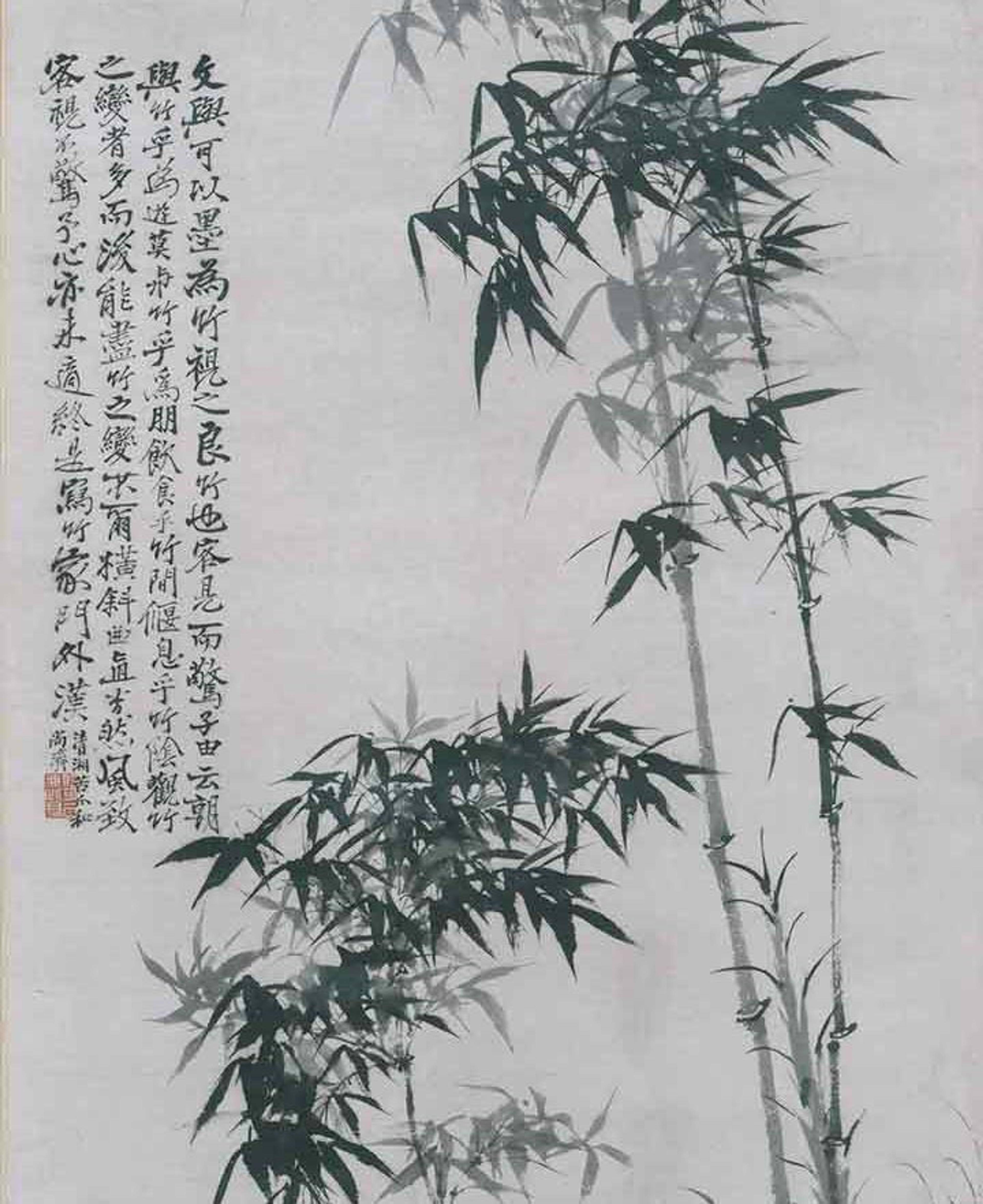
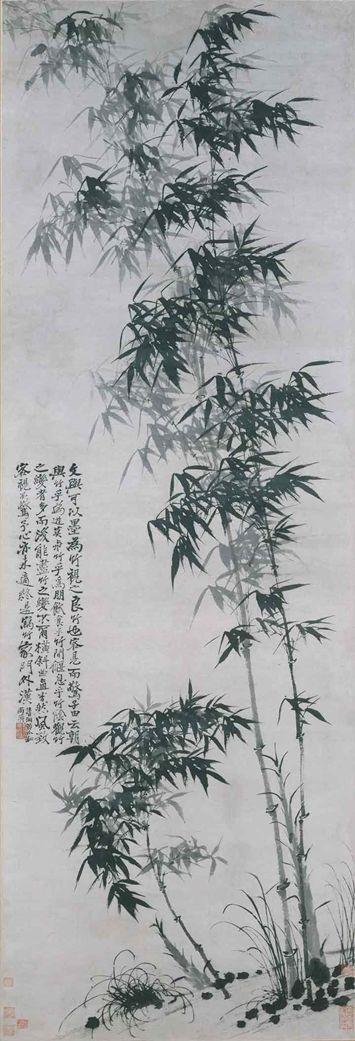
Chinese painters like to relate stories from the past that deepen the significance of their works. On his 17th-century painting of bamboo, the painter Shitao (1642–1707) records the comments of Su Che, an 11th-century scholar who once praised a friend's painting on the same subject:
After invoking the conversation of this fabled circle of friends, Shitao concludes the inscription by endorsing Wen Tong's creative method of total immersion and proclaiming artistic affinity to the earlier master; in the painting, the young bamboo on the left curves toward its tall counterpart, as if bowing in homage.
Another painter, Wang Jun (1816–after 1883), relates stories from the more recent past in an album of paintings that depicts 10 topographical sites associated with the eminent scholar-official Ruan Yuan (1764–1849) with a focus on the Ruan family properties in Yangzhou.
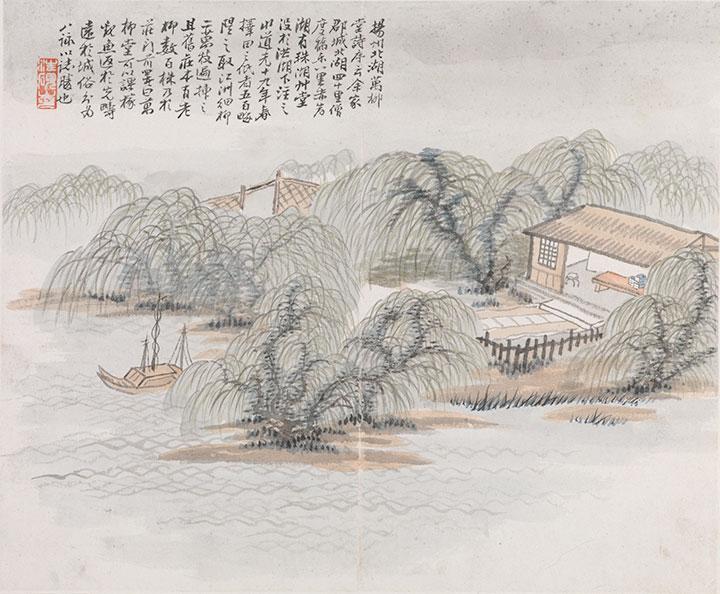
Wang Jun (Chinese, 1816–after 1883). "Hall of Ten Thousand Willows," inTen Sites Associated with Ruan Yuan, 1883. China, Qing dynasty (1644–1911). Leaf from an album of 10 paintings, ink and color on paper, each leaf: 11 x 13 1/4 in. (27.9 x 33.7 cm). The Metropolitan Museum of Art, New York, Gift of Julia and John Curtis, 2015 (2015.784.10)
Wang gives each picture an inscription that tells the story of the place, thereby converting the landscape album into an informative biography of the man. On one leaf, which shows a lakeside cottage surrounded by lush willows expanding into the misty distance, Wang quotes a passage from Ruan Yuan's anthology:
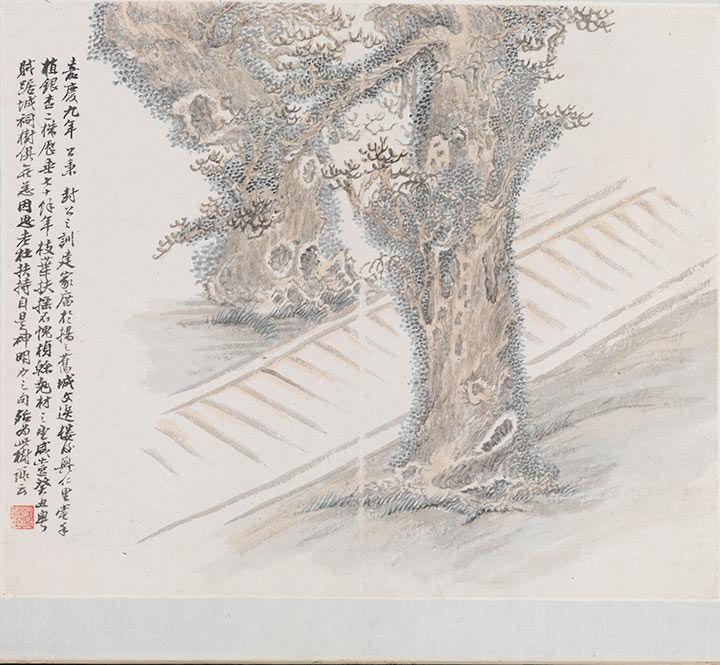
Wang Jun (Chinese, 1816–after 1883). "Gingko Trees," in Ten Sites Associated with Ruan Yuan, 1883. China, Qing dynasty (1644–1911). Leaf from an album of 10 paintings, ink and color on paper, each leaf: 11 x 13 1/4 in. (27.9 x 33.7 cm). The Metropolitan Museum of Art, New York, Gift of Julia and John Curtis, 2015 (2015.784.10)
In another painting, Wang Jun depicts a pair of monumental gingkos that flank a stone path. The deeply pitted, gnarly knots are natural ornaments; and the moss-dappled bark and webs of young twigs brim with vivacity. The artist introduces the trees with an inscription in his own voice:
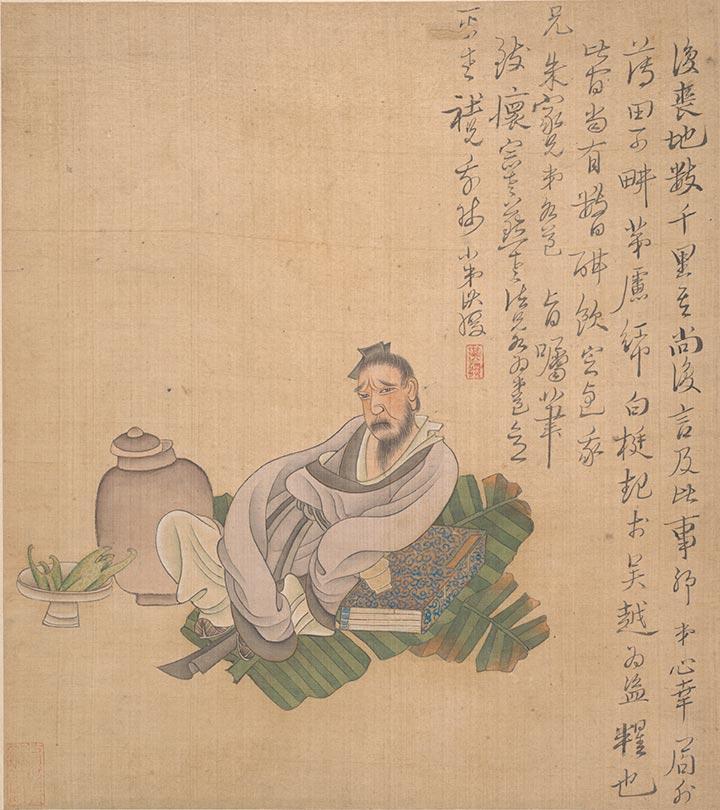
Chen Hongshou (Chinese, 1599–1652). "Self-image," in Figures, Flowers, and Landscapes, ca. 1633. China, late Ming (1368–1644) to early Qing (1644–1911) dynasty. Leaf from an album of 11 paintings, ink and color on silk, image: 8 3/4 x 8 5/8 (22.2 x 21.7 cm). The Metropolitan Museum of Art, New York, Gift of Mr. and Mrs. Wan-go H. C. Weng, 1999 (1999.521)
Artists talk about themselves too. An inscription appended to Chen Hongshou's [1599–1652] generic depiction of a dejected scholar in a drunken stupor transforms the work into a self-portrait. With flushed cheeks and droopy eyes, the man slumps on a stack of books, and the wobbly jar and tilted vessel of fruit suggest his distorted vision of the surroundings. The inscription, a letter to a friend, reveals that this is the artist himself, lamenting the loss of vast territories along China's northern borders to the invading Manchus, and fretting about local disturbances:
The warm regards that the woebegone painter expresses on behalf of his friends, and his anticipation of future drinking parties, reveal a cheerful side of his personality that belies the image.
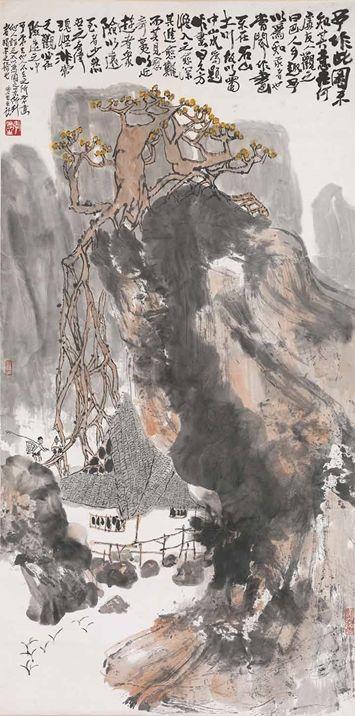
Left: Li Huasheng (Chinese, b. 1944). Rustic Scene, 1982. Hanging scroll, ink and color on paper, image: 53 1/2 x 26 1/2 in. (135.9 x 67.3 cm). The Metropolitan Museum of Art, New York, Gift of Jerome Silbergeld and Michelle DeKlyen, 2013 (2013.1107)
In an eerily bold landscape by Li Huasheng (b. 1944), a massive tree atop a tall bluff sends a cascade of aerial roots down to a gable-roofed pavilion. This almost surreal sight may not be pure invention, but rather a subjective re-creation of something the artist actually saw at an obscure place in his native Sichuan Province. Seeking out such singular sights was essential to his creativity, as he explains in his inscription:
In an intimate voice, the painter describes a creative process that requires both physical and mental detachment, while the abstract rendering of the towering boulder in the foreground reflects his intellectual detachment from visible phenomena.
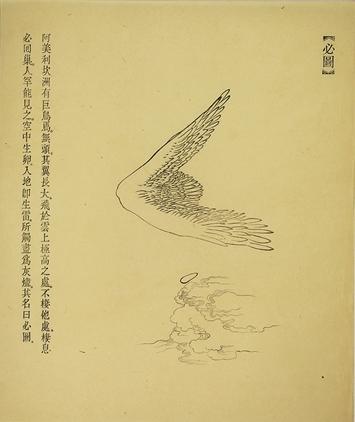
In his provocative remake of The Classic of Mountains and Seas, an ancient encyclopedia describing a myriad of mostly mythical creatures in exotic locales, Qiu Anxiong (b. 1972) adopts the woodblock print–illustrated format of his model, but addresses current issues in an allegorical manner using words and images of his own.
The artist gives each picture a title that is a close phonetic equivalent of the creature's name in English, as well an inscription that describes its physical and behavioral traits. One picture, showing a headless creature with widespread feathery wings soaring above the clouds, is titled "Bitu," an allusion to the B-2 bomber. The inscription reads:
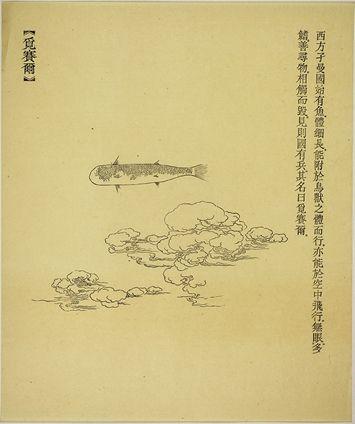
Left: Qiu Anxiong (Chinese, b. 1972). "Misaier" [Missile], in New Classic of Mountains and Seas I, 2008. Leaf from a portfolio of 12 woodblock prints, ink on paper, each leaf: 19 3/4 x 16 1/2 in. (50.2 x 41.9 cm). The Metropolitan Museum of Art, New York, Purchase, Friends of Asian Art Gifts, 2013 (2013.944a–l)
Another picture also presents a sky scene, but this one bizarrely features a fish-like creature whose name, Misaier, is a close transliteration of "missile." The appended story reads:
Qiu's words for each image in the album convey the sense of wonder felt by someone from antiquity encountering the fruits of modernization. "They must appear like enigmatic monsters roaming the world," he remarks. Though a seemingly straightforward imitation of an antique model, his work wryly critiques the "unnatural" creations of our contemporary world.
The topics of the narrative texts appended to the generic images in Chinese painting are diverse, and the interaction of the two components—text and image—operates in innumerable ways to illuminate both the artwork and the artist. From Shitao's evocation of ancient masters to Qiu Anxiong's time-travel allegories, the works in Show and Tell demonstrate the expressive potential and lasting relevance of this type of pictorial storytelling.
Related Links
Show and Tell: Stories in Chinese Painting, on view at The Met Fifth Avenue through August 6, 2017
Now at The Met: "Show and Tell: Exploring Storytelling in Chinese Painting" (January 31, 2017)
Articles Related to this Exhibition
Liu, Shi-yee. "'Show and Tell': The Art of Storytelling in Chinese Painting." Orientations 47, no. 8 (November/December 2016): 44–53.
Liu, Shi-yee. "Containing the West in the Manchu Realm? Emperor Qianlong's Deer Antler Scrolls." Orientations 46, no. 6 (September 2015): 2–13.
Liu, Shi-yee. "Emperor Qianlong's East Turkestan Campaign Pictures: The Catalytic Role of the Documentation of Louis XIV's Conquests." Arts of Asia, March–April 2017, 82–97.