Armchair (Fauteuil à la reine) for Louise-Élisabeth of Parma
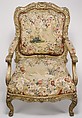
Part of a large set of seat furniture made in Paris but assembled, gilded, and upholstered in Parma, this chair has been attributed to Nicolas-Quinibert Foliot and was possibly executed after a design by the architect and designer Pierre Contant d’Ivry. The Foliots were an important family of chairmakers active in mideighteenth-century Paris and employed by the Garde-Meuble de la Couronne, the royal office that supplied furniture to the French court.
An unknown sculptor executed the high-relief carving, consisting of rocailles, shells, wing motifs, C-scrolls, and floral garlands. This decoration is highly asymmetrical on the chair’s side rails and is thus an expression of the pure Rococo style. The chair is upholstered à châssis, with a drop-in seat and removable back and arm pads, to which the original crimson velvet is tacked underneath, accommodating a seasonal change of upholstery. The scalloped edge of the gold trim echoes the serpentine outline of the chair’s frame. An armchair belonging to the same set is shown in the Museum’s full-length portrait of Louise-Élisabeth’s daughter Maria Luisa of Parma (1751 – 1819), later queen of Spain (26.260.9).
Footnotes
1. Journal entry for March 30, 1749, in Argenson 1857 – 58, vol. 3, p. 252
Artwork Details
- Title: Armchair (Fauteuil à la reine) for Louise-Élisabeth of Parma
- Maker: Nicolas-Quinibert Foliot (1706–1776, warden 1750/52)
- Designer: Possibly after a design by Pierre Contant d'Ivry (French, Ivry-sur-Seine 1698–1777 Paris)
- Date: ca. 1749
- Culture: French, Paris and Italian, Parma
- Medium: Carved and gilded oak; original silk-velvet upholstery and gold trim
- Dimensions: Overall: 43 1/2 × 31 1/2 × 27 1/2 in. (110.5 × 80 × 69.8 cm)
- Classification: Woodwork-Furniture
- Credit Line: Gift of J. Pierpont Morgan, 1906
- Object Number: 07.225.57
- Curatorial Department: European Sculpture and Decorative Arts
Audio
2274. Armchair for Louise-Elisabeth of Parma
NARRATOR: Most eighteenth-century seat furniture has not kept its original upholstery. An exception—although now very worn—is this chair’s once-crimson velvet, with its broad gold trim.
DANIËLLE KISLUK-GROSHEIDE: This chair has a wonderful history. It was created in 1749 for Louisa-Elizabeth, one of the daughters of Louis XV, who married the third son of the King of Spain.
NARRATOR: They became the Duke and Duchess of Parma in northern Italy. And to fill the empty Ducal Palace, Louisa Elizabeth went back to Paris to go shopping.
DANIËLLE KISLUK-GROSHEIDE: And in 1749, she returned back to Italy with thirty-four cartloads full of furnishings, carpets, chandeliers, silver, porcelain, including a set of furniture.
NARRATOR: This ornate Rococo chair was among those cartloads. The broad scalloping gold trim echoes the undulating outline of the frame.The chair is a so-called “fauteuil `a la reine.” It has a low wide seat and a flat back. The arm supports are placed away from the chair’s seat rail. This new style of chair may have been intended to make room for the fashionable court gowns with, panniers, or side hoops, worn at the time. Perhaps you saw a picture in the nearby Sevres Gallery, which portrays a daughter of Louise-Elizabeth, wearing one of these voluminous dresses. She’s shown standing next to a chair from this set.
More Artwork
Related Content
 Free to download
Research Resources
The Met provides unparalleled resources for research and welcomes an international community of students and scholars. The Met's Open Access API is where creators and researchers can connect to the The Met collection. Open Access data and public domain images are available for unrestricted commercial and noncommercial use without permission or fee.
To request images under copyright and other restrictions, please use this Image Request form.
Feedback
We continue to research and examine historical and cultural context for objects in The Met collection. If you have comments or questions about this object record, please contact us using the form below. The Museum looks forward to receiving your comments.
Content Notice
The Metropolitan Museum of Art presents over 5,000 years of art from around the world, and our online collection reflects ongoing work conducted over the course of our more than 150-year history. You may encounter objects or images that may be inappropriate for some viewers or information that may be outdated.