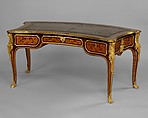
Writing table (table à écrire)
Known for his stylized floral marquetry of end-cut woods, as seen on the main writing slide, Van Risenburgh rarely relied, as he did here, on colorful inlays of engraved mother-of-pearl and tinted horn. Considered one of the most talented ébénistes active during the reign of Louis XV, Van Risenburgh, who was both the son and father of cabinetmakers of the same name, stamped many of his pieces, including this one, with his initials B.V.R.B.
Artwork Details
- Title: Writing table (table à écrire)
- Maker: Bernard II van Risenburgh (ca. 1696–ca. 1767)
- Date: ca. 1755
- Culture: French, Paris
- Medium: Oak veneered with tulipwood, kingwood, amaranth, mahogany, ebony, mother-of-pearl, stained horn; gilt-bronze mounts; modern velvet
- Dimensions: H. 30-3/4 x W. 38 x D. 22-5/8 in. (78.1 x 96.5 x 57.5 cm)
- Classification: Woodwork-Furniture
- Credit Line: Gift of Mr. and Mrs. Charles Wrightsman, 1976
- Object Number: 1976.155.100
- Curatorial Department: European Sculpture and Decorative Arts
Audio
2273. Writing Table
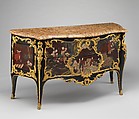
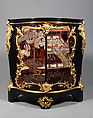
NARRATOR: In this room are several pieces by Bernard Van Risenburgh, whose furniture is among the finest made during the mid-eighteenth-century. Including, in the center of the room a small writing table. The exquisite floral marquetry on the table’s top testifies to why the technique was called “painting in wood.” Here, the marquetry consists of various exotic wood inlays made even richer by inlays of tinted horn and mother-of-pearl. To the right of the chimneypiece in this room is a rare combination of a commode with a console table. The commode was one of the popular new types of furniture introduced in the eighteenth-century. It featured drawers. And this piece has only one in its deep frieze. A console table is made to stand against a wall. This unusual hybrid was fashionable for only a brief period during the middle of the century. Van Risenburgh has veneered the table with panels of Japanese lacquer, dating from the seventeenth century. Asian lacquer was a luxury item, and had been shipped to Europe in limited quantities since the late sixteenth century. But when the older imported lacquer chests and cabinets became out-of-date, talented cabinetmakers like Van Risenburgh would re-use the original lacquer surface. Here, he has carefully cut and bent existing Japanese lacquer panels to fit on a new, more stylish piece.
More Artwork
Press the down key to skip to the last item.
Related Content
 Free to download
Research Resources
The Met provides unparalleled resources for research and welcomes an international community of students and scholars. The Met's Open Access API is where creators and researchers can connect to the The Met collection. Open Access data and public domain images are available for unrestricted commercial and noncommercial use without permission or fee.
To request images under copyright and other restrictions, please use this Image Request form.
Feedback
We continue to research and examine historical and cultural context for objects in The Met collection. If you have comments or questions about this object record, please contact us using the form below. The Museum looks forward to receiving your comments.
Content Notice
The Metropolitan Museum of Art presents over 5,000 years of art from around the world, and our online collection reflects ongoing work conducted over the course of our more than 150-year history. You may encounter objects or images that may be inappropriate for some viewers or information that may be outdated.