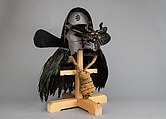
Helmet in the Shape of a Crouching Rabbit
The entire cranial portion of this kawari-kabuto is made from one piece of iron and shaped to represent a crouching rabbit, a technique referred to as ichimai-uchidashi. The unlacquered iron is beautifully contrasted with a neckguard (shikoro) of four rows, three of which are lacquered red, and with the bottom row being covered in gilded leather.
Kawari-kabuto designs can draw from nature, religion, geography, or myths and legends. In choosing the motif of his kawari-kabuto helmet, a samurai made a statement, which in turn needed to be understood by both his allies and enemies. Here, the ear guards (fukigaeshi) are shaped as waves, which in combination with the rabbit alludes to the Noh play Chikubushima––a reference an educated samurai would have understood immediately, informing him about the educated mind of his opponent as well.
Chikubushima is about the retainer of an emperor who travels to Lake Biwa in order to pray at a famous shrine on Chikubushima Island. When the ferry reaches the island, the courtier recites in praise of the scenic beauty the following lines: “Reflections of green trees sink down, and fishes climb their branches; the moon dives beneath the lake, and the rabbit of the moon sports upon the waves.” (1)
(1) Tyler, Royall. "Buddhism in Noh.” Japanese Journal of Religious Studies, vol. 14, no. 1, 1987, pp. 19–52. JSTOR, www.jstor/stable/30234528
Artwork Details
- Title: Helmet in the Shape of a Crouching Rabbit
- Date: 17th century
- Culture: Japanese
- Medium: Iron, lacquer, silver, gold, leather, silk
- Dimensions: 7 x 14 in. (17.8 x 35.6 cm)
- Classification: Helmets
- Credit Line: Rogers Fund, 1907
- Object Number: 07.48
- Curatorial Department: Arms and Armor
Audio
9757. Helmet in the Shape of a Crouching Rabbit
Storytime at The Met
It’s Storytime at The Met: a special podcast series for kids and their families.
[MUSIC]
This podcast tells a story called, “How the Rabbit Got to the Moon." Have you ever seen the rabbit in the moon? You’ve probably seen the man in the moon. But in Japan, children see a rabbit with long ears. Each autumn, the Japanese people celebrate a moon-viewing festival. Families gather to look at the moon. When children ask how the rabbit got to the moon, their parents tell this ancient tale.
Once upon a time, a monkey, a fox, and a rabbit become the best of friends. The spirit of love and kindness filled them, and they decided to live in peace with each other. Every evening these three friends met to share their dinner and talk about their day. The monkey told of swinging through the treetops looking for fruit. The fox talked about stealing food from farms at the edge of the forest. The rabbit spoke very little, all the food he ever found was a few blades of grass. But the three shared whatever they had.
One evening a god looked down from the heavens and saw them sharing a meal. “I can’t believe this” said the god. “Everywhere, people fight and quarrel. Can three animals be so wise? I will test their kindness. Let’s see if they share their food with a stranger.”
The next evening the god came down to earth disguised as a poor man. The three friends found him in the clearing where they had dinner. “Help me” moaned the god in disguise, “I am so hungry that I cannot walk another step.” “We will feed you, poor man!” said the monkey, the fox, and the rabbit. They dashed away in search of food. Suddenly the rabbit stopped and said, “Oh dear, human beings don’t eat grass. What can I bring the man to eat?” He searched and searched but found nothing, so he hopped forlornly back to the clearing. He found the others waiting around a fire. The monkey had an armload of peaches, and the fox held a jug of milk in his jaws. “Sir,” said the rabbit to the poor man, “I couldn’t find any food that you would want. But don’t worry. I will jump into the fire and soon you can eat roast rabbit.” With that, the rabbit leaped into the flames. But then, before the fire singed a hair of the bunny’s coat, the god threw off his disguise. The fire disappeared, leaving the rabbit unharmed. The three friends crouched, shaking in fear.
“Fox,” said the god, “don’t be afraid. You showed kindness to a poor beggar, and I bless you, even though you stole the milk. Monkey, you gave me the sweetest fruit you could find, and I bless your kindness too. But you, rabbit, I bless most of all. These two gave what they could spare, you would have given your life. Humans will remember your kindness as long as they have eyes to see." Then, the god lifted up the rabbit and placed him on the moon. And there he lives today making mochi, or rice cakes, a much nicer meal than grass. The self-sacrifice the rabbit showed in this story is also a quality that a samurai, or Japanese warrior, was supposed to have.
More Artwork
Research Resources
The Met provides unparalleled resources for research and welcomes an international community of students and scholars. The Met's Open Access API is where creators and researchers can connect to the The Met collection. Open Access data and public domain images are available for unrestricted commercial and noncommercial use without permission or fee.
To request images under copyright and other restrictions, please use this Image Request form.
Feedback
We continue to research and examine historical and cultural context for objects in The Met collection. If you have comments or questions about this object record, please contact us using the form below. The Museum looks forward to receiving your comments.
Content Notice
The Metropolitan Museum of Art presents over 5,000 years of art from around the world, and our online collection reflects ongoing work conducted over the course of our more than 150-year history. You may encounter objects or images that may be inappropriate for some viewers or information that may be outdated.