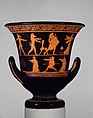
Terracotta bell-krater (bowl for mixing wine and water)
Reverse, libation scene
Persephone, the daughter of the goddess Demeter, was condemned to spend half of each year with Hades, the ruler of the underworld. In this grandiose representation, Persephone ascends to earth through a rocky outcrop. She is guided by Hermes, the divine messenger, and Hekate, a goddess of fertility, magic, and dark things who typically carries torches. At the far right stands the regal Demeter, waiting to receive her daughter and the renewal of life that her return engendered.
Artwork Details
- Title: Terracotta bell-krater (bowl for mixing wine and water)
- Artist: Attributed to the Persephone Painter
- Period: Classical
- Date: ca. 440 BCE
- Culture: Greek, Attic
- Medium: Terracotta; red-figure
- Dimensions: H. 16 1/8 in. (41 cm); diameter of mouth 17 7/8 in. (45.4 cm)
- Classification: Vases
- Credit Line: Fletcher Fund, 1928
- Object Number: 28.57.23
- Curatorial Department: Greek and Roman Art
Audio
1050. Terracotta bell-krater (bowl for mixing wine and water)
A scene from mythology decorates this vase. On the left, Persephone rises from an opening in the earth, wearing a necklace and a crown. Persephone is the bride of Hades, lord of the underworld. This scene is rather the opposite of a wedding; instead of going to her husband's house, Persephone is coming back from the underworld to rejoin her mother Demeter; she stands to the right, holding a staff. In front of Demeter, Hekate, a goddess of darkness and of the earth, lights the way with two torches. The male figure facing straight out at us is Hermes, a god of transitions and journeys. He is one of the few who know the entrances to the underworld, and he is responsible for taking the dead there. Here he is bringing Persephone out. Persephone did not want to marry Hades or live in the gloomy underworld. She stayed with him there for part of the year, and spent the rest of the time with her mother. The Greeks used this story to explain the alternation of seasons in the agricultural year. When Persephone is away, Demeter mourns; the earth seems dead and nothing grows. When she returns, Demeter makes plants spring up in her happiness.
There is nothing overtly supernatural about the outcrop of earth from which Persephone rises; she looks as though she were coming up a flight of underground stairs. For the Greeks, the world of myth was present in the very ground they walked on. The gods lived on Olympus, a mountain in northern Greece, and routes to the underworld ran from specific openings in the earth.
Listen to more about this artwork
More Artwork
Related Content
Research Resources
The Met provides unparalleled resources for research and welcomes an international community of students and scholars. The Met's Open Access API is where creators and researchers can connect to the The Met collection. Open Access data and public domain images are available for unrestricted commercial and noncommercial use without permission or fee.
To request images under copyright and other restrictions, please use this Image Request form.
Feedback
We continue to research and examine historical and cultural context for objects in The Met collection. If you have comments or questions about this object record, please contact us using the form below. The Museum looks forward to receiving your comments.
Content Notice
The Metropolitan Museum of Art presents over 5,000 years of art from around the world, and our online collection reflects ongoing work conducted over the course of our more than 150-year history. You may encounter objects or images that may be inappropriate for some viewers or information that may be outdated.