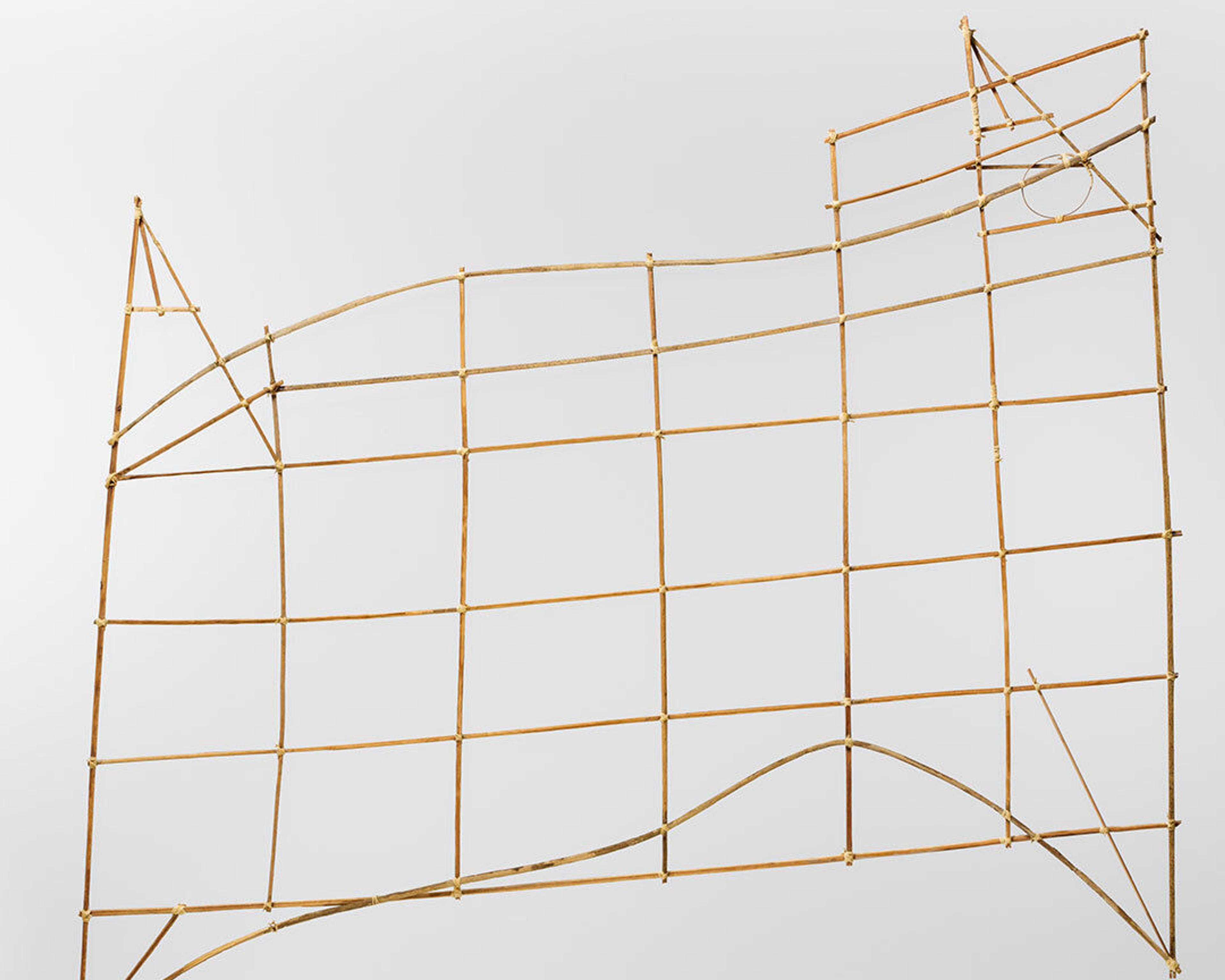
Rebbilib (navigational chart)
This example consists of a gridlike structure of seven vertical sticks lashed to four horizontal ones. The corners extend outside the main grid, while three curved strips, possibly representing the patterns of ocean swells, extend from side to side. The intersections created by the slanting sticks at the corners may indicate the locations of specific islands. In some instances, small cowrie shells, absent on this example, are also used to indicate the positions of individual islands.
Artwork Details
- Title: Rebbilib (navigational chart)
- Artist: Marshall Islands artist
- Date: 19th–early 20th century
- Geography: Republic of the Marshall Islands
- Culture: Marshallese people
- Medium: Coconut palm midrib, fiber
- Dimensions: H. 35 1/4 x W. 43 1/4 x D. 1 in. (89.5 x 109.9 x 2.5 cm)
- Classification: Basketry-Implements
- Credit Line: The Michael C. Rockefeller Memorial Collection, Gift of the Estate of Kay Sage Tanguy, 1963
- Object Number: 1978.412.826
- Curatorial Department: The Michael C. Rockefeller Wing
Audio
1186. Navigational Chart (Rebbilib)
Listen to more about this artwork
More Artwork

Related Content

Research Resources
The Met provides unparalleled resources for research and welcomes an international community of students and scholars. The Met's Open Access API is where creators and researchers can connect to the The Met collection. Open Access data and public domain images are available for unrestricted commercial and noncommercial use without permission or fee.
To request images under copyright and other restrictions, please use this Image Request form.
Feedback
We continue to research and examine historical and cultural context for objects in The Met collection. If you have comments or questions about this object record, please contact us using the form below. The Museum looks forward to receiving your comments.
Content Notice
The Metropolitan Museum of Art presents over 5,000 years of art from around the world, and our online collection reflects ongoing work conducted over the course of our more than 150-year history. You may encounter objects or images that may be inappropriate for some viewers or information that may be outdated.