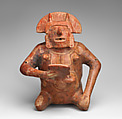
Head from a figure, Xochipilli-Macuilxochitl
A youthful deity associated with indulgence and sensual pleasure, Xochipilli (from xochitl, "flower"; pilli, "prince" or "child") is often adorned with turquoise and other precious jewels, feathers, and flowers. In the Spanish accounts of native life in Mexico, he is specifically referred to as the patron of "palace folk," reinforcing his connection with luxury goods and material wealth. Equally important, however, is his patronage of music, feasting, games of chance, and other activities. Although largely benevolent, he also punishes overindulgence, or sensual excess, by afflicting the guilty with hemorrhoids, venereal diseases, and boils.
That Aztec artists should elect to sculpt the likeness of Xochipilli from a glassy, reflective mineral such as obsidian is perhaps unsurprising, as both god and stone were regularly consulted in certain divination rites. An igneous rock, obsidian is just one type of volcanic "glass" that forms when molten rock quickly cools after coming into contact with water. Because of its rapid solidification, the atoms that form the stone are prevented from assembling into a crystalline configuration. Hence, when obsidian breaks, it does so with a conchoidal fracture along concentric lines, evidence of which can be seen here in the figure’s damaged topknot.
This head was published in Leopold Batres’ Antigüedades mejicanas falsificadas (Falsified Mexican Antiquities, 1909). Subsequent obsidian hydration tests performed by the Smithsonian Institution in 1961—not to mention the large number of archaeological materials that have since been scientifically excavated and compared with this piece—have confirmed an early sixteenth-century date for this work.
William T. Gassaway, 2014–15 Sylvan C. Coleman and Pamela Coleman Fellow
-----
Resources and Additional Readings
Batres, Leopoldo. Antigüedades mejicanas falsificadas. México: Soria, 1909.
Miller, Mary E., and Karl Taube. The Gods and Symbols of Ancient Mexico and the Maya: An Illustrated Dictionary of Mesoamerican Religion. London: Thames & Hudson Ltd, 1993.
Sahagún, Bernardino de. Florentine Codex: General History of the Things of New Spain. Translated by Arthur J. O. Anderson and Charles E. Dibble. Santa Fe and Salt Lake City: School of American Research and University of Utah Press, 1950–82. —For a discussion of Xochipilli-Macuilxochitl, see Bk. 1, Ch. 14.
Artwork Details
- Title: Head from a figure, Xochipilli-Macuilxochitl
- Date: 15th–early 16th century
- Geography: Mexico
- Culture: Mexica (Aztec)
- Medium: Obsidian
- Dimensions: H. 5 x W. 4 3/4 x D. 5 3/8 in. (12.7x12.07x13.65 cm)
- Classification: Glass-Sculpture
- Credit Line: Gift of John and Marisol Stokes, 2012
- Object Number: 2012.517.2
- Curatorial Department: The Michael C. Rockefeller Wing
More Artwork
Research Resources
The Met provides unparalleled resources for research and welcomes an international community of students and scholars. The Met's Open Access API is where creators and researchers can connect to the The Met collection. Open Access data and public domain images are available for unrestricted commercial and noncommercial use without permission or fee.
To request images under copyright and other restrictions, please use this Image Request form.
Feedback
We continue to research and examine historical and cultural context for objects in The Met collection. If you have comments or questions about this object record, please contact us using the form below. The Museum looks forward to receiving your comments.
Content Notice
The Metropolitan Museum of Art presents over 5,000 years of art from around the world, and our online collection reflects ongoing work conducted over the course of our more than 150-year history. You may encounter objects or images that may be inappropriate for some viewers or information that may be outdated.