Oedipus and the Sphinx
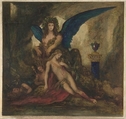
The legendary Greek prince Oedipus confronts the malevolent Sphinx, who torments travelers with a riddle: What creature walks on four legs in the morning, two legs at noon, and three legs in the evening? Remains of victims who answered incorrectly litter the foreground. (The solution is the human, who crawls as a baby, strides upright in maturity, and uses a cane in old age.) Moreau made his mark with this painting at the Paris Salon of 1864. Despite the growing prominence of depictions of everyday life, he portrayed biblical, mythological, and imagined stories. His otherworldly imagery attracted a younger generation that included Odilon Redon and Oscar Wilde.
Artwork Details
- Title: Oedipus and the Sphinx
- Artist: Gustave Moreau (French, Paris 1826–1898 Paris)
- Date: 1864
- Medium: Oil on canvas
- Dimensions: 81 1/4 × 41 1/4 in. (206.4 × 104.8 cm)
- Classification: Paintings
- Credit Line: Bequest of William H. Herriman, 1920
- Object Number: 21.134.1
- Curatorial Department: European Paintings
Audio
6002. Oedipus and the Sphinx
KEITH CHRISTIANSEN: This is Gustave Moreau’s fantastic vision of the ancient Greek hero Oedipus, on the right, staring down the winged Sphinx. Rebecca Rabinow recounts their story: REBECCA RABINOW: Oedipus was on his way to save the City of Thebes when he encountered the monstrous sphinx. He had to answer her riddle correctly or he would be killed. The riddle was: what goes on four legs in the morning, on two at noon and on three in the evening? The answer is a man who crawls on all four as a baby, walks on two legs as an adult and walks with a cane in old age. If you look in the foreground you'll see the hand and a foot of a cadaver and you'll also see the crown of a king and the laurel wreath of a hero, who failed to answer the riddle correctly. Moreau loved color and used it throughout his pictures. He also had great fondness for elaborate ornamental detail. Take, for example, the urn on the column at right. It's intricately depicted. Although Moreau painted hundreds of pictures, he's perhaps best remembered as a teacher of a group of artists that included Henri Matisse. They all felt that Moreau had done so much to further their art because he encouraged them to find their own styles.
Listen to more about this artwork
More Artwork
Related Content
Research Resources
The Met provides unparalleled resources for research and welcomes an international community of students and scholars. The Met's Open Access API is where creators and researchers can connect to the The Met collection. Open Access data and public domain images are available for unrestricted commercial and noncommercial use without permission or fee.
To request images under copyright and other restrictions, please use this Image Request form.
Feedback
We continue to research and examine historical and cultural context for objects in The Met collection. If you have comments or questions about this object record, please contact us using the form below. The Museum looks forward to receiving your comments.
Content Notice
The Metropolitan Museum of Art presents over 5,000 years of art from around the world, and our online collection reflects ongoing work conducted over the course of our more than 150-year history. You may encounter objects or images that may be inappropriate for some viewers or information that may be outdated.