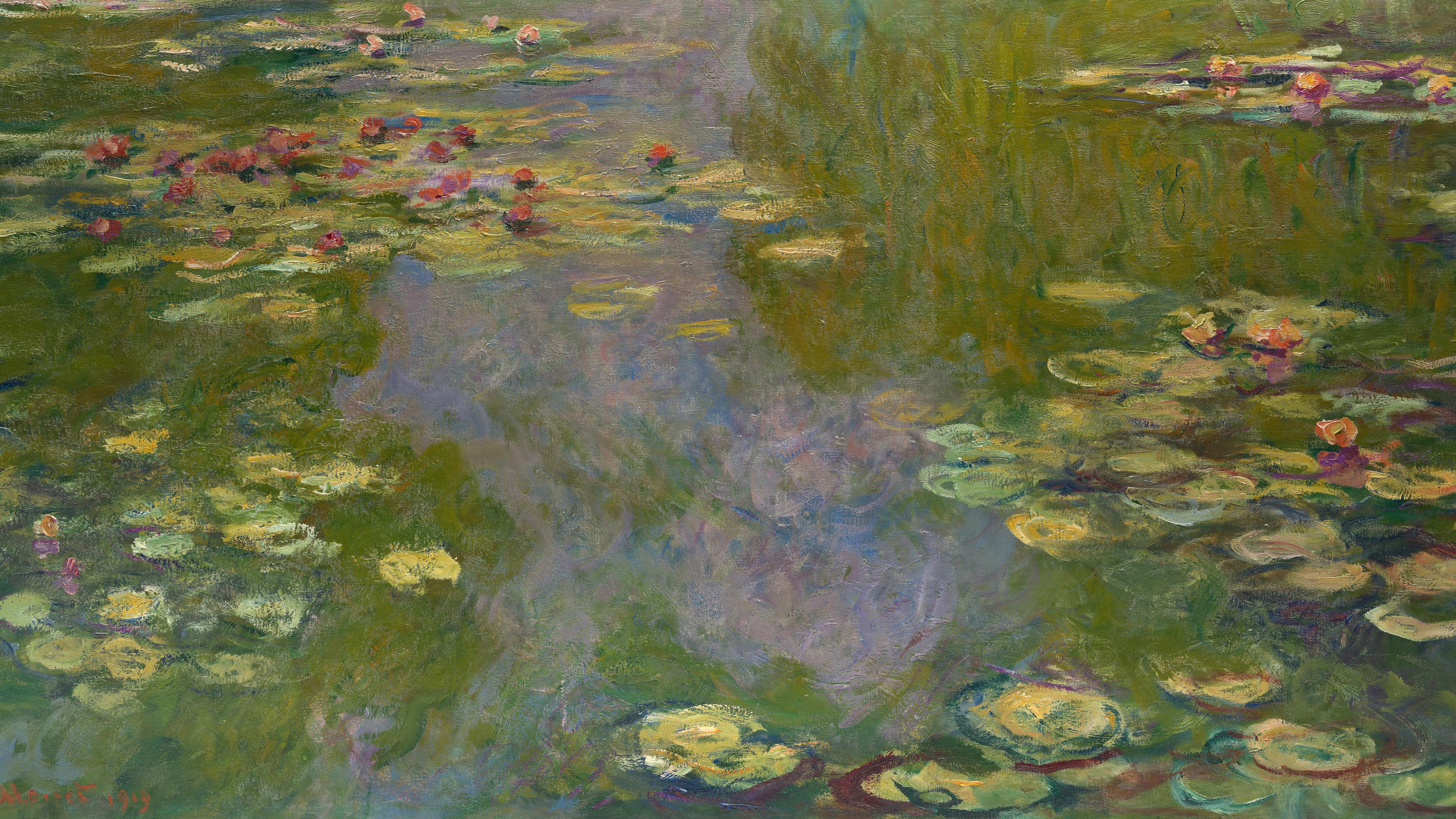
Water Lilies
One of Monet’s critics described this canvas of 1919 as waterlilies "in full flower assert[ing] themselves … their golden discs encased in purple, against the cloudy waters." Although the almost eighty-year-old artist was reluctant to part with recent paintings, he made this landscape and three related pictures with an eye to the market, telling his dealers, Gaston and Josse Bernheim, that he was "working on them passionately." The Bernheim brothers quickly purchased the quartet.
Artwork Details
- Title: Water Lilies
- Artist: Claude Monet (French, Paris 1840–1926 Giverny)
- Date: 1919
- Medium: Oil on canvas
- Dimensions: 39 3/4 x 78 3/4 in. (101 x 200 cm)
- Classification: Paintings
- Credit Line: The Walter H. and Leonore Annenberg Collection, Gift of Walter H. and Leonore Annenberg, 1998, Bequest of Walter H. Annenberg, 2002
- Object Number: 1998.325.2
- Curatorial Department: European Paintings
Audio
9503. Water Lilies
Ellsworth Kelly
Hi, I'm Ellsworth Kelly. I'm an abstract artist that has paintings and some sculpture in the collection. We're standing in front of one of Monet's late paintings. Cézanne said Monet had a good eye, and what an eye! I like the late paintings because they're almost abstract. And he's looking at water lily pads and grass and reflections from trees in the water. Painting in the Renaissance and afterward was like a window where your spatial idea was always through a window at a subject. Then, with Monet, with Cézanne, they started messing up paint and bringing the attention to the surface of the painting. And you had to go up to it and see how it was done and how they did it. And I feel that in my own work, the space between the viewer and the painting is the area that I want to enliven.
More Artwork
Related Content
Research Resources
The Met provides unparalleled resources for research and welcomes an international community of students and scholars. The Met's Open Access API is where creators and researchers can connect to the The Met collection. Open Access data and public domain images are available for unrestricted commercial and noncommercial use without permission or fee.
To request images under copyright and other restrictions, please use this Image Request form.
Feedback
We continue to research and examine historical and cultural context for objects in The Met collection. If you have comments or questions about this object record, please contact us using the form below. The Museum looks forward to receiving your comments.
Content Notice
The Metropolitan Museum of Art presents over 5,000 years of art from around the world, and our online collection reflects ongoing work conducted over the course of our more than 150-year history. You may encounter objects or images that may be inappropriate for some viewers or information that may be outdated.