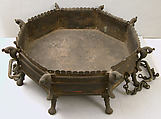
Brazier of Rasulid Sultan al-Malik al-Muzaffar Shams al-Din Yusuf ibn 'Umar
Artwork Details
- Title: Brazier of Rasulid Sultan al-Malik al-Muzaffar Shams al-Din Yusuf ibn 'Umar
- Date: second half 13th century
- Geography: Probably made in Egypt
- Medium: Brass; cast, chased, and inlaid with silver and black compound
- Dimensions: H. 13 7/8 in. (35.2 cm)
W. 15 1/2 in. (39.4 cm)
Max D. 16 3/8 in. (41.6 cm) - Classification: Metal
- Credit Line: Edward C. Moore Collection, Bequest of Edward C. Moore, 1891
- Object Number: 91.1.540
- Curatorial Department: Islamic Art
Audio
1163. Kids: Brazier of Sultan al-Malik al-Muzaffar Shams al-Din Yusuf ibn 'Umar
NAVINA HAIDAR: This box-shaped object is called a ‘brazier’. To use it, a flat pan would be put inside, and the pan would be filled with charcoal. The charcoal would be lit to burn slowly, like a small personal heater, or a portable grill. Braziers can be simple or fancy; this one was made for a sultan, so it’s very fancy! Pointing up from the top of each side are decorations that look like twisted snakes, or dragons, facing each other. Do you see their scaly, silvery skin? Sticking out from the sides of the brazier there are more animal heads, pointing down. Hanging from their mouths are little rings. Those are for putting long rods through the holes to carry the brazier when it’s hot. The brazier is mostly made out of a golden shiny metal called brass. All the lighter-colored areas on the surface were first carved out of the brass. Then they were filled with thin pieces of silver. It’s quite an amazing example of metalwork! All the decorations look so lively. Look carefully around the top band: there’s a row of little animals, chasing each other. And did you notice the legs of the brazier? They look a little bit like animal legs, with hooves. It’s as if the brazier itself is about to come alive and walk away.
Listen to more about this artwork
More Artwork
Related Content

Research Resources
The Met provides unparalleled resources for research and welcomes an international community of students and scholars. The Met's Open Access API is where creators and researchers can connect to the The Met collection. Open Access data and public domain images are available for unrestricted commercial and noncommercial use without permission or fee.
To request images under copyright and other restrictions, please use this Image Request form.
Feedback
We continue to research and examine historical and cultural context for objects in The Met collection. If you have comments or questions about this object record, please contact us using the form below. The Museum looks forward to receiving your comments.
Content Notice
The Metropolitan Museum of Art presents over 5,000 years of art from around the world, and our online collection reflects ongoing work conducted over the course of our more than 150-year history. You may encounter objects or images that may be inappropriate for some viewers or information that may be outdated.