Reliquary Casket with the Deesis, Archangels, and the Twelve Apostles
Artwork Details
- Title: Reliquary Casket with the Deesis, Archangels, and the Twelve Apostles
- Date: 950–1000
- Geography: Made in probably in Constantinople
- Culture: Byzantine
- Medium: Elephant ivory, with gilded copper alloy mounts
- Dimensions: Overall (with mounts): 2 13/16 x 7 3/16 x 4 1/4 in. (7.1 x 18.3 x 10.8 cm)
Overall (without mounts): 2 5/8 x 7 3/16 x 4 in. (6.7 x 18.3 x 10.2 cm)
Top: 7 3/16 x 3 13/16 x 3/8 in. (18.3 x 9.7 x 1 cm) - Classification: Ivories-Elephant
- Credit Line: Gift of J. Pierpont Morgan, 1917
- Object Number: 17.190.238
- Curatorial Department: Medieval Art and The Cloisters
Audio
2720. Reliquary Casket with the Deesis, Archangels, and the Twelve Apostles
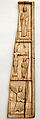
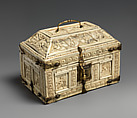
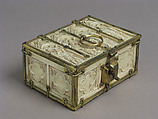
An image of Christ on the heavenly throne appears on the lid of this small ivory casket. He is framed by the Virgin Mary and Saint John the Baptist. This conventional arrangement of these three figures is known as the Deesis, and often appears in the art of Byzantium. Christ’s twelve apostles appear in pairs on either side of the casket. Some of them gesture as if speaking, while others hold scrolls or books.
This casket is related to the style of ivory carving in tenth-century Constantinople, and demonstrates different carving techniques. The lid’s execution is sketchy but precise, while on the sides, the faces of the apostles have more texture and detail.
The casket’s construction is unusually luxurious. It is made of solid pieces of ivory mitered and dovetailed at the corners. Most other caskets are made of thin sheets of ivory or less expensive bone, which are mounted on a wooden core.
More Artwork
Press the down key to skip to the last item.
Related Content
 Free to download
Research Resources
The Met provides unparalleled resources for research and welcomes an international community of students and scholars. The Met's Open Access API is where creators and researchers can connect to the The Met collection. Open Access data and public domain images are available for unrestricted commercial and noncommercial use without permission or fee.
To request images under copyright and other restrictions, please use this Image Request form.
Feedback
We continue to research and examine historical and cultural context for objects in The Met collection. If you have comments or questions about this object record, please contact us using the form below. The Museum looks forward to receiving your comments.