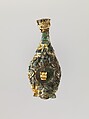
Belt Buckle
Artwork Details
- Title: Belt Buckle
- Date: 550–600
- Culture: Visigothic
- Medium: Copper alloy with garnets, glass, lapis lazuli, and cuttlefish bone
- Dimensions: Overall: 5 3/8 x 2 3/8 x 1 1/8 in. (13.6 x 6 x 2.9 cm)
- Classification: Metalwork-Copper
- Credit Line: Rogers Fund, 1988
- Object Number: 1988.305a, b
- Curatorial Department: Medieval Art and The Cloisters
Audio
2790. Belt Buckle
NARRATOR: Melanie Holcomb is a curator specializing in western medieval art at The Metropolitan Museum:
MELANIE HOLCOMB: We don’t think very much about belt buckles in modern times. But in the fifth through the eighth century, the belt buckle was a field for elaborate decoration and a very visible symbol of rank and status. This is a belt buckle that was created for a Visigothic woman. The Visigoths were an eastern tribe who moved west and ultimately settled in Spain, living amongst the Romans there. They were particularly fine craftsmen of buckles for women.
This piece uses many many garnets to cover most of the buckle. It’s very red. But the borders are made of a very rare and precious stone, lapus lazuli, and on each of the corners, to give that splash of white, is probably cuttlefish bone.
Beautiful gemstones interplay to give it a very spectacular, very colorful look. And again, it would have been obvious to a viewer that this is a woman of high rank.
NARRATOR: The Visigoths, one of the many Germanic groups from the East who were displaced by the advances of the Hun in the late fourth century, had settled in Spain by the late fifth century. Their kingdom, which lasted over two hundred years, proved to be one of the most powerful and culturally sophisticated in the West.
More Artwork
Related Content

 Free to download
Research Resources
The Met provides unparalleled resources for research and welcomes an international community of students and scholars. The Met's Open Access API is where creators and researchers can connect to the The Met collection. Open Access data and public domain images are available for unrestricted commercial and noncommercial use without permission or fee.
To request images under copyright and other restrictions, please use this Image Request form.
Feedback
We continue to research and examine historical and cultural context for objects in The Met collection. If you have comments or questions about this object record, please contact us using the form below. The Museum looks forward to receiving your comments.
Content Notice
The Metropolitan Museum of Art presents over 5,000 years of art from around the world, and our online collection reflects ongoing work conducted over the course of our more than 150-year history. You may encounter objects or images that may be inappropriate for some viewers or information that may be outdated.