Palm Column of Sahure
Many elements in pharaonic stone architecture are stylized representations of wood and reed elements that may have existed only in very early structures. The palm column seems to imitate a wooden pole with date-palm fronds lashed to the top with rope. The end of the rope, tucked under the lashings, reappears beneath as a loop.
This Curatorial Interpretation explores the work in more depth.
Artwork Details
- Title: Palm Column of Sahure
- Period: Old Kingdom
- Dynasty: Dynasty 5
- Reign: reign of Sahure
- Date: ca. 2458–2446 B.C.
- Geography: From Egypt, Memphite Region, Abusir, Pyramid temple of Sahure, court
- Medium: Granite
- Dimensions: Total H. at arrival: 665.4 cm (21 ft. 9 15/16 in.); total H. now: 630 cm (20 ft. 8 in.); Diam. at foot: 86.4 cm (34 in.); Diam. above ring bands: 80 cm (31 1/2 in.); capital: H. 168 cm (66 1/8 in.); abacus: W. 87 cm (34 1/4 in.)
- Credit Line: Rogers Fund, 1910
- Object Number: 10.175.137
- Curatorial Department: Egyptian Art
Audio
3245. Palm Column of Sahure
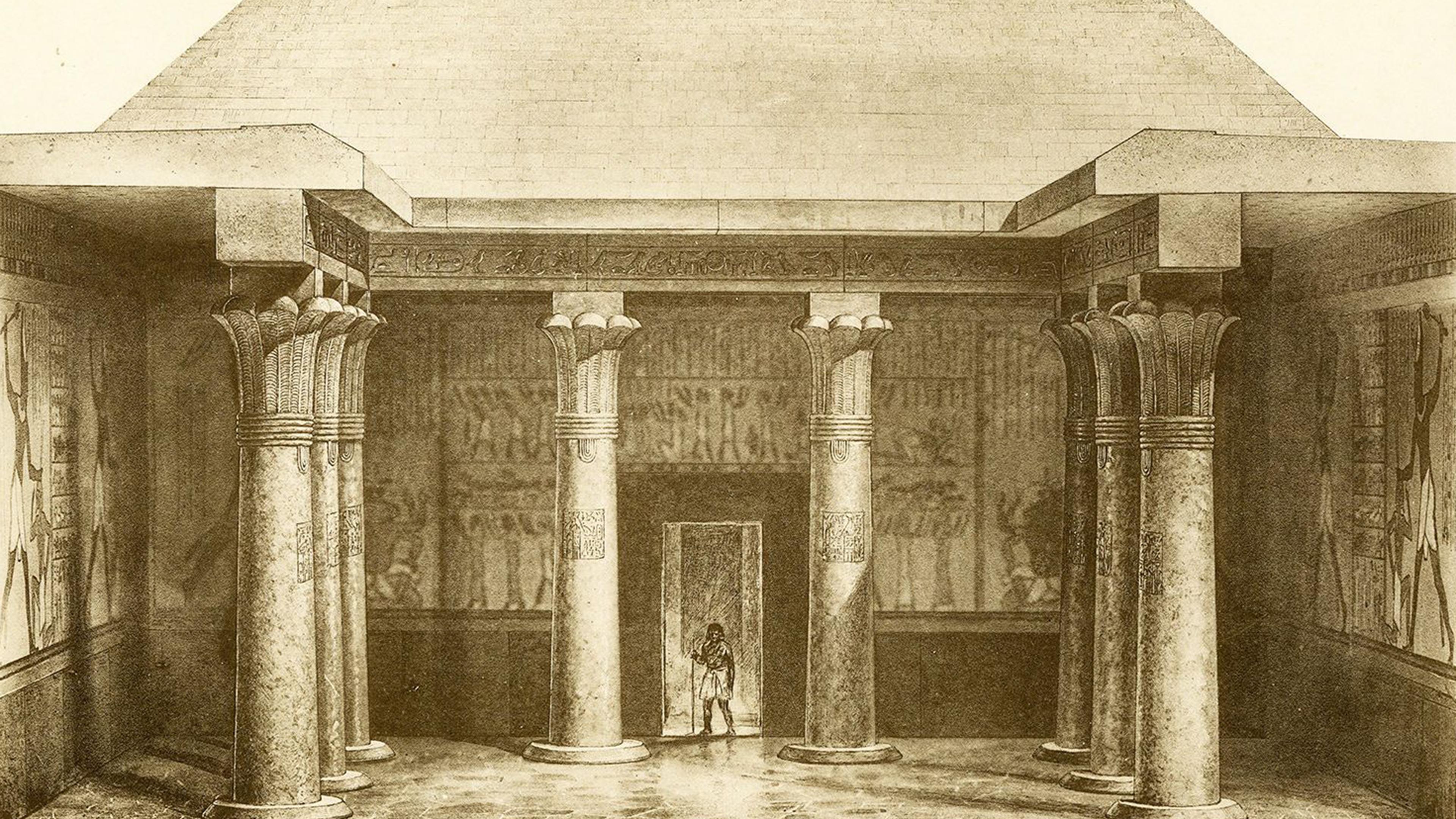
During the Fifth Dynasty—in the heart of the pyramid age—King Sahure built a great pyramid complex for himself at Abusir, a few miles south of Giza, which is part of present day Cairo. The king was buried below the pyramid, but the rituals that guaranteed his eternal life took place in the pyramid temple that was attached to it. This massive column is one of sixteen that surrounded an open courtyard in that temple. It is a single block of granite and was originally over twenty feet high. It was quarried at Aswan and ferried downstream to Abusir—a sizable distance of over five hundred miles.
Look up at the upper end of this massive column. This type of Egyptian column probably imitates a wooden pole to whose top fronds of the date palm tree have been lashed with a rope. Between the column shaft and the palm-branch capital, five rings of rope have been carved. The loop that has been carved in shallow relief below these rings is the end of the rope, which has been tucked under to fasten it in place.
Many elements in pharaonic architecture are stylized representations of very early wood and reed structures. Transferred into stone, these representations became standardized artistic forms. They were used throughout the history of Egyptian art.
More Artwork
Press the down key to skip to the last item.
Related Content
Publications
Books, guides, and catalogues published by The Met.
 Free to download
From the Department
Research and commentary from Museum staff.
Research Resources
The Met provides unparalleled resources for research and welcomes an international community of students and scholars. The Met's Open Access API is where creators and researchers can connect to the The Met collection. Open Access data and public domain images are available for unrestricted commercial and noncommercial use without permission or fee.
To request images under copyright and other restrictions, please use this Image Request form.
Feedback
We continue to research and examine historical and cultural context for objects in The Met collection. If you have comments or questions about this object record, please contact us using the form below. The Museum looks forward to receiving your comments.