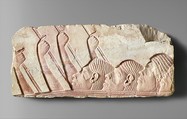
Akhenaten Sacrificing a Duck
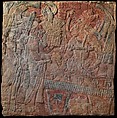
On this block from a temple relief, Akhenaten, recognizable by his elongated features, holds a duck toward the Aten. With one hand he wrings the bird's neck before offering it to the god. Although early depictions of Akhenaten often appear strangely exaggerated, later in his reign sculptors attempted a more naturalistic style, emphasizing a sense of space and movement. Akhenaten's hands here are grasping and straining to hold the struggling duck. Such a scene, capturing a single moment, would never have been attempted in an earlier period. However, Akhenaten's right hand is twisted so that all five fingers can be seen, a pose that conforms to the Egyptian convention of presenting each part of the body as completely as possible. To the lower right appear the webbed feet of a second duck.
In this relief, the artist has cut the outlines of the figures into the surface in a technique called sunk relief. Sunk relief appears mostly on the exterior of buildings, where the outlines cast shadows, emphasizing the sunlight. During the Amarna period almost all relief was executed in this technique.
Artwork Details
- Title: Akhenaten Sacrificing a Duck
- Period: New Kingdom, Amarna Period
- Dynasty: Dynasty 18
- Reign: reign of Akhenaten
- Date: ca. 1347–1330 BCE
- Geography: From Egypt; Probably from Middle Egypt, Hermopolis (Ashmunein; Khemenu); Probably originally from Amarna (Akhetaten)
- Medium: Limestone, paint
- Dimensions: H. 25 × W. 55 × D. 3.3 cm (9 13/16 × 21 5/8 × 1 5/16 in.)
- Credit Line: Gift of Norbert Schimmel, 1985
- Object Number: 1985.328.2
- Curatorial Department: Egyptian Art
Audio
3440. Akhenaten Sacrificing a Duck
The central creed of Akhenaten’s new religion is expressed in the so-called Hymn to the Aten, which is really a hymn to light, the god of Akhenaten’s religion. Apparently written by the king himself, it is preserved in the tomb of one of his courtiers, Ay, the man who eventually succeeded Tutankhamun as pharaoh. The hymn begins with Akhenaten’s praise of light as it comes into the world at dawn:
Perfect is your appearance from the sky’s horizon,
oh living one of the sun-disk, who determines life:
for you are risen from the eastern horizon
and have filled every land with your perfection;
for you are beautiful, great, glittering, high above every land,
and your rays embrace the land to the end of all you have made;
for you are in the sun, reaching to their end
and subduing them for the son you love;
for you are far, yet your rays are on the land:
you are in their face.
A key theme of the hymn is the unity of all creation. Beneath its diversity, all life depends on light:
How manifold is that which you make, even those hidden from sight,
oh sole god, with no other except him—
creating the earth for your heart, while you are one:
people, cattle, and all small animals,
everyone on earth who walks on feet,
all in the heavens, flying with their wings,
foreign countries from Syria to Africa, and the land of Egypt;
giving every man to his place and making what they need:
every one having his food, his lifetime reckoned,
tongues parted in speech, their characters too,
their skins distinguished, as you distinguish foreigners;
making the inundation in the netherworld and bringing it forth as you desire,
to give life to the subjects, just as you make them for you—
you lord of them all, who exhausts himself in them.
You lord of every land, who rises for them;
you sun-disk of the daytime, great of awe;
all far-off foreign lands, you make their life,
for you have given an inundation in the sky to descend for them
and make waves on the mountains like the sea,
in order to water their fields in their towns.
How functional are your designs, oh lord of continuity:
an inudation in the sky for the foreigners and the flocks of every foreign land,
an inudation coming from the netherworld for Egypt;
your rays nursing every plot of land,
rising that they might live and grow for you;
making seasons to develop all you make:
winter to cool them, heat that they might taste you.
You have made the sky far to rise in it,
to see all you make, while you are One,
risen in your medium of the living sun-disk,
apparent and shining, far and glittering,
making millions of evolutions from you, the sole source—
cities, towns, fields, the river’s path—
every eye glimpsing you in relation to them,
while you are in the sun-disk of the daytime above the earth.
More Artwork
Related Content

 Free to download
Research Resources
The Met provides unparalleled resources for research and welcomes an international community of students and scholars. The Met's Open Access API is where creators and researchers can connect to the The Met collection. Open Access data and public domain images are available for unrestricted commercial and noncommercial use without permission or fee.
To request images under copyright and other restrictions, please use this Image Request form.
Feedback
We continue to research and examine historical and cultural context for objects in The Met collection. If you have comments or questions about this object record, please contact us using the form below. The Museum looks forward to receiving your comments.
Content Notice
The Metropolitan Museum of Art presents over 5,000 years of art from around the world, and our online collection reflects ongoing work conducted over the course of our more than 150-year history. You may encounter objects or images that may be inappropriate for some viewers or information that may be outdated.