Artist's Sketches of Senenmut, Sketch of Small Rodent on Opposite Side
Artwork Details
- Title: Artist's Sketches of Senenmut, Sketch of Small Rodent on Opposite Side
- Period: New Kingdom
- Dynasty: Dynasty 18
- Reign: Joint reign of Hatshepsut and Thutmose III
- Date: ca. 1473–1458 BCE
- Geography: From Egypt, Upper Egypt, Thebes
- Medium: Limestone, ink
- Dimensions: H. 10 cm (3 15/16 in.); W. 16.5 cm (6 11/16 in.); Th. 3 cm (1 3/16 in.)
- Credit Line: Anonymous Gift, 1931
- Object Number: 31.4.2
- Curatorial Department: Egyptian Art
Audio
3385. Artist's Sketches of Senenmut
This limestone flake is called an ostracon—the ancient Egyptian equivalent to scrap paper. The smooth surfaces were ideal for sketching.
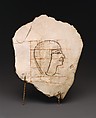
The two profiles on this side represent Senenmut, a commoner who rose through the ranks of Egyptian society to become a close advisor to Hatshepsut, the great female pharaoh of Dynasty 18. The right-hand sketch shows Senenmut with a short beard, an elaborate wig and deep lines in his face. The other profile looks younger, and the eye and mouth are straighter. There is a resonance between the two portraits which reminds us of the complex nature of human personalities—something of which the Egyptians were very much aware.
One of Senenmut’s titles was overseer of all works of the King, often translated as chief architect. He was probably the designer of Hatshepsut’s magnificent terraced temple at Deir el-Bahri, one of the architectural masterpieces of Ancient Egypt. The temple is so beautifully situated that the site is now used as a backdrop for major theatrical performances.
Like other great architects, since the time of Ihmotep in the Pyramid Age, Senenmut was given great honors by the Pharaoh. In addition to his powerful administrative position, he was tutor to Hatshepsut’s daughter, Neferure’.
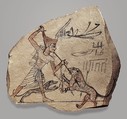
Now, look at the image in the mirror behind the limestone flake. It’s a sketch of a rat. At least one historian thinks the rat is an early example of political satire, and a pointed reference to Senenmut’s overweening ambition. Its true that at some point—we don’t know when or why—opposition to Senenmut became serious. His images were defaced and his monuments destroyed. Turn around and you’ll see his quartzite sarcophagus. It had to be reassembled from more than 1200 fragments.
More Artwork
Related Content
 Free to download
Research Resources
The Met provides unparalleled resources for research and welcomes an international community of students and scholars. The Met's Open Access API is where creators and researchers can connect to the The Met collection. Open Access data and public domain images are available for unrestricted commercial and noncommercial use without permission or fee.
To request images under copyright and other restrictions, please use this Image Request form.
Feedback
We continue to research and examine historical and cultural context for objects in The Met collection. If you have comments or questions about this object record, please contact us using the form below. The Museum looks forward to receiving your comments.
Content Notice
The Metropolitan Museum of Art presents over 5,000 years of art from around the world, and our online collection reflects ongoing work conducted over the course of our more than 150-year history. You may encounter objects or images that may be inappropriate for some viewers or information that may be outdated.