Coffin Set of the Chantress of Amun-Re Henettawy
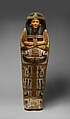
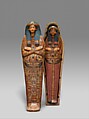
Aside from her rather simple personal jewelry, Henettawy's main burial equipment consisted of two splendid coffins (25.3.182a, b; 25.3.183a, b) and a mummy board (25.3.184), fitting one into the other like parts of a Russian doll. Both coffins and the mummy board are shaped like wrapped mummies with elaborate masks fastened over the heads.
Artwork Details
- Title: Coffin Set of the Chantress of Amun-Re Henettawy
- Period: Third Intermediate Period
- Dynasty: mid Dynasty 21
- Date: ca. 1000–945 BCE
- Geography: From Egypt, Upper Egypt, Thebes, Deir el-Bahri, Tomb of Henettawy F (MMA 59), MMA excavations, 1923–24
- Medium: Wood, gesso, paint, varnish
- Dimensions: Outer coffin: L. 203 cm (79 15/16 in.); Inner coffin: L. 191 cm (75 3/16 in.); Mummy board: L. 171.3 cm (67 7/16 in.)
- Credit Line: Rogers Fund, 1925
- Object Number: 25.3.182–.184-related
- Curatorial Department: Egyptian Art
Audio
3505. Coffin Set of the Chantress of Amun-Re Henettawy
The two coffins and three mummy covers you see here were made for a lady named Henettawy. Like many of the women we meet in this room, she was a chantress of the god Amun-Re. She died during the twenty-first dynasty, when she was very young—about eighteen to twenty-one years old.
The twenty-first dynasty brought difficult times for Egypt, and building activities were restricted. For their burials, the powerful priesthood of the god Amun either re-used earlier tombs or had simple rock-cut shafts and chambers. They did not decorate the walls of these tombs, but the art of coffin decoration flourished.
Look at the pieces in this case. Their masterful composition led the Museum’s excavator Herbert E. Winlock to compare them to the stained-glass windows in Medieval churches. In his excavation report, he wrote: "It was the mosaic of intricate patterns and the harmony of rich colors over the whole composition that gave the opulent effect..." The effect is heightened by an astonishing mastery of technique. The coffins are constructed of joined wood boards. The lids were carved—notice the beautifully rounded abdomens. The faces and sometimes the necks were made separately and attached. A base layer of gesso or gypsum lies under most of the painting, and in some places it is so thick that a relief effect is achieved. Finally, the coffins are covered with a varnish of tree resin.
Listen to more about this artwork
More Artwork
Related Content

Research Resources
The Met provides unparalleled resources for research and welcomes an international community of students and scholars. The Met's Open Access API is where creators and researchers can connect to the The Met collection. Open Access data and public domain images are available for unrestricted commercial and noncommercial use without permission or fee.
To request images under copyright and other restrictions, please use this Image Request form.
Feedback
We continue to research and examine historical and cultural context for objects in The Met collection. If you have comments or questions about this object record, please contact us using the form below. The Museum looks forward to receiving your comments.
Content Notice
The Metropolitan Museum of Art presents over 5,000 years of art from around the world, and our online collection reflects ongoing work conducted over the course of our more than 150-year history. You may encounter objects or images that may be inappropriate for some viewers or information that may be outdated.