The Village
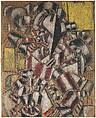
One of the canvases in the Contrasts of Forms series, The Village presents an aerial view of a walled community with angled roofs, rounded trees, and a medieval church with buttresses and a bell tower. It is likely that Léger did not directly observe this scene, but constructed the image from memory of travel, or possibly even of another painting. The composition embodies "the law of plastic contrasts" that Léger sought to explore through careful oppositions of line, form, and color. In this, he was strongly influenced by Paul Cézanne, whom he credited with teaching him to "love forms and volume." While The Village depends on a new pictorial vocabulary, it also relies on traditional techniques of atmospheric perspective and chiaroscuro (the use of light and shadow to create the illusion of three-dimensionality). Forms decrease in size and colors lighten moving from the fore- to the background of the canvas. Léger applied color, however, with little regard for naturalism; his observance of chiaroscuro developed into an exploration of the syncopation that black and white can invigorate across a surface.
The central part of The Village is painted in the colors of the French flag—blue, white, and red—a patriotic note during the increasing political tension in which Léger worked. Completed in the summer of 1914, The Village culminates the Contrasts of Forms series, which came to an end with the outbreak of World War I and Léger’s conscription into military service.
Artwork Details
- Title: The Village
- Artist: Fernand Léger (French, Argentan 1881–1955 Gif-sur-Yvette)
- Date: 1914
- Medium: Oil on canvas
- Dimensions: 31 1/2 × 39 1/2 in. (80 × 100.3 cm)
- Classification: Paintings
- Credit Line: Leonard A. Lauder Cubist Collection, Purchase, Leonard A. Lauder Gift, 2013
- Object Number: 2013.271
- Rights and Reproduction: © 2026 Artists Rights Society (ARS), New York
- Curatorial Department: Modern and Contemporary Art
More Artwork
Related Content

Research Resources
The Met provides unparalleled resources for research and welcomes an international community of students and scholars. The Met's Open Access API is where creators and researchers can connect to the The Met collection. Open Access data and public domain images are available for unrestricted commercial and noncommercial use without permission or fee.
To request images under copyright and other restrictions, please use this Image Request form.
Feedback
We continue to research and examine historical and cultural context for objects in The Met collection. If you have comments or questions about this object record, please contact us using the form below. The Museum looks forward to receiving your comments.
Content Notice
The Metropolitan Museum of Art presents over 5,000 years of art from around the world, and our online collection reflects ongoing work conducted over the course of our more than 150-year history. You may encounter objects or images that may be inappropriate for some viewers or information that may be outdated.