
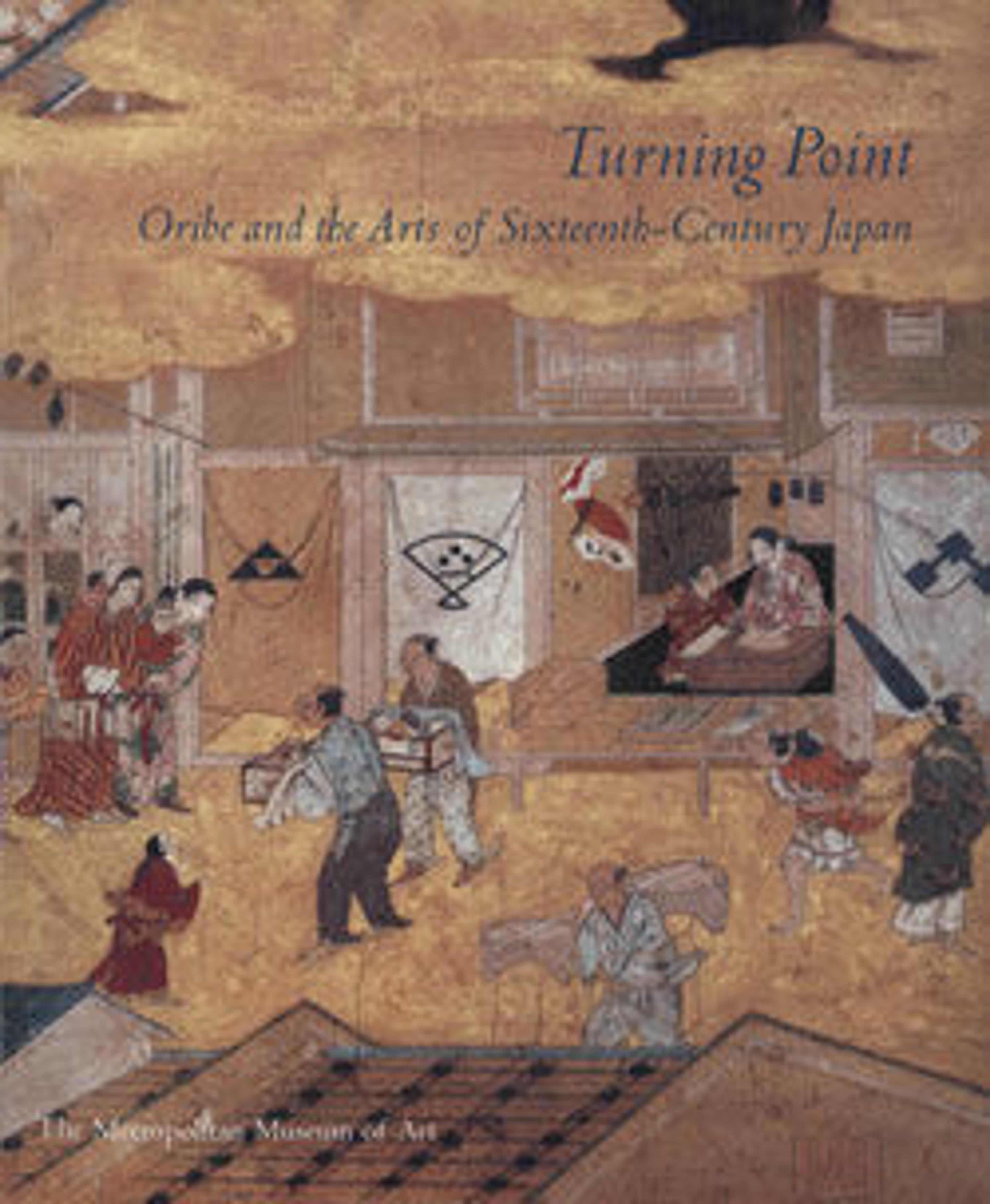
Turning Point: Oribe and the Arts of Sixteenth-Century Japan
340 pages
230 illustrations
This title is out of print.
The warrior-tea master Furuta Oribe (1543/44–1615) played a seminal role in establishing a unique set of aesthetics for the tea ceremony that had profound implications for Japanese art. Oribe's new concepts of tea led to the creation of ceramic wares bearing his name that possess originality and afford delight; these in turn helped bring forth a new canon of beauty for paintings, lacquerware, and textiles in the milieu of rapid social and political change that characterized the Momoyama period (1573–1615). Japan's first exposure to European culture also took place in this tumultuous time.
"Turning Point: Oribe and the Arts of Sixteenth-Century Japan" is the first major exhibition examining the nature and extent of Oribe's influence ever to be held in the West. His life signified a turning point in the arts of Japan. This exhibition and its accompanying catalogue likewise mark a turning point in the study of Japanese art in the time of Oribe. They draw not only on decades of pioneering research but also on fortuitous discoveries that began in the mid-twentieth century: of kiln sites where ceramic wares reflecting the new aesthetic were produced; of consumer sites in Kyoto from which the wares were distributed; and of Oribe's Kyoto residence. These finds are particularly important because the extent of Oribe's impact on the ceramic ware that carries his name had been a subject of intense debate long before the modern era, with scholars reluctant to give the master credit in the absence of solid documentary evidence. Now, however, examination of the recently excavated ceramics and careful reexamination of old records of tea gatherings and of Oribe's own writings on tea utensils suggest that he was largely responsible for promoting the development of Oribe wares. These vessels, which are sometimes irregular or deformed in shape and are expansively and colorfully decorated with brushed designs, have a startlingly modern appearance. Bursting into the largely monochromatic world of Japanese ceramics that was the standard before Oribe, these strangely shaped and brilliantly colored wares must have made a striking impression on the sedate tea aficionados of the time.
The new aesthetic that Oribe promoted, as this exhibition demonstrates, was expressed not only in ceramics but in all the arts of the period; paintings, lacquerware, and textiles exhibit a similar explosion of energy and introduce a host of modern, even outlandish design ideas. No other period in Japanese history has witnessed such closely related achievements in different sphere of the arts.
Met Art in Publication
Japan
late 16th–early 17th century
Japan
early 17th century
Japan
early 17th century
Japan
early 17th century
Japan
early 17th century
Japan
early 17th century
Japan
early 17th century
Japan
early 17th century
Japan
early 17th century
Japan
early 17th century
Japan
early 17th century
Japan
late 16th–early 17th century
Japan
late 17th century
Japan
early 17th century
In the style of Shunzan
ca. 1770
Shuntai
19th century
Japan
early 19th century
Japan
19th century
Japan
first half of 17th century
Japan
early 17th century
Showing 20 of 21
You May Also Like
Free to download
Related Content
- Timeline of Art History | Essay
The Japanese Tea Ceremony
- Timeline of Art History | Essay
Momoyama Period (1573–1615)
Citation
Murase, Miyeko, Mutsuko Amemiya, and Metropolitan Museum of Art (New York, N.Y.), eds. 2003. Turning Point: Oribe and the Arts of Sixteenth-Century Japan. New York : New Haven: Metropolitan Museum of Art ; Yale University Press.