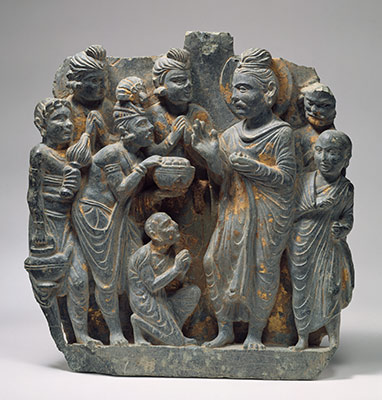
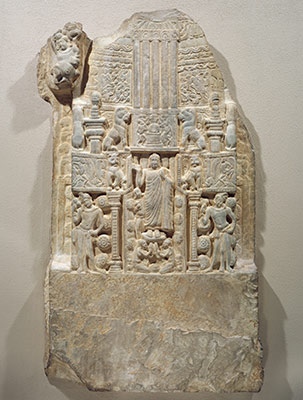
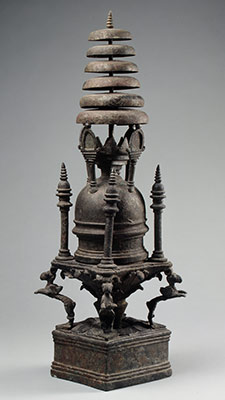
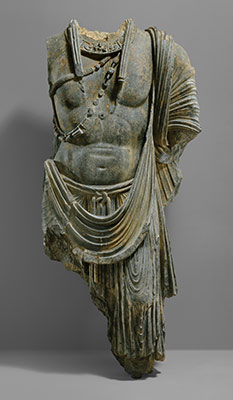
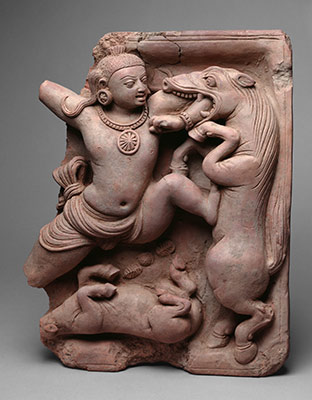
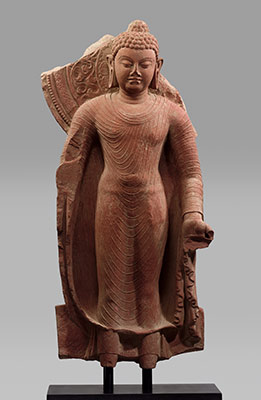
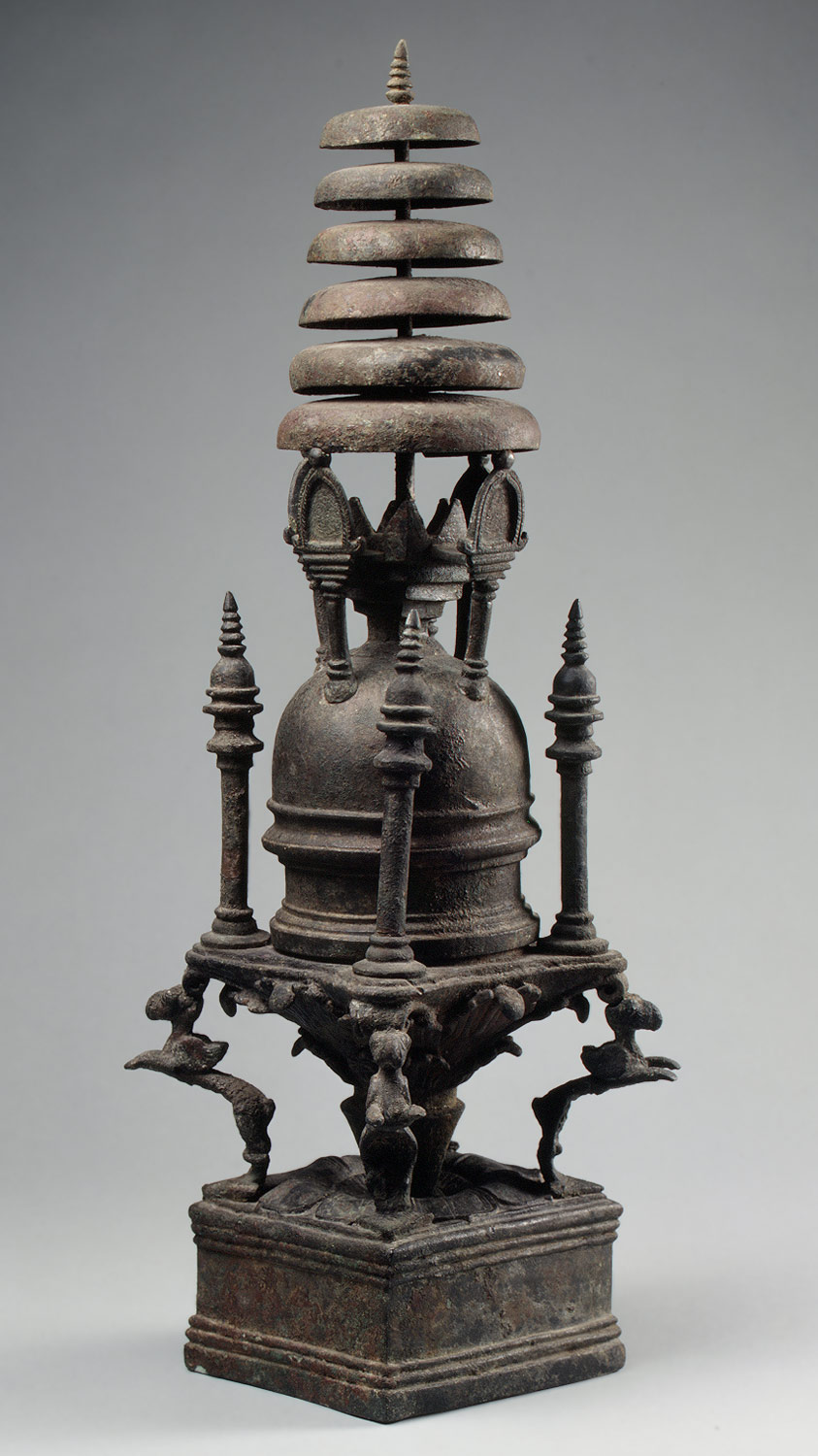
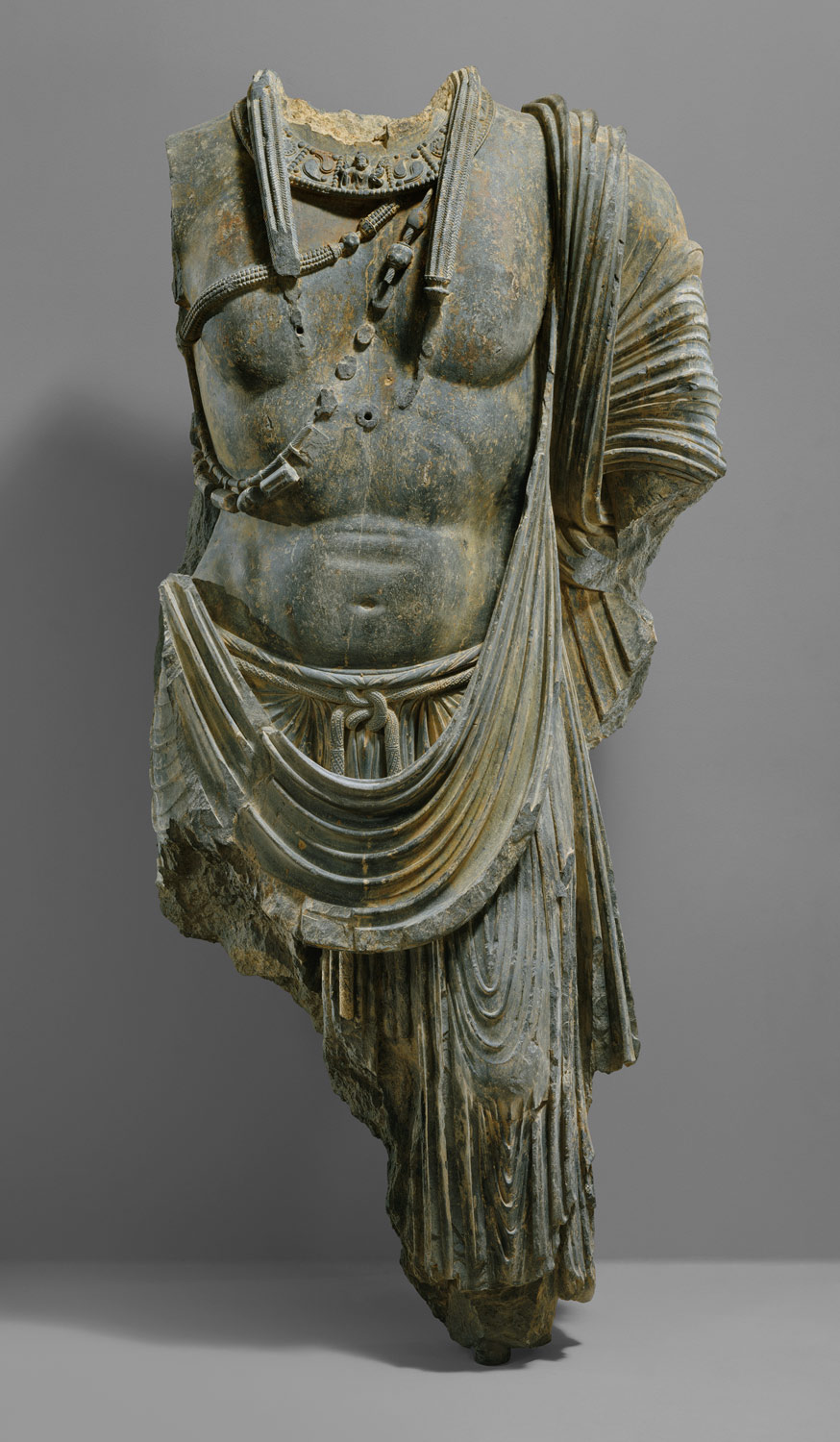
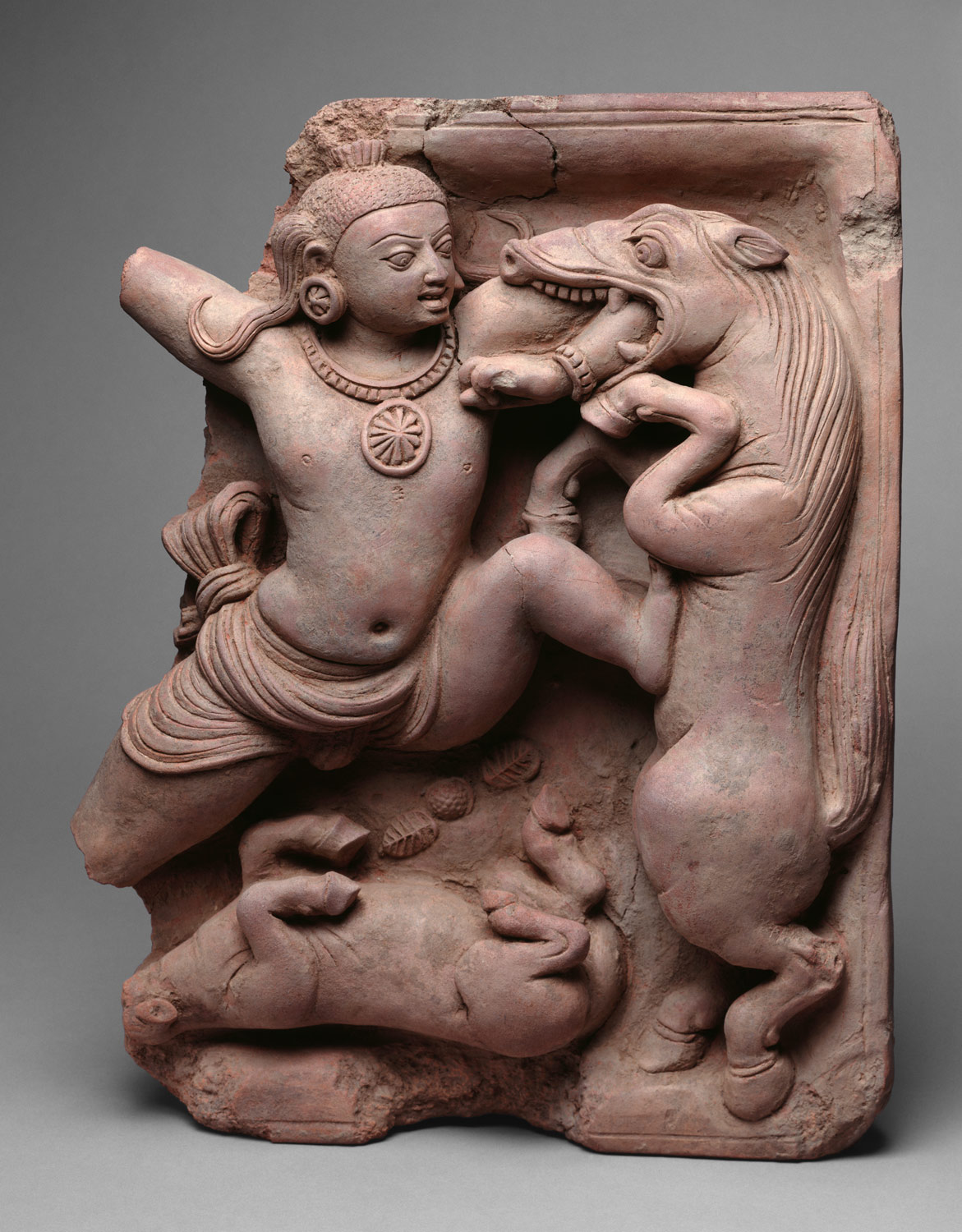
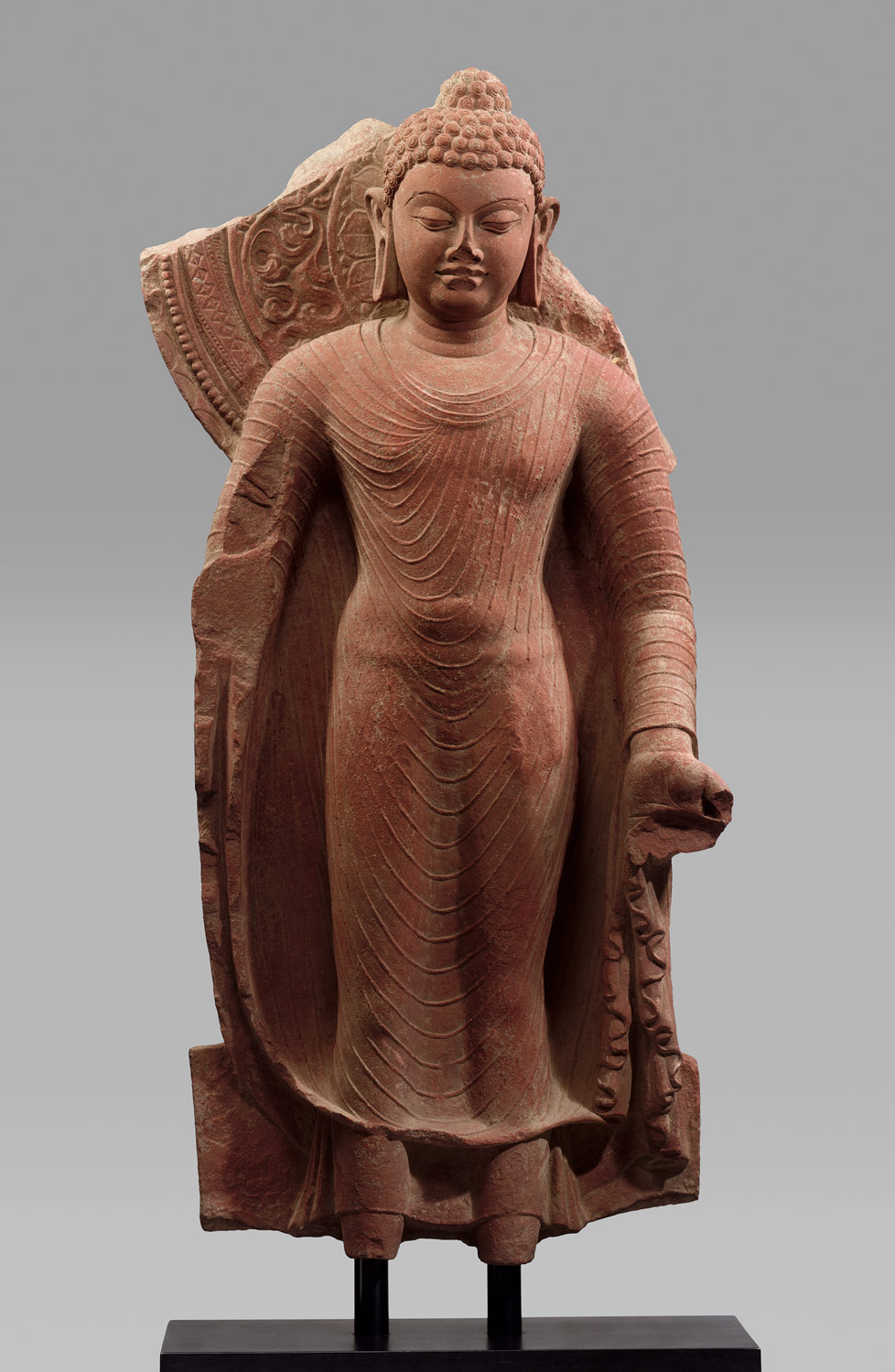
Smaller regional centers across the north, under Kushan control in the early centuries of the first millennium A.D., are brought together under the Gupta dynasty in the fourth century. Mahayana Buddhism flourishes; the earliest paintings preserved in India (fifth-century cave paintings) depict the Buddha and scenes from his life. Buddhism spreads to Central Asia and China along international trade routes. The religion known as Hinduism assumes ritual and artistic form, and Hindu sculptures and temples proliferate. India trades with Rome and other cultures to the west, including Southeast Asia.
South Asia, 1–500 A.D.
-
 1987.142.1
 -
 28.31
28.31 -
 1985.387ab
 -
 1995.419
 -
 1991.300
 -
 1979.6
Timeline
1 A.D.
125 A.D.
Early large centralized kingdoms and empires, ca. 322 B.C.–500 A.D.
NORTH
Kushan empire, 2nd century B.C.–3rd century A.D.
SOUTH / DECCAN
Satavahana and Ikshvaku dynasties, 2nd century B.C.–4th century A.D.
Anuradhapura period, Sri Lanka, ca. 3rd century B.C.–11th century A.D.
125 A.D.
250 A.D.
Early large centralized kingdoms and empires, ca. 322 B.C.–500 A.D.
NORTH
Kushan empire, 2nd century B.C.–3rd century A.D.
SOUTH / DECCAN
Satavahana and Ikshvaku dynasties, 2nd century B.C.–4th century A.D.
Vakataka dynasty, mid-3rd–late 5th century A.D.
Anuradhapura period, Sri Lanka, ca. 3rd century B.C.–11th century A.D.
250 A.D.
375 A.D.
Early large centralized kingdoms and empires, ca. 322 B.C.–500 A.D.
NORTH
Gupta empire controls most of the north, ca. 321–ca. 500 A.D.
SOUTH / DECCAN
Satavahana and Ikshvaku dynasties, 2nd century B.C.–4th century A.D.
Vakataka dynasty, mid-3rd–late 5th century A.D.
Anuradhapura period, Sri Lanka, ca. 3rd century B.C.–11th century A.D.
375 A.D.
500 A.D.
Early large centralized kingdoms and empires, ca. 322 B.C.–500 A.D.
NORTH
Gupta empire controls most of the north, ca. 321–ca. 500 A.D.
SOUTH / DECCAN
Vakataka dynasty, mid-3rd–late 5th century A.D.
Anuradhapura period, Sri Lanka, ca. 3rd century B.C.–11th century A.D.
Overview
Key Events
-
1st century A.D.
Saint Thomas, an apostle of Jesus Christ, visits India. His burial site is said to be in modern-day Madras, although his relics are said to rest in Italy.
-
1st–2nd century A.D.
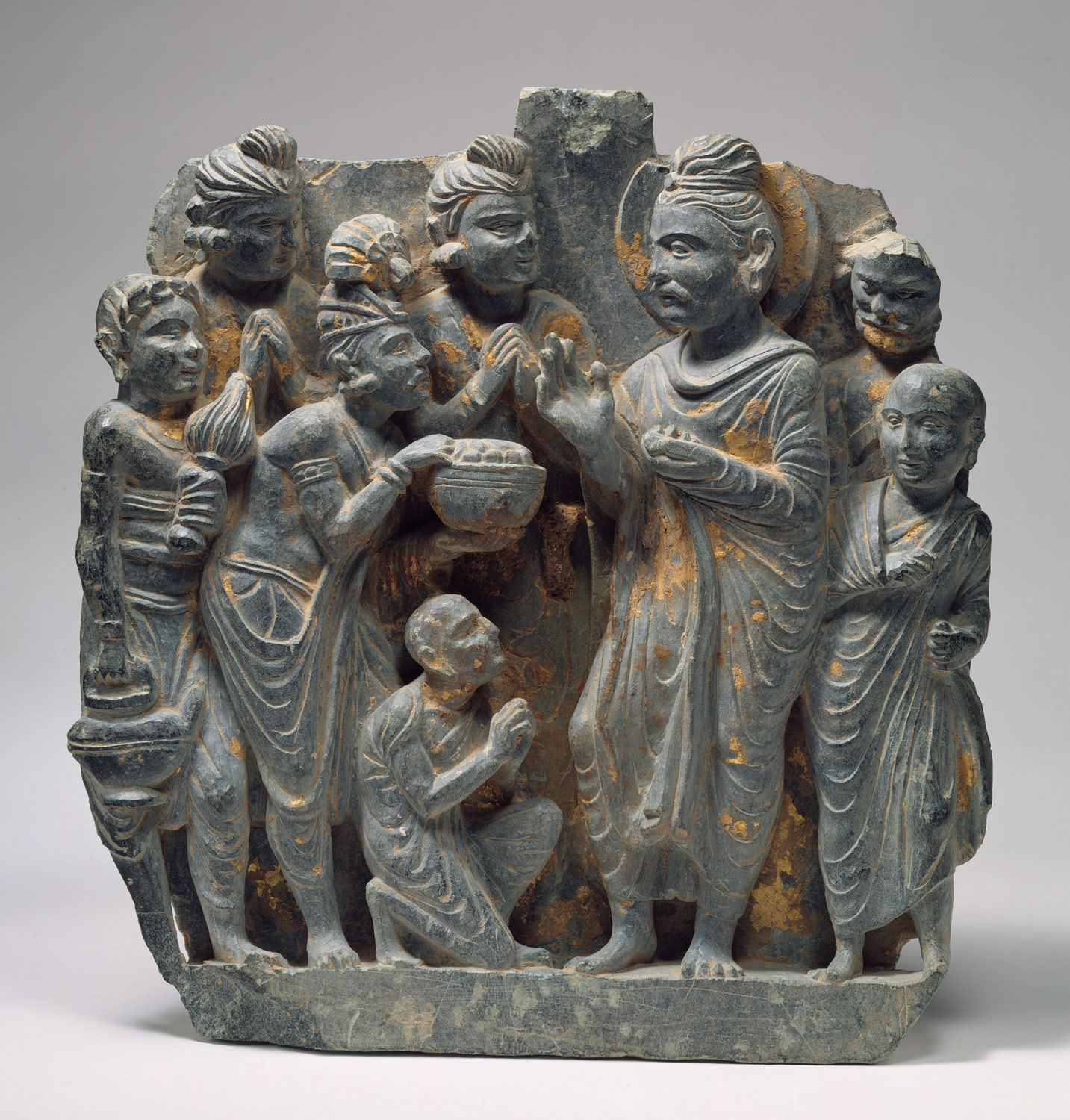
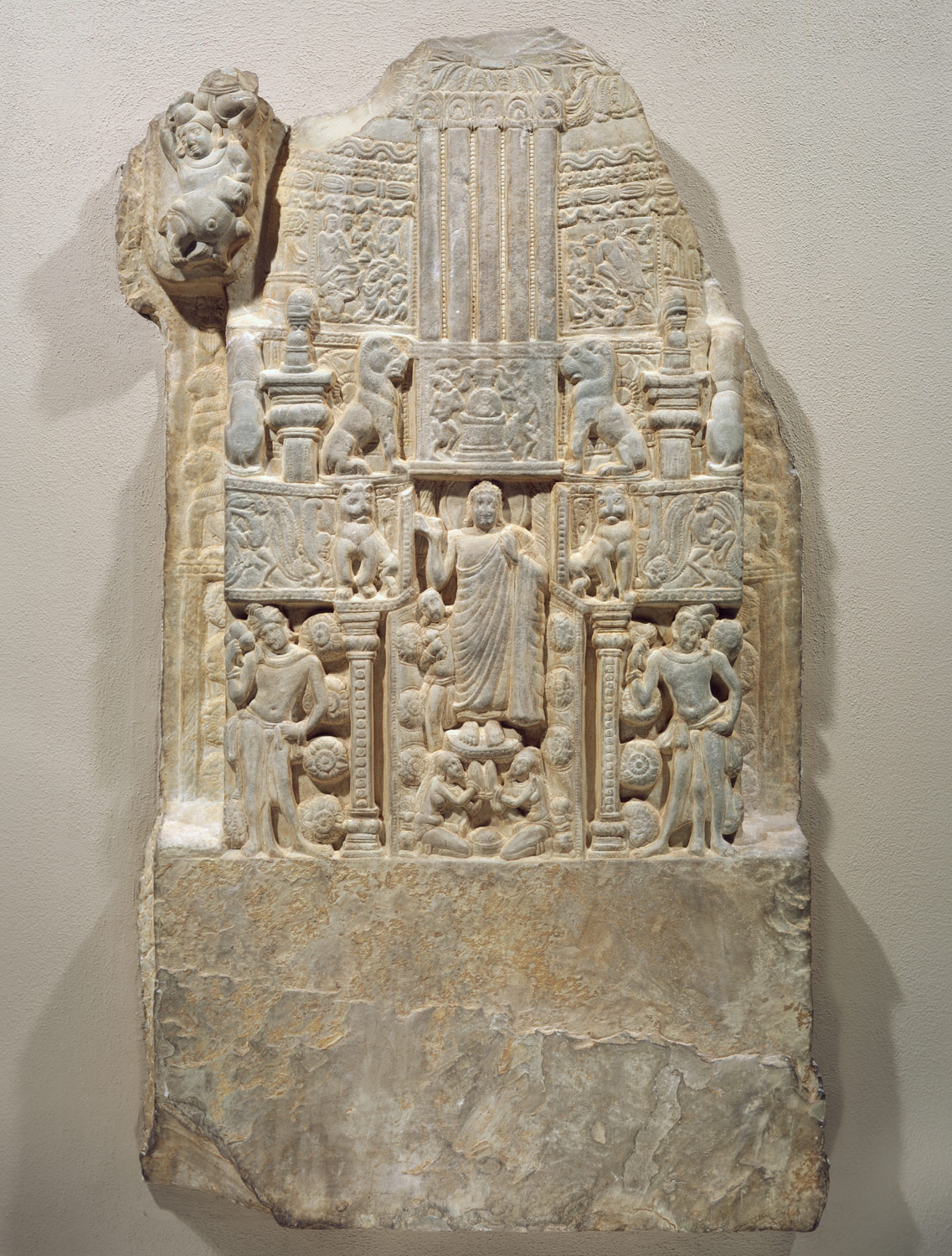
Kanishka, ruler of the Kushan empire in the northwest and north, acts as a great patron of Buddhism. The Kushan empire is founded in the northwest by the Yuezhi of Central Asia in the second century B.C. and achieves its greatest territorial extent under Kanishka. Buddhist art continues to flourish past the waning of Kushan power in the middle of the third century A.D.
-
Buddhism spreads to Central Asia and China via the Silk Road, a transcontinental trade route connecting the Mediterranean world to China through Central Asia. South Indian kingdoms also engage in extensive trading contact with Rome, cultures to the west, and parts of Southeast Asia.
-
ca. 1st–4th century A.D.
Early Tamil literature, Sangam, is compiled in present-day Tamil Nadu, South India. This literature is largely secular in orientation and consists of books of grammar and rhetoric as well as anthologies. They are said to have been produced in three sangams, or literary academies, in Madurai.
-
2nd–5th century A.D.
The traditions of Mahayana Buddhism develop and flourish, and major scholastic centers are founded at Nalanda and Valabhi. The scholar-philosopher Nagarjuna founds the Madhyamika school of Buddhist philosophy (second century, in South India). Extensive textual traditions associated with Mahayana are created. The Lotus Sutra and other texts begin to be translated into Chinese at this time. Many extant Buddhist texts have been preserved, primarily in Chinese.
-
4th century A.D.
The early Puranas, records of the genealogies of the Hindu gods, seers, heroes, kings, and other subjects, are composed and continue to be composed in following centuries. The deities celebrated in these texts become the focus of worship and popular subjects in works of art.
-
4th–5th century A.D.
Chandragupta I (r. 318–30 A.D.) consolidates Gupta control over much of the north and emerges as a great patron of art and literature. The Gupta style of Buddhist sculpture is developed, based on Mathuran and Gandharan forerunners, and is highly influential throughout South, Southeast, and East Asia. The poet and playwright Kalidása composes works in classical Sanskrit, including the renowned play Shakuntala and the highly erotic poem Kumarasambhava, which tells of the courtship of the great gods Parvati and Shiva and the subsequent birth of their son Skanda (also known as Kumara).
-
Hindu sculptures and temples proliferate in this period, as seen in the rock-cut shrine at Udayagiri (near Bhopal in Central India), built in the reign of Chandragupta II at the end of the fourth century. Early freestanding temples are built of brick and house the image of the deity in what is called the garbha-griha (womb chamber). One of the earliest stone Hindu temples, dedicated to the god Vishnu, is built at Deogarh in Central India, reflecting Pancharatra (“five rights”) beliefs that Vishnu takes on different forms as creator, preserver, and destroyer. The temple platform, which now exists only in fragments, features scenes from the stories of Rama and Krishna. As symbols of political power and authority, images and temples are built and maintained by rulers to assert independence and sovereignty. In some cases, the appropriation of an image associated with a competing or prior dynasty acts as a means of establishing supremacy over or continuity with such a dynasty.
-
ca. 5th century A.D.
Ajanta cave constructions and paintings begin in Central India under Vakataka patronage, particularly under Harisena (r. ca. 460–78 A.D.). The highly refined Ajanta cave paintings, the earliest examples of painting in India, depict the Buddha, his attendants, and scenes from the jataka tales (the lives of the Buddha).
Citation
“South Asia, 1–500 A.D.” In Heilbrunn Timeline of Art History. New York: The Metropolitan Museum of Art, 2000–. http://www.metmuseum.org/toah/ht/?period=05®ion=ssa (October 2000)
Related
Map

Encompasses present-day southeastern Afghanistan, Bangladesh, Bhutan, India, Nepal, Pakistan, Sri Lanka, and Tibet
Primary Chronology
Secondary Chronology
Keywords
- Afghanistan
- Andhra Pradesh
- Anuradhapura Period
- Asia
- Bangladesh
- Bhutan
- Delhi
- Gandhara
- Gujarat
- Gupta Period
- Ikshvaku Period
- India
- Kushan Period
- Licchavi Period
- Mumbai (Bombay)
- Nepal
- Pakistan
- Rajasthan
- South Asia
- Southeast Asia
- Sri Lanka
- Tamil Nadu
- Tibet
- Uttar Pradesh
- 1st Century A.D.
- 2nd Century A.D.
- 3rd Century A.D.
- 4th Century A.D.
- 5th Century A.D.
CLOSE
Heilbrunn Timeline of Art History