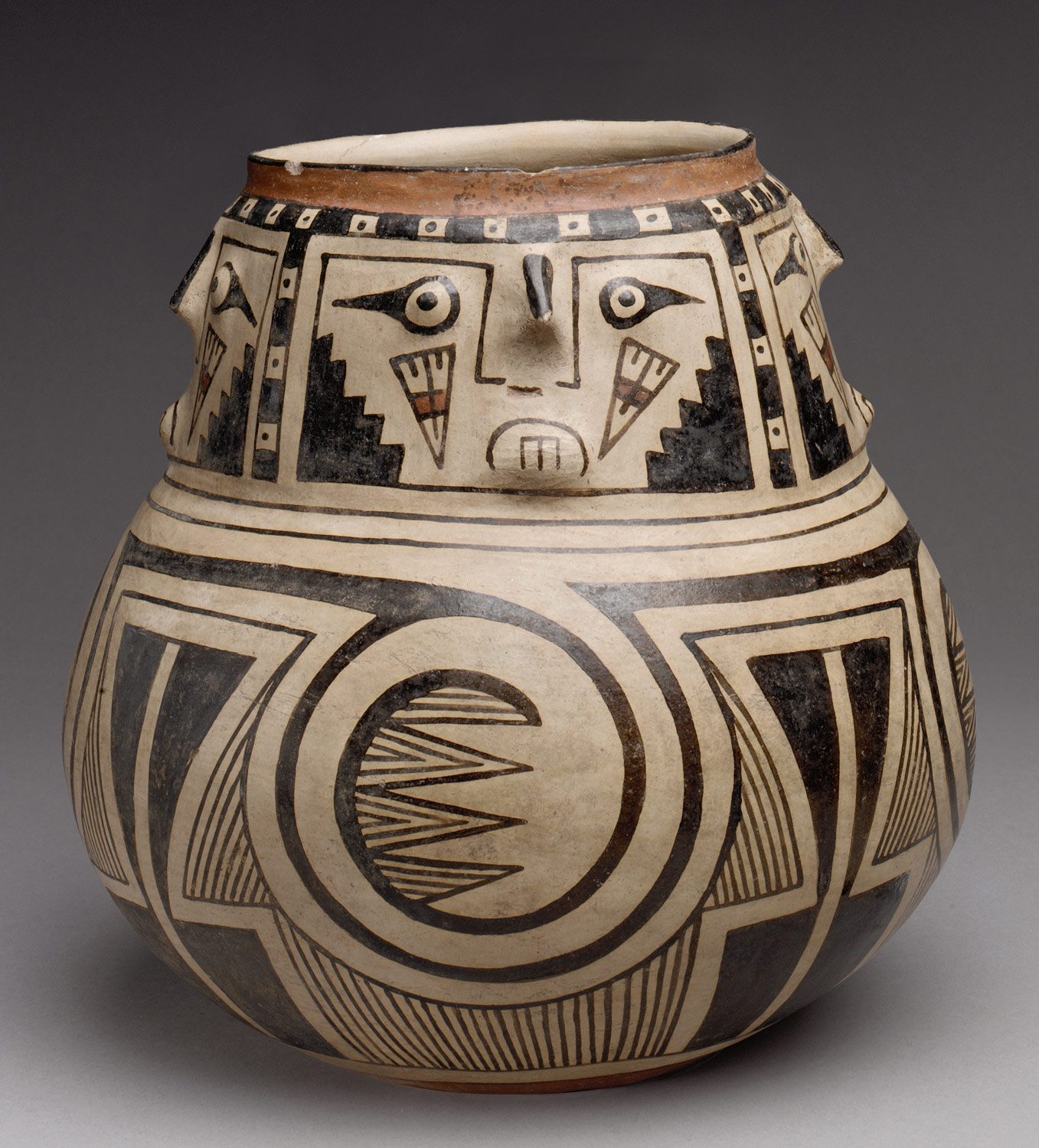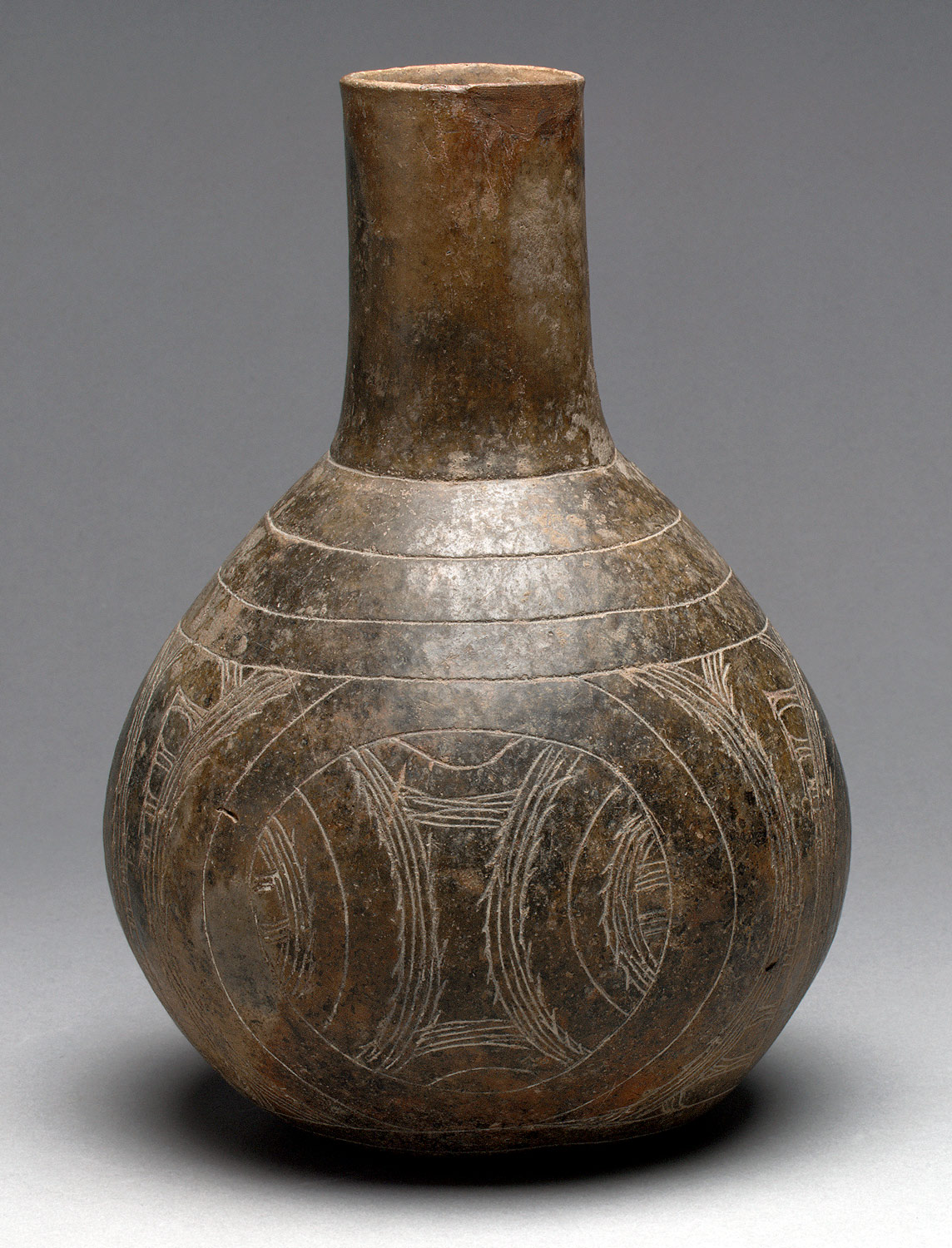
At the beginning of the fifteenth century, many native peoples populate North America. They speak countless languages and follow diverse patterns that are adapted to, and vary with, their environments. In some areas—such as the Northeast—they begin to group into more centralized political structures, while in the South, with the weakening of the important Mississippian centers, populations disperse into smaller communities. The arrival of Europeans at the end of the century, followed by the coming of fishermen, fur traders, gold seekers, and colonists, alters Native American lifeways forever. Contacts between Europeans and Native Americans increase during the following century, particularly in the Northeast, where trade expands and the arts of the region begin a period of integration of foreign elements into objects of everyday use. Such integration, in one measure or another, occurs throughout the continent, the specifics varying with time, place, and groups involved. New diseases, too, arrive with the Europeans, beginning a cycle of decimation that will last until the nineteenth century.
North America, 1400–1600 A.D.
-
 1979.206.1171
 -
 1978.412.85
Timeline
1400 A.D.
1450 A.D.
NORTHEAST
SOUTHEAST
PLAINS
SOUTHWEST
NORTHWEST COAST
ARCTIC
1450 A.D.
1500 A.D.
NORTHEAST
SOUTHEAST
PLAINS
SOUTHWEST
NORTHWEST COAST
ARCTIC
1500 A.D.
1550 A.D.
NORTHEAST
SOUTHEAST
PLAINS
SOUTHWEST
NORTHWEST COAST
ARCTIC
1550 A.D.
1600 A.D.
NORTHEAST
SOUTHEAST
PLAINS
SOUTHWEST
NORTHWEST COAST
ARCTIC
Overview
Key Events
-
1400
Moundville in Alabama becomes less residential while maintaining its ceremonial functions, and eventually experiences a loss of population and wealth. The political power of the Southeastern chiefdoms of Etowah and Spiro ends. The centers are abandoned.
-
1400
The Kachina cult spreads to the Puebloan Zuni and Hopi peoples, and eventually throughout the Southwest.
-
1425
The populations of villages along the Zuni River in central New Mexico grow. A defensive architecture of multistory, windowless apartments are built of adobe-surfaced stone. The flat roofs are used as public spaces.
-
1492
Christopher Columbus lands on an island in the Caribbean, and claims it for the kings of Spain.
-
1497
John Cabot claims Newfoundland for England; Europeans begin to fish on the Grand Banks, leading to contact with coastal tribes.
-
1500
The power and position of the last important Mississippian culture center, Moundville in Alabama, declines.
-
1515
European fishermen investigate the possibilities of trade in animal furs. The fur trade becomes a major economic force throughout North America.
-
1525
Southern Athapaskan peoples migrate to the Southwest from west central Canada; they will become the Apache and the Navajo, among others.
-
1540
The Spanish soldier/explorer Francisco Vásquez de Coronado searches for the legendary wealth of the Seven Cities of Cibola—actually Zuni villages—but finds no treasure there or elsewhere in the Southwest. Disappointed, his journey is characterized by brutal contact with Indian groups.
-
1550
Cultural patterns emerge along the Northwest Pacific Coast that will persist into historic times. Central features include permanent village life and large lineage houses.
-
1550
The League of the Iroquois, the Northeast confederacy of Mohawk, Oneida, Onondaga, Cayuga, and Seneca peoples, forms to avoid continuing conflict among them.
-
1585
An English settlement is established on Roanoke Island, North Carolina. Colonist John White makes an important series of watercolor drawings of people and places.
-
1598
Spanish settlers under Juan de Oñate, searching for precious metals, occupy San Juan Pueblo in the Rio Grande valley of New Mexico. Franciscan missionaries are active.
Citation
“North America, 1400–1600 A.D.” In Heilbrunn Timeline of Art History. New York: The Metropolitan Museum of Art, 2000–. http://www.metmuseum.org/toah/ht/?period=08®ion=na (October 2002)
Related
Map