Wangchuan Villa
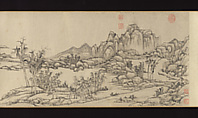
Tutored in painting by his grandfather Wang Shimin (1592–1680), Wang Yuanqi followed the lead of Dong Qichang (1555–1636), the first artist to transform landscape structure in painting by means of abstract compositional movements known as "breath force" (qishi). Inspired by the archaic convention of ringed mountain motifs in the engraving, Wang Yuanqi created "dragon veins" (longmo), through which the cosmic "breath force" vigorously flows. Calligraphic brush formulas suddenly become torrents of writhing, churning rock forms, rising and falling like waves.
Artwork Details
- 清 王原祁 輞川圖 卷
- Title: Wangchuan Villa
- Artist: Wang Yuanqi (Chinese, 1642–1715)
- Period: Qing dynasty (1644–1911)
- Date: dated 1711
- Culture: China
- Medium: Handscroll; ink and color on paper
- Dimensions: Image: 14 in. x 17 ft. 10 3/4 in. (35.6 x 545.5 cm)
Overall with mounting: 14 3/8 in. x 34 ft. 7 1/2 in. (36.5 x 1055.4 cm) - Classification: Paintings
- Credit Line: Ex coll.: C. C. Wang Family, Purchase, Douglas Dillon Gift, 1977
- Object Number: 1977.80
- Curatorial Department: Asian Art
Audio
7605. Wangchuan Villa
More Artwork
Related Content

Research Resources
The Met provides unparalleled resources for research and welcomes an international community of students and scholars. The Met's Open Access API is where creators and researchers can connect to the The Met collection. Open Access data and public domain images are available for unrestricted commercial and noncommercial use without permission or fee.
To request images under copyright and other restrictions, please use this Image Request form.
Feedback
We continue to research and examine historical and cultural context for objects in The Met collection. If you have comments or questions about this object record, please contact us using the form below. The Museum looks forward to receiving your comments.
Content Notice
The Metropolitan Museum of Art presents over 5,000 years of art from around the world, and our online collection reflects ongoing work conducted over the course of our more than 150-year history. You may encounter objects or images that may be inappropriate for some viewers or information that may be outdated.