Banda mask
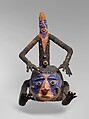
Today, the Banda headdress is danced only for entertainment, although historical documentation suggests that it originally carried an extremely sacred significance. Banda represented a high and powerful spiritual being that would appear only to privileged society elders. During that period, banda was used in rituals designed to protect against dangers such as animal attacks or even human malevolence, especially around the time of important male initiation rites. In contemporary Baga society, the banda performer, invariably a young man, carries the wooden headdress on top of his head. Attached to the underside of the headdress is a large raffia cape that covers the dancer's face and extends to his knees. The performance takes place in a circular arena formed by the crowd and is accompanied by drummers playing on giant wooden slit gongs. The choreography of the dance invokes the movements of various animals, including soaring birds, foot-stamping bulls, and undulating serpents. In the greatest spectacle of the performance, the dancer goes into a dizzying spin holding the headdress aloft, then twirling it in a series of figure eights and plunging it to the ground, finally returning the headdress to his head, all without missing a beat.
Although known to European travelers since the late fifteenth century, Baga society has remained largely inaccessible to Western scholars due to its physical isolation in the marshlands of the Guinea coast. In addition, during much of the twentieth century, the country was under the strict control of a Marxist regime. With the collapse of that government in 1984, Baga society has not only opened up to the West, but also experienced a renaissance of its own, as traditional art forms and rituals like the banda mask have been reintroduced among the Baga.
The raffia and textile attachments that can be seen on this mask were reconstructed in 1995.
Artwork Details
- Title: Banda mask
- Artist: Nalu artist
- Date: late 19th–first half of 20th century
- Geography: Guinea, Niger River region
- Culture: Nalu peoples
- Medium: Wood, paint
- Dimensions: H. 10 × W. 12 13/16 × D. 52 9/16 in. (25.4 × 32.5 × 133.5 cm)
- Classification: Wood-Sculpture
- Credit Line: The Michael C. Rockefeller Memorial Collection, Gift of Nelson A. Rockefeller, 1964
- Object Number: 1978.412.307
- Curatorial Department: The Michael C. Rockefeller Wing
More Artwork
Press the down key to skip to the last item.
Research Resources
The Met provides unparalleled resources for research and welcomes an international community of students and scholars. The Met's Open Access API is where creators and researchers can connect to the The Met collection. Open Access data and public domain images are available for unrestricted commercial and noncommercial use without permission or fee.
To request images under copyright and other restrictions, please use this Image Request form.
Feedback
We continue to research and examine historical and cultural context for objects in The Met collection. If you have comments or questions about this object record, please contact us using the form below. The Museum looks forward to receiving your comments.
Content Notice
The Metropolitan Museum of Art presents over 5,000 years of art from around the world, and our online collection reflects ongoing work conducted over the course of our more than 150-year history. You may encounter objects or images that may be inappropriate for some viewers or information that may be outdated.