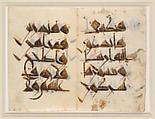
Folio from the "Blue Qur'an"
This folio comes from a sumptuous, multivolume Qur'an with indigo pages and silver verse markers that was probably copied in North Africa. Its palette is thought to refer to the purple‑dyed, gilded manuscripts made in the neighboring Byzantine empire. As in other early Qur'ans, the script here is difficult to read because the letters have been manipulated to make each line the same length, and the marks necessary to distinguish between letters have been omitted.
Artwork Details
- Title: Folio from the "Blue Qur'an"
- Date: second half 9th–mid-10th century
- Geography: Made in Tunisia, possibly Qairawan
- Medium: Gold and silver on indigo-dyed parchment
- Dimensions: H. 11 15/16 in. (30.4 cm)
W. 15 13/16 in. (40.2 cm) - Classification: Codices
- Credit Line: Purchase, Lila Acheson Wallace Gift, 2004
- Object Number: 2004.88
- Curatorial Department: Islamic Art
More Artwork
A slider containing 5 items.
Press the down key to skip to the last item.
Press the down key to skip to the last item.
5th–6th century
Author Abu'l Qasim Firdausi
mid-15th century
3rd–7th century
Author Amir Khusrau Dihlavi
Painting attributed to Miskin
1597–98
ca. 410 AH/1019–20 CE
Related Content

Showing 4 of 6
Research Resources
The Met provides unparalleled resources for research and welcomes an international community of students and scholars. The Met's Open Access API is where creators and researchers can connect to the The Met collection. Open Access data and public domain images are available for unrestricted commercial and noncommercial use without permission or fee.
To request images under copyright and other restrictions, please use this Image Request form.
Feedback
We continue to research and examine historical and cultural context for objects in The Met collection. If you have comments or questions about this object record, please contact us using the form below. The Museum looks forward to receiving your comments.