Child Saint Sambandar
Sambandar, a seventh-century child saint, is among the most popular of the Hindu saints of South India. Legend recounts that after receiving a gift of milk (represented by the bowl) from the goddess Uma, Sambandar devoted his life to composing hymns in praise of Lord Shiva. Here, his raised hand points to Shiva’s heavenly abode at Mount Kailash, in the Himalayas. Sambandar is one the three principal saints of South India, the muvar (revered three), who were the focus of the vast corpus of devotional hymns written in the seventh to ninth century. The sculptor masterfully captured the childlike quality of the saint while empowering him with the maturity and authority of a spiritual leader
Artwork Details
- Title: Child Saint Sambandar
- Period: Chola period (880–1279)
- Date: late 11th century
- Culture: India, Tamil Nadu
- Medium: Copper alloy
- Dimensions: H. 29 3/8 in. (74.6 cm); W. 14 5/8 in. (37.1 cm); D. (rectangular base) 12 5/8 in. (32.1 cm)
- Classification: Sculpture
- Credit Line: Purchase, Lila Acheson Wallace and Doris Wiener Gifts, 2010
- Object Number: 2010.230
- Curatorial Department: Asian Art
More Artwork
A slider containing 5 items.
Press the down key to skip to the last item.
Press the down key to skip to the last item.
probably early 15th century
Nepal, Kathmandu Valley
10th century
India (Tamil Nadu)
11th century
late 14th century
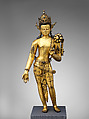
Nepal, Kathmandu Valley
11th–12th century
Related Content
Showing 4 of 15
Research Resources
The Met provides unparalleled resources for research and welcomes an international community of students and scholars. The Met's Open Access API is where creators and researchers can connect to the The Met collection. Open Access data and public domain images are available for unrestricted commercial and noncommercial use without permission or fee.
To request images under copyright and other restrictions, please use this Image Request form.
Feedback
We continue to research and examine historical and cultural context for objects in The Met collection. If you have comments or questions about this object record, please contact us using the form below. The Museum looks forward to receiving your comments.