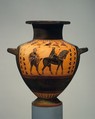
Terracotta column-krater (bowl for mixing wine and water)
Reverse, Dionysos among satyrs and maenads
The symposium, conventionally interpreted as a drinking party, was a well-established feature of Greek—particularly Athenian— society. For over a century, representations on vases document that wine, women, and song were central ingredients. Even more worthy of emphasis, however, is the importance of the symposium as an institution that permitted citizens to gather, to transact business, and—as Plato's dialogue makes clear—to engage in serious discussion. An essential piece of equipment for the symposium was the vase in which the wine was diluted with water and from which it was served.
In black-figure vase-painting before the last quarter of the sixth century B.C., the decoration of large, elaborate kraters tended to be mythological. (On red-figure vases, the symposium itself was often depicted.) This krater is of exceptional significance because it is one of the first on which wine, women, and song are presented, albeit in a mythological guise.
The subject, which encompasses both sides of the vase, is the return of Hephaistos to Mount Olympos, the home of the gods. Hephaistos, the divine smith, was the son of Hera and Zeus. Because he was born lame, his mother cast him out of Olympos. In revenge, Hephaistos fashioned a throne that held Hera fast when she sat on it. only Hephaistos could release her. Therefore, he was given wine and escorted to Olympos by Dionysos, the god of wine, accompanied by his male and female followers, the satyrs and maenads.
Artwork Details
- Title: Terracotta column-krater (bowl for mixing wine and water)
- Artist: Attributed to Lydos
- Period: Archaic
- Date: ca. 550 BCE
- Culture: Greek, Attic
- Medium: Terracotta; black-figure
- Dimensions: Overall: 22 3/16 x 27 1/4 in. (56.4 x 69.3 cm); diameter 23 1/16 in. (58.6 cm)
- Classification: Vases
- Credit Line: Fletcher Fund, 1931
- Object Number: 31.11.11
- Curatorial Department: Greek and Roman Art
Audio
1021. Terracotta column-krater (bowl for mixing wine and water), Part 1
The decoration of this vessel shows a lively scene from Greek myth. On one side, in the center, you see a male figure with long hair who seems to be standing still. He wears long garments and a garland of ivy on his head. This is Dionysos, the god of wine, holding a drinking horn and the vine he taught men to cultivate. Around him are shaggy creatures with horses’ tails and ears. These are the satyrs, the god's male followers. Also present are maenads, female devotees of Dionysos, wearing animal skins over their dresses.
Everyone here is moving in the same direction, in a spirited dance. Lydos, who painted this vase, made his figures large and gave each one individual qualities. Follow the procession around to the other side. As you go, you see a satyr carrying a bulging wineskin, and another satyr looking straight out at you. In front of him, riding on a donkey, is Hephaistos, the blacksmith god and master craftsman to the gods.
According to the myth, Hephaistos was born lame. His mother Hera was so disgusted by his deformity that she wanted him out of Olympus, where the gods lived. Before he left, he prepared his revenge. He made a beautiful throne, a parting gift for his mother. When she sat in it, delighted, it held her fast, and no one could get her out but Hephaistos himself. So the gods sent Dionysos to fetch him back, with wine to induce him. Hephaistos shows no sign of lameness in this scene, and in fact rarely elsewhere in Greek art.
Turn to the case on the wall nearby. Here you see fragments of another krater Lydos painted with the same mythological scene. Look at how much bigger the main band of decoration is in the fragmentary krater. You get a sense of how much larger it must have been—the smaller krater holds some nineteen gallons!
In the center of the case, you see Hephaistos again riding his donkey, with his name painted just to the right. All of the other figures also have painted names, some very descriptive: the happy satyr lying under the donkey has a name that translates “caring about nothing.” He is looking out at us, completely drunk, holding a drinking cup in his left hand and the leg of a faun in his right. This carousing comes perhaps a few hours after the energetic dances depicted on the smaller krater.
If you'd like to hear more about the fragmentary krater from Distinguished Research Curator Dietrich von Bothmer, push the green play button to continue this message.
Listen to more about this artwork
More Artwork
Related Content

Research Resources
The Met provides unparalleled resources for research and welcomes an international community of students and scholars. The Met's Open Access API is where creators and researchers can connect to the The Met collection. Open Access data and public domain images are available for unrestricted commercial and noncommercial use without permission or fee.
To request images under copyright and other restrictions, please use this Image Request form.
Feedback
We continue to research and examine historical and cultural context for objects in The Met collection. If you have comments or questions about this object record, please contact us using the form below. The Museum looks forward to receiving your comments.
Content Notice
The Metropolitan Museum of Art presents over 5,000 years of art from around the world, and our online collection reflects ongoing work conducted over the course of our more than 150-year history. You may encounter objects or images that may be inappropriate for some viewers or information that may be outdated.