Charles I
This embroidered portrait miniature, Portrait of Charles I, is one of the most beautifully executed examples of professional embroidery from the seventeenth century. All of the elements, from the lace collar and medallion of the Order of the Garter worn by the king, to the highlights in his eyes and hair, are rendered in minute stitches of silk and metal thread. A number of similar portraits survive in public and private collections, further evidence that these were produced in a professional workshop setting. However, the Museum's example is the only one known to include the inscription "Deus meus est Rvpis mea Psa: 18," a reference to Psalm 18:2–3, which reads: "The Lord is my rock and my fortress, and my deliverer; my God, my strength in whom I trust; my buckler, and the horn of my salvation, and my high tower. I will call upon the Lord, who is worthy to be praised: so shall I be saved from mine enemies." This psalm was reputedly one of Charles' favorites.
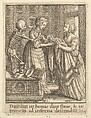
The portrait miniature can be understood as a commemorative object associated with the cult of the "Martyr King," which developed after the beheading of Charles I in 1649. The image was based on a 1641 engraving by the Bohemian artist Wenceslas Hollar, which was in turn taken from a 1632 formal portrait of Charles I and Queen Henrietta Maria by court painter Anthony van Dyck (1599–1641). This same image appears as the frontispiece for the 1651 Reliquiae Sacrae Carolae.
The portrait miniature can be understood as a commemorative object associated with the cult of the "Martyr King," which developed after the beheading of Charles I in 1649. The image was based on a 1641 engraving by the Bohemian artist Wenceslas Hollar, which was in turn taken from a 1632 formal portrait of Charles I and Queen Henrietta Maria by court painter Anthony van Dyck (1599–1641). This same image appears as the frontispiece for the 1651 Reliquiae Sacrae Carolae.
Artwork Details
- Title: Charles I
- Artist: After an engraving of by Wenceslaus Hollar (Bohemian, Prague 1607–1677 London)
- Date: 1650–70
- Culture: British
- Medium: Silk and metal thread on silk
- Dimensions: H. 6 x W. 4 1/2 inches (15.2 x 11.4 cm)
- Classification: Textiles-Embroidered
- Credit Line: Purchase, Mrs. Thomas J. Watson Gift, 1939
- Object Number: 39.13.7
- Curatorial Department: European Sculpture and Decorative Arts
More Artwork
A slider containing 5 items.
Press the down key to skip to the last item.
Press the down key to skip to the last item.
Embroidered by R. Hayes
after 1649
after 1651
Etcher Wenceslaus Hollar
After Hans Holbein the Younger
[1651] late 18th century printing
British
first half 18th century
Multiple artists/makers
ca. 1683
Research Resources
The Met provides unparalleled resources for research and welcomes an international community of students and scholars. The Met's Open Access API is where creators and researchers can connect to the The Met collection. Open Access data and public domain images are available for unrestricted commercial and noncommercial use without permission or fee.
To request images under copyright and other restrictions, please use this Image Request form.
Feedback
We continue to research and examine historical and cultural context for objects in The Met collection. If you have comments or questions about this object record, please contact us using the form below. The Museum looks forward to receiving your comments.