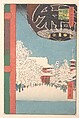
Kinryūsan Temple at Asakusa, from the series "One Hundred Famous Views of Edo"
In this print, snow white is complemented by the reds of the temple's buildings, the gate, the large lantern, and even the label signed "painted by Hiroshige" in the lower right corner. The auspicious color scheme of red and white here creates a celebratory mood.
Artwork Details
- 名所江戸百景 浅草金龍山
- Title: Kinryūsan Temple at Asakusa, from the series "One Hundred Famous Views of Edo"
- Artist: Utagawa Hiroshige (Japanese, Tokyo (Edo) 1797–1858 Tokyo (Edo))
- Period: Edo period (1615–1868)
- Date: 1856
- Culture: Japan
- Medium: Woodblock print; ink and color on paper
- Dimensions: H. 14 1/16 in. (35.7 cm); W. 9 1/2 in. (24.1 cm)
- Classification: Prints
- Credit Line: The Howard Mansfield Collection, Purchase, Rogers Fund, 1936
- Object Number: JP2519
- Curatorial Department: Asian Art
More Artwork
Related Content

 Free to download
Research Resources
The Met provides unparalleled resources for research and welcomes an international community of students and scholars. The Met's Open Access API is where creators and researchers can connect to the The Met collection. Open Access data and public domain images are available for unrestricted commercial and noncommercial use without permission or fee.
To request images under copyright and other restrictions, please use this Image Request form.
Feedback
We continue to research and examine historical and cultural context for objects in The Met collection. If you have comments or questions about this object record, please contact us using the form below. The Museum looks forward to receiving your comments.
Content Notice
The Metropolitan Museum of Art presents over 5,000 years of art from around the world, and our online collection reflects ongoing work conducted over the course of our more than 150-year history. You may encounter objects or images that may be inappropriate for some viewers or information that may be outdated.