Search the collection

Filter By

Object Type / Material
Geographic Location
Department
Date
Show Only:
  • As part of the Met's Open Access policy, you can freely copy, modify and distribute this image, even for commercial purposes.
    APIPublic domain data for this object can also be accessed using the Met's Open Access API
  • Objects with changed or unknown ownership in continental Europe between 1933-1945. Learn more
More than 10,000 results for Façon de Venise, probably south Lowlands or Germany
Sort by:
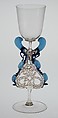
Goblet, Colorless (yellowish), transparent turquoise blue, and opaque brick red, yellow, and white nonlead glass.  Blown, trailed, pincered, "vetro a retorti"., Façon de Venise, probably south Lowlands or Germany
Façon de Venise, probably south Lowlands or Germany
17th century
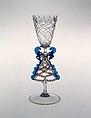
Goblet, Colorless (slightly gray) transparent turquoise blue, and opaque brick red, white, and yellow nonlead glass. Blown, pattern molded, trailed, pincered, "vetro a retorti"., Façon de Venise, probably south Lowlands or Germany
Façon de Venise, probably south Lowlands or Germany
probably 17th century, possibly 19th century
Boot glass, Colorless (gray) and opaque white nonlead glass. Blown, "vetro a retorti", trailed, applied and impressed parts, gilt., Venetian or façon de Venise, probably south Lowlands or Germany
Venetian or façon de Venise, probably south Lowlands or Germany
late 16th or early 17th century
Boot glass, Colorless (slightly tan) and opaque white nonlead glass. Blown, "vetro a retorti", trailed, applied and impressed parts, gilt., Venetian or façon de Venise, probably south Lowlands or Germany
Venetian or façon de Venise, probably south Lowlands or Germany
late 16th or early 17th century
Armorial tazza, Italian (Venice) or façon de Venise (Venetian-style), Colorless (slightly gray) nonlead glass; blown, pattern-molded, enameled, gilt, Venetian or façon de Venise, or French
Italian
French
1499–1514
Beaker, Colorless (slightly tan) nonlead glass. Blown, ice-glass technique, trailed, gilt., Italian (Venice) or façon de Venise, probably south Lowlands
Italian (Venice) or façon de Venise, probably south Lowlands
late 16th–early 17th century
Goblet, Gray-green nonlead glass. Blown, pattern molded, enameled, gilt., Façon de Venise, probably Bohemian
Façon de Venise, probably Bohemian
late 16th century
Goblet, Gray nonlead glass. Blown, mold blown, enameled, gilt., Façon de Venise, probably Bohemian
Façon de Venise, probably Bohemian
late 16th century
Spouted jug, Transparent dark blue and opaque white nonlead glass. Blown, pattern molded, trailed., Façon de venise, probably Barcelona
Façon de venise, probably Barcelona
ca. 1500
Tazza, Colorless (slightly gray) and opaque white nonlead glass. Blown, "vetro a retorti", pincered., Venetian or façon de Venise
Venetian or façon de Venise
first half 16th century
Drinking horn, Colorless (slightly gray) and opaque white nonlead glass. Blown, "vetro a retorti", trailed., Venetian or façon de Venise
Venetian or façon de Venise
late 16th century
Armorial goblet, Colorless (strong gray) nonlead glass. Blown, enameled, gilt., Façon de Venise, probably southern Germany or Tyrol
Façon de Venise, probably southern Germany or Tyrol
1592
Wineglass, Colorless (slightly purplish gray), bubbly nonlead glass. Blown, diamond-point (scratch) engraved., Façon de Venise, probably northern European (Lowlands or France)
Façon de Venise, probably northern European (Lowlands or France)
early 17th century
Double cup (Doppelscheuer), Colorless (slightly gray) nonlead glass. Blown, enameled, gilt., Façon de venise, Germany or Silesia (possibly Petersdorf)
Façon de venise, Germany or Silesia (possibly Petersdorf)
late 19th century
Pitcher, Colorless (gray) and transparent dark blue-green nonlead glass. Blown, ice-glass technique, trailed., Italian (Venice), or façon de Venise
Italian (Venice), or façon de Venise
early 17th century
Stemmed cup (?), Colorless (slightly grayish tan) nonlead glass. Blown, pattern molded, trailed, gilt., Italian (Venice) or façon de Venise
Italian (Venice) or façon de Venise
probably 16th century
Wineglass, Colorless (strongly greenish gray) nonlead glass. Blown, mold blown., Façon de Venise, northern European
Façon de Venise, northern European
16th century
Wineglass, Colorless (slightly tan) and transparent bright blue-green bubbly nonlead glass. Blown, trailed, pincered., Façon de Venise, northern European
Façon de Venise, northern European
probably 17th century, possibly late 19th century
Wineglass, Colorless (slightly gray) and transparent turquoise blue nonlead glass. Blown, pattern molded, trailed, pincered, milled., Façon de Venise, northern European (possibly the Lowlands)
Façon de Venise, northern European (possibly the Lowlands)
17th century
Dish, Colorless (gray) nonlead glass. Blown, reverse painted, gilt (unfired)., Venetian or façon de Venise, probably Tyrol (Innsbruck)
Venetian or façon de Venise, probably Tyrol (Innsbruck)
mid to late 16th century
Goblet, Colorless (slightly gray) nonlead glass; silvered metal fittings. Blown, pattern molded., probably façon de Venise, northern European or Venetian
probably façon de Venise, northern European or Venetian
late 16th–mid-17th century
Armorial flask, Colorless (slightly gray) and opaque white nonlead glass.  Blown, "vetro a retorti", enameled, gilt., Venetian or façon de Venise, possibly Saxony
Venetian or façon de Venise, possibly Saxony
mid-16th century
Sprinkler bottle(?), Colorless (purplish gray) and opaque white nonlead glass. Blown, pattern molded, trailed., Façon de venise, possibly Spanish (Barcelona)
Façon de venise, possibly Spanish (Barcelona)
17th century
Tazza, Colorless (slightly gray) nonlead glass. Blown, reverse painted, gilt (unfired)., Venetian or façon de Venise, probably Tyrolean; possibly Venice
Venetian or façon de Venise, probably Tyrolean; possibly Venice
ca. 1570
Tazza, Colorless (slightly tan) and transparent turquoise blue nonlead glass. Blown, trailed, diamond-point (scratch) engraved., Italian (Venice) or façon de Venise, northern European
Italian (Venice) or façon de Venise, northern European
17th century
Goblet, Bubbly colorless (very faint gray), opaque white, and transparent turquoise blue nonlead glass. Blown, trailed, pincered, "vetro a retorti"., Northern European (possibly south Lowlands or Germany)
Northern European (possibly south Lowlands or Germany)
probably late 17th century
Wineglass, Glass, blown with applied decoration, Italian, Venice (Murano) or façon de Venise possibly Dutch
Italian, Venice (Murano) or façon de Venise possibly Dutch
17th century
Drinking bottle (Porrón), Glass; blown, a retorti, Spanish, probably Barcelona (Façon de Venise)
Spanish, probably Barcelona (Façon de Venise)
18th century
Bowl, Glass; blown, a ghiaccio, applied decoration, Spanish, probably Catalonia, façon de Venise
Spanish, probably Catalonia, façon de Venise
16th-17th century
Goblet vase, Glass, Italian, Venice or Façon de Venise
Italian, Venice or Façon de Venise
16th–17th century
Corset, Facon, silk, elastic, metal, French
Facon
Saks Fifth Avenue
1930–35
Beaker (Stangenglas), Colorless (slightly gray) and opaque white nonlead glass; pewter mount. Blown, "vetro a retorti"., probably south Lowlands; possibly Bohemia or Saxony
probably south Lowlands; possibly Bohemia or Saxony
late 16th century
Necklace Formed of Fifteen Dress Ornaments, Gold, enamel, ruby and pearls., probably Transylvanian, possibly South Germany
Transylvania
ca.1600
Bottle with two white fillets, Glass, Italian, Venice, Murano or façon de Venise
Italian, Venice, Murano or façon de Venise
17th century
Dish: The Destruction of the Hosts of Pharaoh, Master IC (probably Jean Court) or French, Limoges, Painted enamel on copper, partly gilt.
Master IC (probably Jean Court)
Jean Cour (or Court)
probably early 17th century
Adoration of the Magi, Southern Germany or Austria  Southern Germany or Austria, Tempera and gold and silver leaf on parchment, Southern German or Austrian
Southern Germany or Austria
ca. 1235–50
Angel of the Annunciation, Jean de Liège  Franco-Netherlandish, Marble, South Netherlandish or French
Jean de Liège
ca. 1370–90
Standing Scholar (Prophet?) Turned to the Right (Recto); Standing Scholar (Prophet?) Turned to the Left (Verso), Germany, Middle Rhine  German, Middle Rhine, Pen and carbon black ink, traces of black chalk underdrawing, on paper prepared with sanguine wash, Germany, Middle Rhine
Germany, Middle Rhine
ca. 1460–70
Saint Mary Magdalene, Jean de Liège  Franco-Netherlandish, Marble, South Netherlandish
Jean de Liège
ca. 1350–75
Seal Impression, Saint Margaret, Black wax, Netherlandish or South Lowlands (?)
Netherlandish or South Lowlands (?)
ca. 1358