English
DonateMembershipTickets

Search for Art

Search Tips
1-42 of 1,308 results for classical-ruins
Sort by:
Show only
Images
Date
For BCE dates, enter a negative number. E.g. For 2000 BCE, enter -2000.
–
Artist / culture
Object type / material
Match
 
Show results matching
selected filters.
Geographic location
Match
 
Show results matching
selected filters.
Department
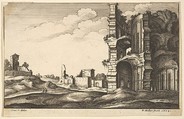
Classical Ruins, Wenceslaus Hollar  Bohemian, Etching; second state of two
Etcher Wenceslaus Hollar
After Sebastiaen Vrancx
1673
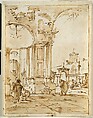
An Architectural Capriccio, with Classical Ruins, Francesco Guardi  Italian, Pen and brown ink, brown wash
Francesco Guardi
ca. 1780–85
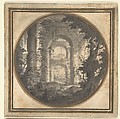
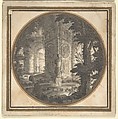
Imaginary Landscape with Classical Ruins, Carlo Fantaccini  Italian, Point of a brush and gray wash, over graphite; framing lines in pen and brown ink and bronze paint
Carlo Fantaccini
1700–50
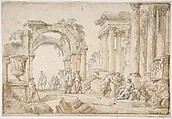
Figures in Classical Ruins, Giovanni Paolo Panini  Italian, Pen and brown ink, brush and brown and gray wash, over black chalk
Giovanni Paolo Panini
1691–1765
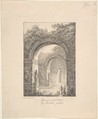
Classical Ruins: A Public Bath, Joseph Lemercier  French, Pen and black and gray ink
Joseph Lemercier
19th century
Imaginary Landscape with Classical Ruins; Fountain in Foreground, Carlo Fantaccini  Italian, Point of a brush and gray wash, over graphite; framing lines in pen and brown ink and bronze paint
Carlo Fantaccini
1700–50
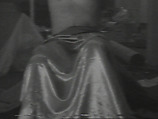
Classical Ruins, William Wegman  American, Single-channel digital video, transferred from Sony CV 1/2-inch video tape, black-and-white, sound, 15 sec.
William Wegman
1970
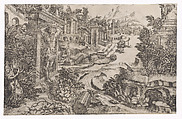
Fantastic River Landscape with Classical Ruins and an Atlantes, Monogrammist DB, Etching and engraving
Monogrammist DB
Monogrammist IH
ca. 1550
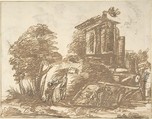
Figures in a Landscape with Classical Ruins (recto); Six Figure Studies (verso), Ercole Procaccini The Younger  Italian, Pen and brown and black ink on cream laid paper (recto); pen and brown ink (verso); fragments of framing lines
Ercole Procaccini The Younger
17th century
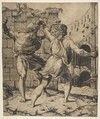
Entellus and Dares fighting in front of classical ruins, Marco Dente  Italian, Engraving
Marco Dente
After Raphael (Raffaello Sanzio or Santi)
1520–25
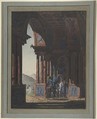
Two Mounted Soldiers in Classical Ruins, for a poem by Cremes, Franz von Hauslab the Younger  Austrian, Watercolor, gouache, and pen and black ink.  Pen and black ink framing line added when mounted.
Franz von Hauslab the Younger
1812–83
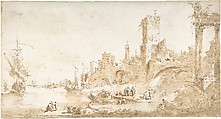
Capriccio with a Seaport and Classical Ruins, Francesco Guardi  Italian, Pen and brown ink, brush and brown wash, over black chalk
Francesco Guardi
1712–93
Giovanni Domenico Ferretti
After Marco Ricci
1743
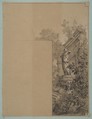
Design for mural decoration surrounding a door:  landscape with classical ruins, Jules-Edmond-Charles Lachaise  French, black chalk, heightened with white on beige wove paper; mounted on blue wove paper
Jules-Edmond-Charles Lachaise
Eugène-Pierre Gourdet
1830–97
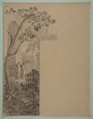
Design for mural decoration surrounding a door: landscape with classical ruins, Jules-Edmond-Charles Lachaise  French, black chalk heighted with white on beige wove paper; mounted on blue wove paper
Jules-Edmond-Charles Lachaise
Eugène-Pierre Gourdet
1830–97
Marco Ricci
1723–30
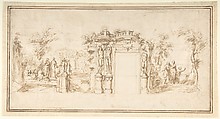
Design for a Painted Wall Decoration, with Figures in a Landscape with Classical Ruins, Anonymous, Italian, 18th century  Italian, Pen and brown ink, brush with brown wash, over black chalk on cream laid paper. Groundline stylus-incised
Anonymous, Italian, 18th century
18th century
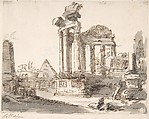
Classical Landscape with Ruins (recto); Two men in Roman military dress (verso), Robert Adam  British, Scottish, Pen and brown ink, brush and gray wash, over black chalk
Robert Adam
1755–57
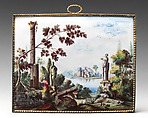
Plaque with classical landscape, Enamel on copper, British, probably Birmingham
British, probably Birmingham
ca. 1755
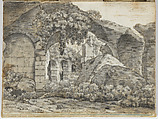
Roman ruins (recto). Three figures in classical robes (verso) (Smaller Italian sketchbook, leaf 1), Joseph Wright (Wright of Derby)  British, Recto: pen and ink, brush and gray wash, over graphite<br/>Verso: graphite
Joseph Wright (Wright of Derby)
1774–75
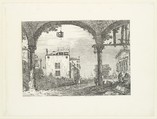
A three-arched portico with an open lantern hanging at center, a triumphal arch and ruins of a classical temple in the background, from "Views" (Vedute altre prese da i luoghi altre ideate da Antonio Canal), Canaletto (Giovanni Antonio Canal)  Italian, Etching; second state of three
Canaletto (Giovanni Antonio Canal)
Dedicatee Joseph Smith
1735–46
Bernardo Bellotto
1741–42
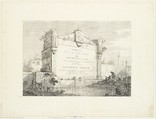
Title page with a large wall of a classical ruin, with a figure seated at right pointing to the dedication, from "Views" (Vedute altre prese da i luoghi altre ideate da Antonio Canal), Canaletto (Giovanni Antonio Canal)  Italian, Etching; second state of two
Canaletto (Giovanni Antonio Canal)
Dedicatee Joseph Smith
1735–46
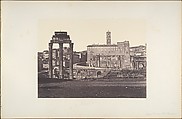
Campo Vaccino (Foro Romano), Eugène Constant  French, active Italy, Albumen print from glass negative
Eugène Constant
1848–52
Ruins and Foreground, Acropolis, Athens (55. Athènes. 1842. Acropole. ruines et 1ers plans (pour tableau)), Joseph-Philibert Girault de Prangey  French, Daguerreotype
Joseph-Philibert Girault de Prangey
1842
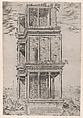
The Septizodium, Anonymous, Etching and engraving
Anonymous
Publisher Antonio Lafreri
1556
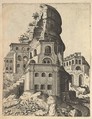
Vertical Landscape with the Ruins of the Temple of Venus and Roma, from "Ruinarum variarum fabricarum delineationes pictoribus caeterisque id genus artificibus multum utiles", Lambert Suavius  Netherlandish, Etching
Lambert Suavius
Publisher Gerard de Jode
1554
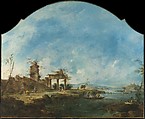
Fantastic Landscape, Francesco Guardi  Italian, Oil on canvas
Francesco Guardi
ca. 1765
The Ruins of the Forum of Nerva, Rome, seen from the South-West, Matthijs Bril the Younger  Netherlandish, Pen and brown ink
Matthijs Bril the Younger
ca. 1570–80
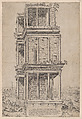
The Septizodium, from "Speculum Romanae Magnificentiae", Anonymous, Etching and engraving
Anonymous
1556
Ruins, with a Statue on the Left, Giovanni Paolo Panini  Italian, Pen and brown ink, gray, brown, blue, green and yellow washes
Giovanni Paolo Panini
ca. 1728
Veduta del Tempio di Giove Tonante, Giovanni Battista Piranesi  Italian, Engraving
Giovanni Battista Piranesi
1740s–60s
View of Ancient Roman Ruins, an Arch and a Triangular-Pedimented Doorway, Filippo Mochi  Italian, Pen and brown ink, brush and gray wash and leadpoint; framed outlines in black ink and  blue wash
Filippo Mochi
18th century
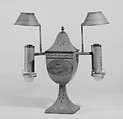
Lamp, Painted tin
ca. 1815
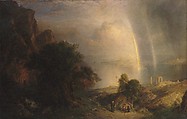
The Aegean Sea, Frederic Edwin Church  American, Oil on canvas, American
Frederic Edwin Church
ca. 1877
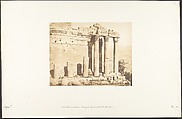
Colonnade occidental du Temple de Jupiter, à Baâlbek (Héliopolis), Maxime Du Camp  French, Salted paper print from paper negative
Maxime Du Camp
September 15, 1850
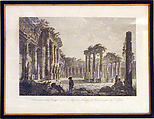
Engraving, Ink on paper
18th century
Erechtheion, Athens (62. Athènes. 1842. T. de Minerve Poliade.), Joseph-Philibert Girault de Prangey  French, Daguerreotype
Joseph-Philibert Girault de Prangey
1842
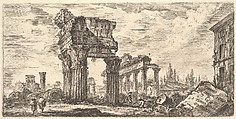
Plate 7: Temple of Jupiter Tonans (Jupiter the Thunderer). 1. Temple of Concord. (Tempio di Giove Tonans. 1. Tempio della Concordia.), from "Antichità Romane de' Tempi della Repubblica, e de' primi Imperatori", Giovanni Battista Piranesi  Italian, Etching
Giovanni Battista Piranesi
ca. 1748
Façade and Ruins, Mauro Antonio Tesi  Italian, Pen and brown ink, brush and gray wash
Attributed to Mauro Antonio Tesi
1750–66
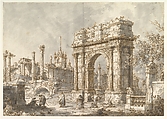
Capriccio with a Roman Triumphal Arch, Canaletto (Giovanni Antonio Canal)  Italian, Pen and brown ink, brush and gray wash, over traces of leadpoint or graphite
Canaletto (Giovanni Antonio Canal)
1720–30
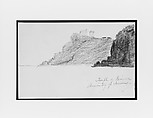
Temple of Minerva (from Sketchbook), Mary Newbold Sargent  American, Graphite on paper, American
Mary Newbold Sargent
1904

Content Notice

The Metropolitan Museum of Art presents over 5,000 years of art from around the world, and our online collection reflects ongoing work conducted over the course of our more than 150-year history. You may encounter objects or images that may be inappropriate for some viewers or information that may be outdated.