English
DonateMembershipTickets

Tughra (Insignia) of Sultan Süleiman the Magnificent (r. 1520–66)

ca. 1555–60
On view at The Met Fifth Avenue in Gallery 460
A tughra is a stylized royal seal and signature applied by the Ottoman sultans to every royal edict. Different types were used by the early rulers. Suleiman the Magnificent (r. 1520–66) introduced a standard calligraphic design, starting from right with two to three horizontal lines, drawing a large oval to the left, and ending in the center with intervening letters at the bottom and three vertical undulated axes at the top. Each sultan’s tughra is slightly different, but typically comprises the name of the reigning sultan as well as his father’s name, his title, and the phrase "the eternally victorious." In this example, administrative function and artistry have created a masterpiece of Ottoman calligraphy, where the designed surface is filled with ornaments such as the scrolling floral vines in gold and blue.

Artwork Details

Object Information
  • Title: Tughra (Insignia) of Sultan Süleiman the Magnificent (r. 1520–66)
  • Date: ca. 1555–60
  • Geography: Attributed to Turkey, Istanbul
  • Medium: Ink, opaque watercolor, and gold on paper
  • Dimensions: Tughra:
    H. 20 1/2 in. (52.1 cm)
    W. 23 1/2 in. (59.7cm)
    Mat:
    H. 25 in. (63.5 cm)
    W. 30 in. (76.2 cm)
  • Classification: Codices
  • Credit Line: Rogers Fund, 1938
  • Object Number: 38.149.2
  • Curatorial Department: Islamic Art
More Artwork
Tughra (Insignia) of Sultan Süleiman the Magnificent (r. 1520–66), Ink, opaque watercolor, and gold on paper
ca. 1555–60
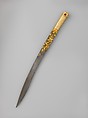
Short Sword (Yatagan) from the Court of Süleyman the Magnificent (reigned 1520–66), Ahmed Tekelü  possibly Iranian, Steel, gold, ivory (walrus), silver, turquoise, pearls, rubies, Turkish, Istanbul
Sword maker Workshop of Ahmed Tekelü
ca. 1525–30
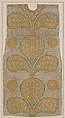
Fragment of a Kaftan Back, Silk, metal wrapped thread; taqueté (seraser)
mid-16th century
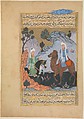
"The Angel Gabriel meets 'Amr ibn Zaid (the Shepherd)", Folio from a Siyer-i Nebi (the Life of the Prophet), Mustafa ibn Vali, Ink, opaque watercolor, and gold on paper
Painting by Mustafa ibn Vali
Patron Commissioned by Sultan Murad III
Author Mustafa b. Yusuf al-Darir al-Erzerumi
ca. 1595
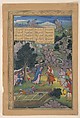
"A King Offers to Make Amends to a Bereaved Mother", Folio from a Khamsa (Quintet) of Amir Khusrau Dihlavi, Amir Khusrau Dihlavi  Indian, Main support: Ink, opaque watercolor, gold on paper<br/>Margins: Gold on dyed paper
Author Amir Khusrau Dihlavi
Painting attributed to Miskin
1597–98

Research Resources

The Met provides unparalleled resources for research and welcomes an international community of students and scholars. The Met's Open Access API is where creators and researchers can connect to the The Met collection. Open Access data and public domain images are available for unrestricted commercial and noncommercial use without permission or fee.

To request images under copyright and other restrictions, please use this Image Request form.

Feedback

We continue to research and examine historical and cultural context for objects in The Met collection. If you have comments or questions about this object record, please contact us using the form below. The Museum looks forward to receiving your comments.

Send feedback

Content Notice

The Metropolitan Museum of Art presents over 5,000 years of art from around the world, and our online collection reflects ongoing work conducted over the course of our more than 150-year history. You may encounter objects or images that may be inappropriate for some viewers or information that may be outdated.