English
DonateMembershipTickets

Cabinet

ca. 1880
On view at The Met Fifth Avenue in Gallery 743
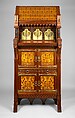
While New York City’s cabinetmakers and decorators dominated the American market for luxury interior decorations during the country’s Gilded Age, Philadelphia also supported premier artisans and designers. A. and H. Lejambre was one such firm that flourished Philadelphia during the latter half of the nineteenth-century. Founded by the French émigré John Peter Alphonse Lejambre (d.1843), during its heyday, it was run by his widow Anna, (d. 1878), their son, Alexis (d. 1862), and later, his son, Henri Lejambre. Like Herter Brothers, Louis C. Tiffany and others, the Lejambre firm imported French textiles, furniture, and decorations, in addition to its cabinetmaking operation. The furniture made in the late 1870s and early 1880s in the Aesthetic style is notable for its delicate forms, luxury materials, fine craftsmanship, and rectilinear lines. Distinctive to Lejambre is its marquetry decoration of insects, as the seen in the brass, copper, and mother-of-pearl grasshoppers. This refined cabinet, one of a known pair, and the most ambitious form produced by the firm known today, would have exhibited ceramics or other small objet d'art collected in the period.

Artwork Details

Object Information
  • Title: Cabinet
  • Maker: A. and H. Lejambre (American, Philadelphia, Pennsylvania, active 1865–ca. 1907)
  • Date: ca. 1880
  • Geography: Made in Philadelphia, Pennsylvania, United States
  • Culture: American
  • Medium: Mahogany, maple veneer, brass, copper, mother-of-pearl, and glass
  • Dimensions: 61 × 51 in. (154.9 × 129.5 cm)
  • Credit Line: Purchase, Barrie A. and Deedee Wigmore Foundation Gift, 2017
  • Object Number: 2017.233a–g
  • Curatorial Department: The American Wing
More Artwork
Table, A. and H. Lejambre  American, Probably purpleheart, yellow poplar, inlaid woods, brass, American
A. and H. Lejambre
ca. 1880
Sauceboat, Anthony Rasch  American, Silver, American
Anthony Rasch
ca. 1815
Rolltop desk, David Roentgen  German, Oak, cherry, pine, mahogany, veneered with maple, burl woods, holly, hornbeam (all partially stained), tulipwood, mahogany, and other woods; mother-of-pearl; partially gilded and tooled leather; gilt bronze, iron, steel, brass, partially gold-lacquered brass, German, Neuwied am Rhein
David Roentgen
Designer Drawer pulls after a design by Thomas Chippendale
Designer Marquetry panel after a design by Januarius Zick
ca. 1776–79
Cabinet, Daniel Pabst  American, born Germany, Walnut, maple, white pine, glass, American
Attributed to Daniel Pabst
Designer Attributed to Frank Furness
ca. 1873–76
Desk, Stickley Brothers  American, Quarter-sawn oak, oak veneer, cedar, mahogany, brass,
 copper, pewter, leaded glass, American
Stickley Brothers
1904

Research Resources

The Met provides unparalleled resources for research and welcomes an international community of students and scholars. The Met's Open Access API is where creators and researchers can connect to the The Met collection. Open Access data and public domain images are available for unrestricted commercial and noncommercial use without permission or fee.

To request images under copyright and other restrictions, please use this Image Request form.

Feedback

We continue to research and examine historical and cultural context for objects in The Met collection. If you have comments or questions about this object record, please contact us using the form below. The Museum looks forward to receiving your comments.

Send feedback

Content Notice

The Metropolitan Museum of Art presents over 5,000 years of art from around the world, and our online collection reflects ongoing work conducted over the course of our more than 150-year history. You may encounter objects or images that may be inappropriate for some viewers or information that may be outdated.