A Century of Design, Part IV: 1975–2000
June 26, 2001–August 11, 2002
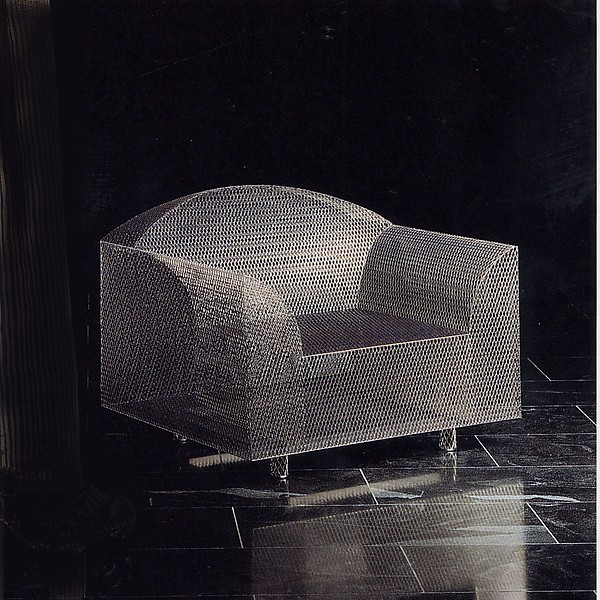
A confluence of styles, materials, techniques, and trends characterizes this exhibition, the last in a series surveying 20th-century design around the world through the display of significant objects in all media drawn from the Museum's collection. Ranging from the postmodernist avant-garde, who challenged the stylistic rigors of modernism by returning to motifs of the past, to high-tech designs and bold experimentation with color, form, and function, the presentation features important objects by celebrated designers and architects such as Tadao Ando, Sir Norman Foster, Frank Gehry, Shiro Kuramata, Ettore Sottsass, Philippe Starck, and Robert Venturi. Also on view are works by younger designers—such as Ross Lovegrove and Reiko Sudo—who are practicing at the vanguard of a field now marked by more innovation, novelty, and variance than ever before.
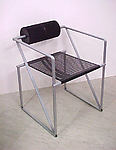
The International Style architecture that developed in Europe between the world wars maintained a prominence within the design world throughout the balance of the 20th century. Many designers and architects retained the earlier modernist philosophies, aiming to integrate modern technology and formal elements derived from the basic grid. The use of industrial materials—predominantly stainless steel and other metals—and minimalist, linear forms evoke the language of the idealistic International Style philosophy, "less is more." Mario Botta's undecorated Seconda Armchair (1982) is a study in the simple geometric forms of square, cylinder, and triangle, while the grid is Peter Eisenman's organizing principle for his House X model (1980).
The exhibition also features design from the mid-1970s, when the post-modernists began to challenge stylistic rigors of earlier 20th-century modernism and looked to traditional neoclassical forms and materials for inspiration. In 1972, the publication of Robert Venturi's Learning from Las Vegas (The MIT Press, Cambridge, Massachusetts, and London, England, 1977), among other treatises, advocated experimentation with vernacular forms and materials. Visual references drawn from art and architectural history superseded functionalism. Overt historical references and decoration transformed architecture, furniture, tabletop accessories and jewelry into objects of fantasy. Robert Venturi's Sheraton style side chair (1984), one of a series of nine seats based on 18th- and 19th-century forms, is made out of plywood and brightly colored plastic laminate rather than sober mahogany and walnut. Robert A.M. Stern's candlestick (1983) for Swid Powell evokes the classical Doric columns of antiquity, and Ricardo Bofill's perspective drawing (1982) for a housing project in Versailles, France, combines architectural theories of the Renaissance and classical antiquity.
In Italy, the Studio Alchimia created experimental design that used irony to break down rigid, austere Bauhaus principles. On view is the original collage for the cover of the exhibition catalogue Alchimia: Never Ending Italian Design, (1985). In 1980, the Italian architect and industrial designer Ettore Sottsass formed a loose association of architects and designers, whose witty furniture explodes with radical new concepts of color, form, and pattern. Among the highlights of the exhibition is Sottsass's Tartar Table (1985).
The studio art movement, which began shortly after World War II, flourished during the last quarter of the 20th century, especially in America. The idea of a return to handcrafted objects, proffered through graduate programs in glassmaking, ceramics, and textile designs at universities, was sought after by many artists, while others attempted to turn craft into fine art. William Morris's blown-glass Suspended Artifact (1993), evocative of prehistoric remains, Olga de Amaral's shimmering wall hanging of gold leaf and linen, Alquimia XIII (1984), and Ron Kent's translucent turned-wood bowl (1982) are among the one-of-a-kind objects in the exhibition.
In the 1990s many contemporary designers and architects combined new technologies and innovative materials to make sophisticated yet utilitarian objects, such as Mario Bellini's stacking chair for Heller, in which the fiberglass-reinforced polyurethane legs are left hollow to provide added tensile strength. Other designers, recognizing the inherent beauty of materials developed for science, began to employ them in a wide range of consumer products. These include Werner Aisslinger's Soft Chaise Lounge (1999) and Olgoj Chorchoj Studio's Carbon 40 Bowl (1999). Finally, at the end of the century, some designers and architects began to address environmental concerns and seek "green" solutions to design problems. Trevor Baylis's FreePlay Self-Powered Lantern (1994) is a flashlight powered by a wind-up spring mechanism that does not depend on battery or electric power. Samuel Mockbee and his architectural students at The Rural Studio address housing and public building needs in the rural South. Their project, Yancey Chapel, Hale County, Alabama, was built with recycled and used materials such as worn automobile tires, salvaged lumber, and tin reclaimed from local barns.