Chinese Export Porcelain at The Metropolitan Museum of Art
January 14–July 27, 2003
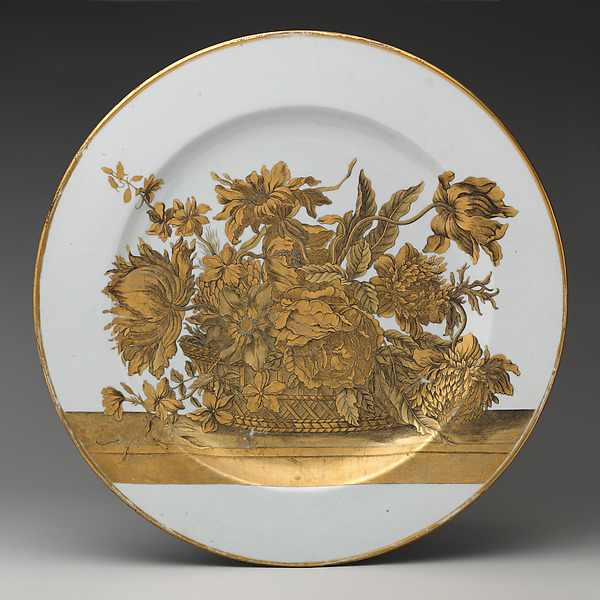
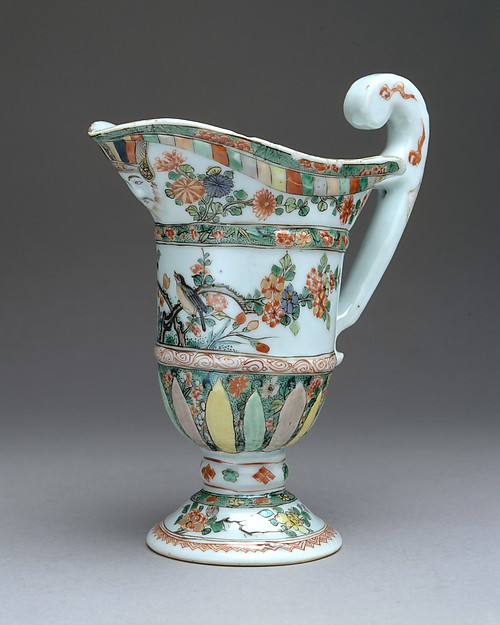
Featuring more than eighty works drawn from the Museum's own collections, this exhibition examines the precious porcelain created in China for export to Europe and America. Dating from the mid-sixteenth century through the third quarter of the nineteenth century, the exhibition includes a wide range of vessel types as well as services and punch bowls, and two works in ivory. Together with the Metropolitan's winter 2003 Bulletin on the subject, the exhibition highlights this little-known facet of the Museum's collections.
Introduced to Europe in the fourteenth century, Chinese porcelains were regarded as objects of rarity and luxury. In the early sixteenth century, however—after Portugal established trade routes to the Far East and began commercial trade with Asia—Chinese porcelains began to arrive in the West in some quantity. By the eighteenth century, trade between China and Europe had expanded from spices to tea, textiles, silver, and porcelain as well. Although porcelain was incidental to the success of the trade, the quantity of exported items—some three hundred million pieces that are believed to have reached England over two centuries—ensured a lasting influence on Western taste and the history of ceramics.
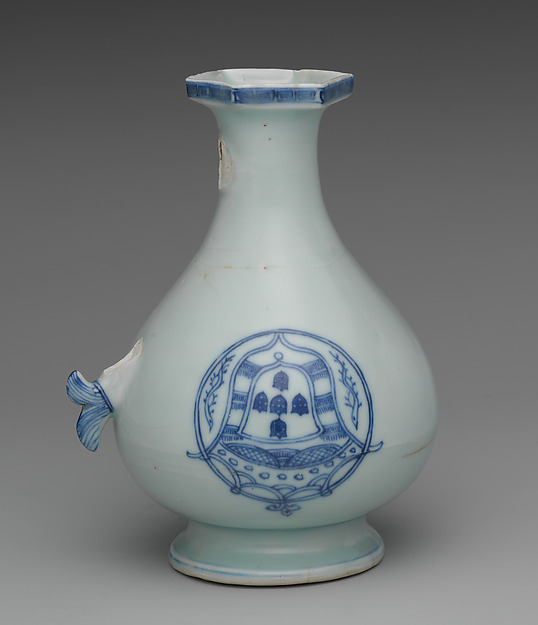
The exhibition begins with some of the earliest export porcelains known, including a ewer in Islamic form dating to about 1520, a rare surviving example of the first porcelain production intended for the West.
Of particular note are the armorial porcelains for the Dutch, Portuguese, Swedish, English, and American markets. On view is a large plant tub dating to 1693–97, the earliest known piece of armorial porcelain made for the English market. Both individual objects and entire services decorated with coats of arms comprised a significant percentage of the trade in Chinese porcelain. Patrons often supplied their armorials in the form of a drawing or a print in which the details were indicated in heraldic language. Occasionally, these instructions were misinterpreted; in a dish made for the English market of about 1715, the words sa (for sable, black) and argt (for argent, silver) were included in the coat of arms.
Two extensive porcelain services featured in the exhibition are particular strengths of the Museum's collection: one group consisting of more than two hundred pieces from about 1795 for the family of Samuel Chase of Baltimore, Maryland, and the other from about 1765 that was made for the Portuguese Saldanha family. A group of porcelains produced just following America's entry into trade with China, which began in 1784, is also on display.
A plate belonging to a large group of porcelains owned by George Washington (1732–99) and Henry "Lightfoot" Lee (1756–1818) is also featured in the exhibition. It is distinguished by the central motif depicting the Angel of Fame holding aloft the medallion of the Society of the Cincinnati suspended from a blue-and-white silk ribbon. Such porcelains arrived in America on only the second American ship to return with goods from China. Another striking example that emerged from American trade with China is an early nineteenth-century covered tureen emblazoned on front and back with a large spread eagle, framed by four quadrants of the so-called Fitzhugh pattern of leaves and flowers.
Besides porcelain, a small number of works in other media is also presented to provide a contextual dimension to the exhibition. Porcelain was only part of the extensive trade between China and the West, and cargoes were full of tea, silks, paintings, lacquerware, metalwork, and ivory. One extraordinary survivor is a nine-story pagoda—over 3 1/2 feet high—that was said to have been brought back from China by Samuel Shaw in 1784 on the Empress of China, the first ship to sail from an American port to China. The intricate pagoda is composed of carved ivory walls with carved bells suspended from each roof, and with a fretwork fence and willowy, overscale flowers of stained ivory.
The exhibition and its accompanying publication were made possible by Mary and Marvin Davidson.