The Essential Art of African Textiles: Design Without End
September 30, 2008–April 5, 2009
Dazzling textile traditions figured importantly in the earliest recorded accounts of visitors to sub-Saharan Africa, dating to as early as the ninth century. Historically, textiles also constituted one of the primary commodities imported into sub-Saharan Africa, through trade routes that extended south across the Sahara from North Africa until the fifteenth century and subsequently by Europeans along the Gold Coast. Among the earliest documented examples of West African textile traditions were those collected by European textile manufacturers seeking new markets for their own exports in the nineteenth century. A significant collection given to The British Museum in 1934 consisted of the African textiles gathered in West Africa before 1913 by Charles Beving, who was a partner of a Manchester firm. More than a dozen of these works, which were gathered as part of market research to determine regional tastes, figure centrally in this exhibition.
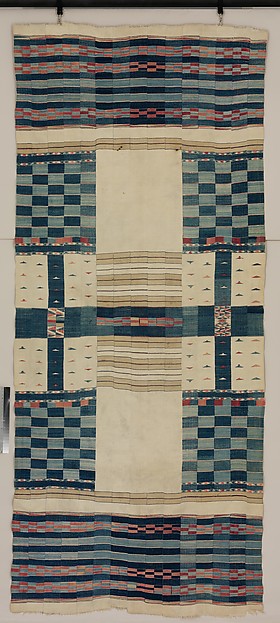
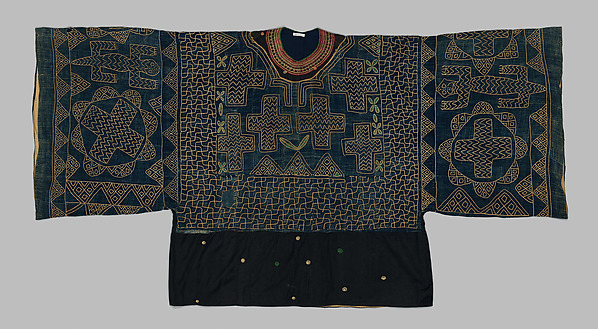
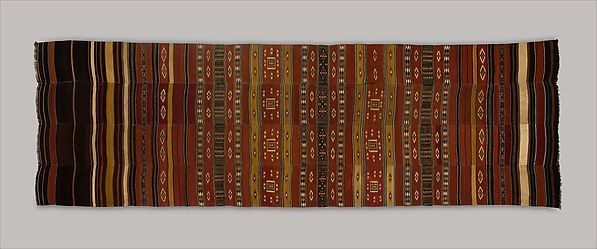
The myriad distinctive regional traditions represented in this exhibition include the expansive monumental wool and cotton strip-woven architectural elements created in Mali and Niger; a rich range of deep blue indigo, resist-dyed textile genres produced in Senegal, Gambia, Ghana, Nigeria, and Cameroon; textile panels composed and woven by Igbo women and Yoruba men in Nigeria, to be wrapped around the body as apparel; and a series of the impressive voluminous robes and tunics that have been designed from regional fabrics from Algeria to Nigeria.
The various examples of regional vernaculars on display provide a foundation and point of departure for the consideration of sixteen works by eight contemporary artists who are conversant with this highly sophisticated visual language: El Anatsui; Sokari Douglas Camp; Rachid Koraïchi; Atta Kwami; Seydou Keïta; Grace Ndiritu; Yinka Shonibare; and Malick Sidibé. The unique conversation between "contemporary" and "classical" forms of expression establishes continuity between the overarching aesthetics and enhances the appreciation of the contemporary works.
El Anatsui (Ghanaian, b.1944), Between Earth and Heaven, 2006. Aluminum, copper wire; 86 3/4 in. x 10 ft. 6 in. (220.3 x 320 cm). The Metropolitan Museum of Art, New York, Purchase, Fred M. and Rita Richman, Noah-Sadie K. Wachtel Foundation Inc., David and Holly Ross, Doreen and Gilbert Bassin Family Foundation and William B. Goldstein Gifts, 2007 (2007.96)
The exhibition is made possible in part by The Andrew W. Mellon Foundation, Fred and Rita Richman, and The Ceil & Michael E. Pulitzer Foundation, Inc.
It was organized by The Metropolitan Museum of Art, New York, in collaboration with the British Museum, London.
The scope of meaning associated with cloth is so wide I have not heard it more aptly and succinctly put than by Sonya Clark . . . that cloth is to the African what monuments are to Westerners. Indeed their capacity and application to commemorate events, issues, persons, and objectives outside of themselves are so immense and fluid it even rubs off on other practices.
—El Anatsui (2003)
The son and brother of men who wove Ewe kente cloth in Ghana's Volta region, textiles have been a leitmotif in Anatsui's own sculptural oeuvre. A graduate of Kwame Nkrumah University of Science and Technology in Kumasi (KNUST), as a student Anatsui supplemented his training in Western media with careful observation of the creative efforts of local artisans in regional idioms. Like humanists in the fourteenth through seventeenth centuries who carefully studied the visual language of Greek and Roman classicism and applied it to their own particular subject matter, Anatsui is a twenty-first century master intensely aware of Africa's art historical traditions and who infuses them with new life and meaning.
Over the course of a career that has spanned forty years, Anatsui has been a pioneer in identifying and harvesting a variety of locally available natural and manmade materials from his immediate environment as media for radically new sculptural genres. These have included tropical hardwood, broken ceramic pots, grain mortars, evaporated milk tin lids, cassava graters, driftwood, and, most recently, discarded liquor bottle caps. In the late 1990s, Anatsui developed a form of metal textiles or tapestries. Using the bottle caps discarded by Nigerian distilleries as an experimental material, he sorted them by color before flattening them,and stitching them together with copper wire. In doing so he found that he had arranged them in a manner reminiscent of the fabric and structure of narrow band textiles woven in West Africa. With this dazzling body of work he has developed a new and highly original form of artistry with formal and conceptual links to regional traditions. Since 1975, Anatsui has lectured at the University of Nigeria, Nsukka, where he is professor of sculpture. An internationally acclaimed artist, he was among Africa's first contemporary artists to be featured at the Venice Biennale in 1990.
Kalabari culture revolves around cloth especially for women. Our heirlooms are cloth. A key concern is how much important cloth you have to clothe the family for big occasions, funerals, births, marriages. We lay cloth out for wakes, covering rooms, beds, and even the deceased. When the body is buried a display of the cloth used for the wake is exhibited for a week with coral and jewelry. As a girl, I graduated from beads to wearing a dress and subsequently additional cloths over time. The way the cloth is wrapped around one's body and the height of it depended on one's age and importance. So I was always very conscious of fabric. Some cloths (prints) can not be worn in some areas of my town during important occasions.
As an artist I like figures that are clothed. . . . .The different styles of clothing and textiles in Nigeria and Europe [as well as] the fabrics that cross cultures have been features in my work. f The tactile qualities in fabrics and the way the material is worn is fascinating to me.
—Sokari Douglas Camp (London, 2007)
Trained at the Royal College of Art and now working in the U.K., Sokari Douglas Camp remains keenly engaged with the cultural life of the Kalabari people of Nigeria where she spent her early childhood. Douglas Camp has regularly revisited the scene of her formative years and made it a major subject of her artistic explorations.
As a female artist who expresses herself in the physically demanding medium of welded metals, Douglas Camp occupies a unique place. Her expansive sculptural portrayals distill their subjects' physicality to essential features. These hollowed representations omit certain aspects of the body and exactingly define others through cutting out two-dimensional designs from sheets of metal. Although Douglas Camp's work is predominantly figurative in nature, it emphasizes the abstract forms of negative space so that blouses, textile wrappers, and tied headgear are rendered elegantly as openwork shells. In doing so she endows these solid armatures with a whimsical lightness and grace. She has also sought to infuse sculpture with a sense of vitality through evoking movement both by introducing kinetic features and underscoring the performative and active dimension of her subjects.
Moving easily between the Niger Delta and London, Douglas Camp's oeuvre visually summons individuals she has observed in Buguma festivals or Brixton markets. Best known for her evocations of regional masquerade festivals, her work has responded to events that have unfolded in the Niger Delta that are of universal import. These have included the tragic execution of the author Ken Saro Wiwa, the ecological disasters that have resulted from oil exploitation in the Niger Delta, and the legacy of the Slave Trade. Many of the female subjects alluded to in her sculptures reflect the Kalabari aesthetic practice of widening the lower body through wrapping it in multiple layers of cloth. Both the considerable heft of a substantial corporeal being and the lavish use of costly textiles are favored for their identification with prosperity and abundance. Douglas Camp further insists on the inherent aesthetic qualities of textiles by highlighting their decorative patterns and suggesting their flowing movements in the most inflexible of media.
Blue, a supraterrestrial color, is the path of the infinite. It expresses detachment from the values of the world.
—Rachid Koraïchi
Born in Algeria, based in Paris, and traveling continually to Algeria, Tunisia, and Egypt, Rachid Koraïchi takes on ambitious artistic endeavors that are catalysts for journeys of discovery. These pilgrimages, punctuated by multimedia installations, retrace the paths taken by venerated Sufi mystics. Trained at Algeria's École des Beaux-Arts, the Institut d'Urbanisme de l'Académie de Paris, and both the École des Beaux-Arts and École des Arts Décoratifs in Paris, central to Koraïchi's identity is his heritage of Sufism that informs his emphasis on the inseparability of aesthetics and metaphysics. Both the process of developing these demanding meditations and experiencing them may be likened to the tariqa, or way, of Sufi mysticism through which one perpetually strives to deepen understanding in the quest for grace.
Through making manifest the writings of exemplary mystics, Koraïchi seeks to capture an idea of transcendence. He never literally transcribes sacred texts but rather expressively translates them into his own personal script that combines the written word in Islamic calligraphy, characters that originate in pre-Islamic Berber and Tuareg tradition, magical squares, and talismanic numbers. Despite his focus on the power of esoteric signs, Koraïchi's works are invariably multifaceted, comprising different kinds of media in combination. These projects seek to highlight the cosmopolitan character of the Mediterranean world going back to the medieval period through reviving the legacy of specialized artisans. He executes these in collaboration with individuals trained in a region's classical traditions, such as weavers and dyers who produce elements of his monumental, often site-specific, creations under his supervision. Koraïchi's expansive vision reignites complex intercultural networks, resides in major cultural institutions, and has been recognized in international exhibitions including both the 47th and 49th Venice Biennales.
Over time, I have been better able to embody those aspects of my everyday life which have the greatest significance: kiosks, commercial (sign) painting, woven textiles, Ghanaian music (Koo Nimo) and jazz, all of which allow for serial composition in strips, stripes, grids. I have focused on color as my subject matter, perhaps taking me back to where I started with the perception of my mother's paints and textiles, but my art also resonates, I have seen, with the wider world of color formalist painters, such as Piet Mondrian, Mark Rothko, Sean Scully, and Ellsworth Kelly.
—Atta Kwami (Kumasi, January 2008)
Atta Kwami draws inspiration from the sensory stimuli of his adopted urban environment of Kumasi, the cultural capital of the Asante region. His abstract imagery is a synthesis of elements: pulsating musical rhythms, the city's dynamic entrepreneurial landscape, and the vibrant designs and intense colors of regional textile traditions. While he has regularly produced large-scale installation works, he imbues meaning into the small visual detail as one might isolate a musical chord or interlude.
Atta Kwami has combined his work as a fine artist with his desire to chronicle Ghanaian art history. The title of his soon-to-be published doctoral thesis is Kumasi Painting, 1951–2007. His mother, Grace Salome Kwami, a gifted artist and educator, served as a critical formative influence. A sculptor, weaver, and painter, she submitted watercolors and gouaches to Ghanaian textile manufacturers in the 1960s. At the prestigious Achimota School, Atta Kwami studied weaving, among other art subjects, with an Ewe master. Kwami holds degrees in painting and art history from Kwame Nkrumah University of Science and Technology (KNUST) in Kumasi, the Royal College of Art in London, and The Open University, Milton Keynes, in the U.K., and a diploma from the Royal College of Art, London. For more than twenty years he was Senior Lecturer of painting and printmaking at KNUST. His work is exhibited internationally and he has served as a major catalyst for bringing together Ghana's fine arts community.
My first backdrop was my bedspread. After that, I changed the backdrop every two or three years: this is how I can now establish the dates of the negatives . . . Sometimes the backdrop went well with the clothes, particularly for the women.
—Seydou Keïta (Bamako, August 1994)
The studio photographer Seydou Keïta was an eloquent chronicler of the aspirations of a new urban elite in Mali's capital during the 1940s and 50s. During this period of immense economic and demographic growth, the population more than doubled. In this context, he was one of a number of self-taught individuals who launched businesses as commercial portrait photographers in Bamako. Beginning in 1948 his studio was situated at the heart of the city not far from the train station, the large market (le Marché Rose), and the cinema (Soudan Ciné). The élan and aesthetic appeal of Keïta's work reflect his gifts in choreographing a mise en scéne that ideally captured each of his subjects' individual character with elegance and composure. Keita shot in black and white and developed his own 13 x 18 cm negatives as prints of the same size. Despite his restricted palette, textiles dominate as vibrant formal elements; these include the various fabric backdrops he selected as well as the personal sense of style evident in the fashions worn by the female sitters. In combination these lively contrasting patterns create a distinctive and dynamic visual tension.
According to Keïta, the qualities evident in his work that attracted his clientele were his emphasis on capturing crisp detail, sharpness and clarity of line, and masterfully calibrated composition. These commissioned portraits, carefully calculated to reflect the cosmopolitanism of their subjects, were originally intended for intimate viewing in their subjects' homes. Keïta closed his studio in the early 1960s when he was called upon to serve the newly independent Malian state as official government photographer. In the 1990s, large-format prints were produced from the original negatives in Paris. The names of the individuals immortalized in these images are for the most part lost, as Keïta's archives of his negatives did not record the identities of the thousands of clients who passed through his studio.
Seeing the Royal Academy exhibition Matisse: The Fabric of Dreams, His Art and His Textiles reaffirmed the similarity of our working process . . . we share the ritual of assembling textiles and setting up the studio with fabrics as a background to galvanize our artistic practice. Matisse understands and appreciates the beauty and simplicity of working with textiles. The hallucinogenic properties of overlapping patterns, shift and swell in his paintings, override perspective and divorce shape from color. His paintings appear to expand the viewer's eye and mind. . . . By wrapping my body within textiles I extend Matisse's methodology of transforming both the figure and patterns into a single pictorial plane. By loading patterns upon patterns . . . I also create and control tensions with the fabrics that provoke a transcendental experience.
—Grace Ndiritu (London, 2005)
Grace Ndiritu boldly relies on her own physical presence as the central agent of her evocative artistry. Her "handcrafted videos" are highly personal and introspective solo performances in front of a camera fixed on a tripod. Although Ndiritu studied textile art at the Winchester School of Art in the U.K., she was never interested in designing fabrics. Instead she came to exploit textiles as a meaningful vehicle for creative expression following journeys of self-discovery extending from the Himalayas to Iceland and from India to Mali. During those nomadic explorations she derived a basic level of personal security from a simple scarf that makes its appearance in her video The Nightingale.
Raised and based in Britain, Ndiritu's Kenyan heritage has instilled in her a lack of affiliation with any one place and a belief in the importance of obtaining an awareness of as broad a spectrum of experiences as possible. Her experiences outside the West have led her to reflect on the way that art elsewhere is more seamlessly a part of every day life, as in the way she found textiles to be integrated into Malian society. In drawing from that tradition, she has sought to manipulate textiles as vehicles for eliciting emotional responses and as objects of aesthetic contemplation in concert with the body. Among the international presentations of Ndiritu's work was a solo exhibition at the 2005 Venice Biennale.
In 1990 I developed another way of questioning ideas about cultural authenticity. I started to use "African" fabric purchased from Brixton Market in my work. Batik, which is commonly known as "African" fabric, has its origins in Indonesia and is industrially produced in Holland and Manchester for export to Africa where it is made into traditional dress. The adoption of the fabric, particularly in West Africa, has led to the development of local industries which also manufacture fabrics. . . . In my own practice, I have used the fabrics as a metaphor for challenging various notions of authenticity both in art and identity.
—Yinka Shonibare (London, 1996)
Yinka Shonibare's use of industrially manufactured "Dutch wax prints" in his work reflects on the most recent chapter of the history of trade between Africa and the West, the nature of that relationship, and assumptions about creativity and identity. Shonibare's sharp insights into this history reflect his own personal trajectory of being born in England to Nigerian parents, spending formative years of his youth in Lagos, and pursuing his vocation as an artist in Britain. With thoughtful ingenuity, visual poetry, satirical humor, and aesthetic panache, his work subverts misconceptions about racial, class, and cultural identity and distinctions between high and low art. Trained as a painter and a graduate of Goldsmith's College of the University of London, Shonibare has developed his ideas in a variety of media that include installation art, photography, and film. In each of these, he has drawn upon cloth as a prominent formal element that suggests to the viewer that things are not what they may appear to be at first glance. His use of this complex signifier has ranged from austerely stretching it as a canvas to lavish deployment in theatrical tableaux that foil established icons of Western culture.
In 2004 Shonibare was nominated for the Turner Prize and in 2005 was awarded the title Member of the British Empire in recognition of his service to the nation. His proposal for a public sculpture for the Fourth Plinth site in London's Trafalgar Square was recently selected. The Museum of Contemporary Art in Sydney, Australia, has organized a mid-career retrospective of his work, which will be on view this fall, followed by a presentation at the Brooklyn Museum.
In the studio, I liked working on composition.The photographer's relationship with his subject happens through touch. Arranging the person, finding the right profile, the right lighting to highlight their features, bring out the beauty in their bodies . . . I'd find positions and postures that suited each person, I had my own tactics.
—Malick Sidibé (Bamako, 1998)
Malick Sidibé's photography uniquely captured the youthful exuberance of post-Independence Malian society. At an early age his natural talent for drawing was identified and his artistic education began in 1952 at the Maison des Artisans Soudanais in Bamako. He subsequently transferred that sensibility for representation of the world around him to developing a command of the photographic medium by observing the practice of the French studio photographer Gérard Guillot. Sidibé opened his own studio in the Bagadadji district of Bamako in 1962. His own photographic record is distinctive, however, for his movement between portrait photography and event-driven coverage of the way the youth of Bamako spent their leisure time.
The appeal of this fresh and energetic subject matter led to his tireless pursuit of documenting social gatherings, ranging from the club scene animated by rock and roll and soul to excursions down the Niger. His images reflect the sheer joie de vivre and insouciance of their protagonists during this period of Africa's transition to modernity of the 1960s and 70s. Whether in the studio or at a dance his keen eye for spontaneity as well as imaginative clothes and attitudes afford his imagery originality and a distinctive style. While his formative attachment was to black-and-white photography, in recent years he has also worked in color for the French fashion magazines Vogue, Elle, Cosmopolitan, and Double. Sidibé received the Hasselblad Award for Photography in 2003, the Venice Biennale's Golden Lion for lifetime achievement award in 2007, and the ICP Infinity Award for lifetime achievement in 2008.
