Turkmen Jewelry from the Collection of Marshall and Marilyn R. Wolf
At The Met Fifth Avenue
October 9, 2012–February 24, 2013
The jewelry, carpets, and robe featured in this exhibition were produced in the nineteenth and twentieth centuries in Central Asia and Iran by Turkmen craftsmen. While Turkmen nomads had lived for hundreds of years in the region now divided between Turkmenistan, Uzbekistan, Kazakhstan, and northeast Iran, their lives changed markedly in the nineteenth century when, in response to a loss of pasture land, they increasingly joined settled populations. Despite the cultural shift, Turkmen craftsmen continued to work in a traditional mode. Their impressive silver jewelry was worn by women, though some objects, such as whips, were used by men. Additionally, silver ornaments were produced for horses, the most valuable asset of nomadic Turkmen. In exchange for the silver and gold used for their jewelry, the Turkmen took and traded slaves, raiding the Persian population as well as Cossacks and Russians.
From the top down, Turkmen women's jewelry consisted of headgear in the form of crowns, caps, headbands, and braid ornaments; pendants attached to headdresses and suspended on either side of the head; earrings; pectoral and dorsal ornaments; amulet holders; appliqués for clothing; armbands; and rings. While many of the pieces shown here were made by nomads, some were created by craftsmen based in towns or cities. This jewelry reflects the different styles used by specific tribal groups: the Yomut preferred surfaces crowded with ornamental designs, the Teke produced pieces in which fire-gilded decoration contrasts with a silver background, and the Ersari and Saryk tended toward no gilding and minimal decoration. On Kazakh jewelry, stamped decoration resembling granulation is prevalent. In the later twentieth century, craftsmen from Afghanistan and Turkmenistan copied older Turkmen jewelry but often used glass or composite materials rather than carnelian, pearls, or other semiprecious stones.

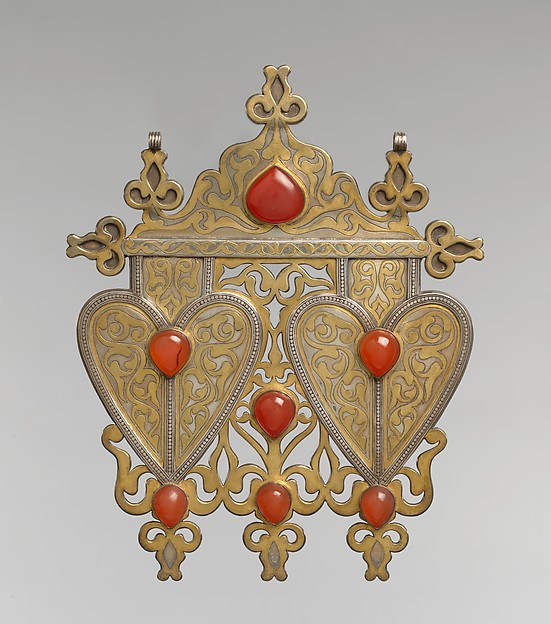
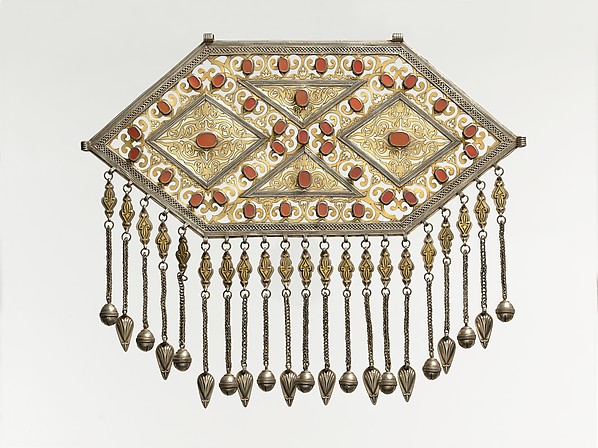
Most of the objects in this section of the exhibition are products of the Teke, a subtribe of the Turkmen living in the Merv oasis. Bold, uncrowded compositions of contrasting fire-gilded and plain silver set with table-cut carnelians characterize the work of Teke craftsmen. Pieces such as the double-cordiform pendant have openwork arabesques—a common motif in Teke jewelry—that join its two main elements. In addition to pectoral and dorsal ornaments worn by women, this case includes a man’s large belt with decorative appliqués. The combs, begging bowl, and triangular amulet holder were produced in an urban setting and contrast with the Teke pieces in decoration and technique.
The objects featured in another case in the exhibition display a variety of surface decoration based on the repetition of small elements or motifs. The Kazakh makers of the tripartite pectoral ornament and the teapot-shaped ornament embellished the fire-gilded sheet surface with stamped beading and silver shot resembling granulation. The filigree on a lobed plaque from Khotan is atypical of Turkmen jewelry, but this technique may be related to the feathery low-relief patterns on the Yomut collar stud. Some pieces encompass recognizable animal forms, such as the camel-shaped amulets and the bird and fish on the teapot-shaped ornament, while others are decorated with abstract animal motifs such as ram's horns.
Turkmen women wore impressively large cordiform, or heart-shaped, ornaments as functional dorsal jewelry, decorating the upper back when attached to braids; and as pectoral jewelry, probably originally attached to a cylindrical amulet holder. Braids also were adorned with long plait ornaments. Similarly, temple ornaments were suspended from women’s caps or the crowns of their heads. Most of these dangling ornaments had chains with bells that jingled when the wearer moved, an aspect of Turkmen life that caught the attention of European travelers. Amulet holders, made singly or in pairs, consisted of horizontal cylinders or rectangles that, when opened, could hold prayers or Qur'anic verses written on paper.
All of the pieces in this case are attributed to Teke workmanship and feature openwork decoration. To achieve the openwork design, craftsman cut through the silver sheet with a chisel or fret saw. Whether backed with fabric in a contrasting color or left without a backing, the openwork ornament lends these pieces a sense of dynamic movement. Using relatively few motifs—the trefoil, S-shape, stylized ram's head, and interlaced arabesque—the craftsmen produced a remarkable range of decoration for their jewelry and furnishings.
In addition to jewelry, Turkmen silversmiths produced objects for ceremonial purposes, such as silver whips inlaid with turquoise and carnelian. The table-cut turquoise found on one of the whips here appears on an outsized ring as well, suggesting that both objects were produced in an urban setting, also the likely source of the headdress ornament in the shape of a double bird. The ornately shaped armbands studded with small turquoise and carnelian may be a relatively recent creation of a Kazakh craftsman who used the long-lived motif of unusually shaped birds' heads. Despite their enormous size, double finger rings were given to women who acted as matchmakers.
The exhibition is made possible by The Hagop Kevorkian Fund.
