Cocktail dress
Jean Dessés originally travelled to Paris from Egypt to study law and diplomacy; however, he soon discovered that his true passion was designing. He opened his own couture house in Paris in 1937 and became known for his characteristic twists and gathers which he magically executed on a variety of fabrics. Considered his best work are his evening dresses of chiffon, which have the appearance of classical sculpture. He favored ombré fabrics and colors other than black, such as Wedgwood blue, old rose, taupe, eggplant, green, brown, pale grays, faint pinks, and whites.
This cocktail dress represents a classic silhouette popularized in the nineteen-fifties. The portrait collar is extremely feminizing, framing the face and neck. The skirt is unique, as it is lightly draped at back, accented by a large patch pocket placed at the right back hip.
This cocktail dress represents a classic silhouette popularized in the nineteen-fifties. The portrait collar is extremely feminizing, framing the face and neck. The skirt is unique, as it is lightly draped at back, accented by a large patch pocket placed at the right back hip.
Artwork Details
- Title: Cocktail dress
- Designer: Attributed to Jean Dessès (French (born Egypt), Alexandria 1904–1970 Athens)
- Date: ca. 1952
- Culture: French
- Medium: silk
- Credit Line: Brooklyn Museum Costume Collection at The Metropolitan Museum of Art, Gift of the Brooklyn Museum, 2009; Gift of Dorothy Baden Stamm, 1963
- Object Number: 2009.300.328a, b
- Curatorial Department: The Costume Institute
More Artwork
A slider containing 5 items.
Press the down key to skip to the last item.
Press the down key to skip to the last item.
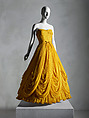
On loan to The Met
Designer Jean Dessès
fall/winter 1953–54
French
19th century
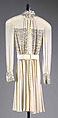
Design House Valentino S.p.A.
Designer Valentino
ca. 1970
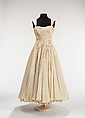
Designer Jean Dessès
ca. 1955
Possibly French
19th century
Research Resources
The Met provides unparalleled resources for research and welcomes an international community of students and scholars. The Met's Open Access API is where creators and researchers can connect to the The Met collection. Open Access data and public domain images are available for unrestricted commercial and noncommercial use without permission or fee.
To request images under copyright and other restrictions, please use this Image Request form.
Feedback
We continue to research and examine historical and cultural context for objects in The Met collection. If you have comments or questions about this object record, please contact us using the form below. The Museum looks forward to receiving your comments.