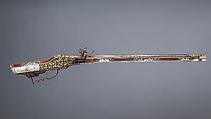
Doppelläufige Radschlosspistole Kaiser Karls V.
Artwork Details
- Titel: Doppelläufige Radschlosspistole Kaiser Karls V.
- Künstler: Peter Peck, Deutscher, 1503–1596 und Ambrosius Gemlich, Deutscher, aktiv ca. 1520–50
- Datum: ca. 1540–45
- Medium: Stahl, Gold, Holz, Horn
- Dimensionen: L. 49,2 cm, Kaliber 12 mm
- Anerkennung: Schenkung von William H. Riggs, 1913
- Akzession Nr.: 14.25.1425
- Curatorial Department: Arms and Armor
Audio
4411. Double-Barreled Wheellock Pistol Made for Emperor Charles V
DONALD LAROCCA: This is a double-barrel, wheel-lock pistol made for the Holy Roman Emperor Charles the Fifth, about 1540, or 45.
NARRATOR: Donald Larocca is Curator of Arms and Armor.
DONALD LAROCCA: Charles the Fifth was ruler of huge territories; it was under his reign that much of the New World was explored. He had large territories throughout Europe as well. He was a great patron of the armorer’s art. He had many, many armors, complete suits of armor, sets of decorated swords, and lots of firearms too, and this pistol here is really one of the best types of pistols from that period. Handheld firearms are still a relatively new development at this period of time in the early sixteenth century. Firearms had been developing for a good century, and artillery for another century before that, so you have the use of gunpowder on the battlefields of Europe from the thirteenth century onward. It was only early in the sixteenth century, when these type of firing mechanisms were perfected, that allowed a gun to be practical for use, that they really began to be used much more widely by the nobility and on the battlefield.
What we see is that this is a highly decorated piece, this is not just a rough-and-tumble thing intended for use in warfare necessarily. The stock is inlaid with bone or ivory; the metal work is chiseled and engraved and then gilded. So from the amount of decoration you can see that it is a piece for a very highly-placed patron. It has two locks, each lock allowing one of the two barrels to fire separately. The locks are the circular pieces that you see on the side and that’s where the name “wheel-lock” comes from. The wheel-lock is almost like a clock mechanism, and in fact the gun maker on this, Peter Peck, was also a clockmaker. The early mechanisms for firearms of this type were frequently made by people who were also clock-makers, because they knew the techniques to make those kinds of mechanisms.
More Artwork
Related Content
Research Resources
The Met provides unparalleled resources for research and welcomes an international community of students and scholars. The Met's Open Access API is where creators and researchers can connect to the The Met collection. Open Access data and public domain images are available for unrestricted commercial and noncommercial use without permission or fee.
To request images under copyright and other restrictions, please use this Image Request form.
Feedback
We continue to research and examine historical and cultural context for objects in The Met collection. If you have comments or questions about this object record, please contact us using the form below. The Museum looks forward to receiving your comments.
Content Notice
The Metropolitan Museum of Art presents over 5,000 years of art from around the world, and our online collection reflects ongoing work conducted over the course of our more than 150-year history. You may encounter objects or images that may be inappropriate for some viewers or information that may be outdated.