Spearhead
Durgā is often considered to be the wrathful manifestation of Mahādevī, the Great Goddess, also known simply as Devī. Through manifestations, or projections of their divine essence, the gods and goddesses created variations of themselves with different powers, attributes, and names, which were suited to meet the demands of specific crises or adventures. Devī is seen as the universal mother and by some accounts is the ultimate source of all Hindu goddesses. She is widely revered in her Durgā form and in her benign manifestation as the goddess Pārvatī, wife of Shiva (see acc. no. 36.25.361).
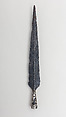
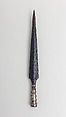
The most famous episode among the Durgā legends involves the goddess's destruction of Mahisha, the mighty buffalo demon who had vanquished all the male incarnations of the gods. Angered by their defeat, the gods pooled their fury into one fiery emanation, which resulted in the creation of Durgā, an invincible warrior in the form of a beautiful young woman. They bestowed their own weapons upon her, and, thus armed and riding the lion steed of Devī, she was easily able to kill Mahisha and many other demons. Durgā is frequently depicted with many arms in order to accommodate the sacred weapons given to her by the gods. On this spearhead, however, she is shown with only two arms, in which she bears the trident of Shiva and a sword.
Because of her stature as an undefeatable warrior, the worship of Durgā became an important means of seeking divine assurance for success in battle. The ritual of her worship included the ceremonial consecration of individual weapons and their veneration as minor deities. The use of Durgā's image in the decoration of this spearhead may be seen as a sign of homage to the goddess, as an invocation of her prowess, and as a means of sanctifying and therefore empowering the weapon in her name.
Artwork Details
- Title: Spearhead
- Date: 16th century
- Culture: Indian
- Medium: Steel, gold
- Dimensions: L. 16 1/2 in. (41.9 cm)
- Classification: Shafted Weapons
- Credit Line: Rogers Fund, 1920
- Object Number: 20.151.5
- Curatorial Department: Arms and Armor
More Artwork


Related Content
Publications
Books, guides, and catalogues published by The Met.
Research Resources
The Met provides unparalleled resources for research and welcomes an international community of students and scholars. The Met's Open Access API is where creators and researchers can connect to the The Met collection. Open Access data and public domain images are available for unrestricted commercial and noncommercial use without permission or fee.
To request images under copyright and other restrictions, please use this Image Request form.
Feedback
We continue to research and examine historical and cultural context for objects in The Met collection. If you have comments or questions about this object record, please contact us using the form below. The Museum looks forward to receiving your comments.
Content Notice
The Metropolitan Museum of Art presents over 5,000 years of art from around the world, and our online collection reflects ongoing work conducted over the course of our more than 150-year history. You may encounter objects or images that may be inappropriate for some viewers or information that may be outdated.