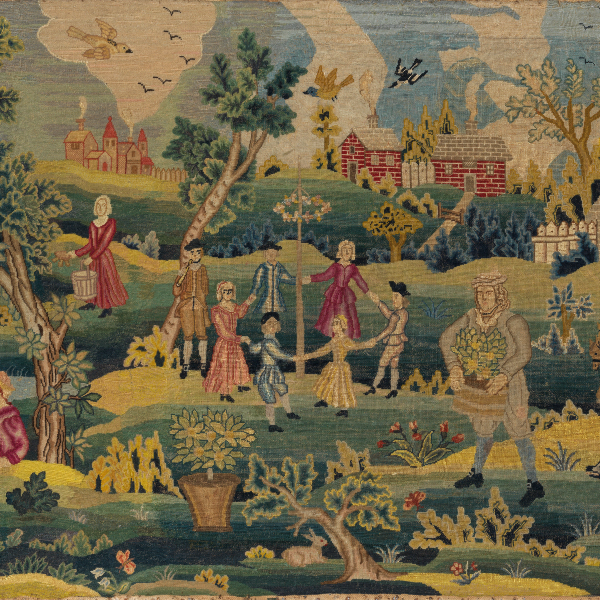
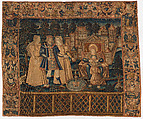
Needlework Picture with Maypole Scene
Artwork Details
- Title: Needlework Picture with Maypole Scene
- Date: ca. 1700
- Culture: British
- Medium: Silk and wool on canvas
- Dimensions: H. 21 3/4 x W. 49 inches (55.2 x 124.5 cm); Framed: 28 1/2 x W. 55 3/4 inches (72.4 x 141.6 cm)
- Classification: Textiles-Embroidered
- Credit Line: Gift of Irwin Untermyer, 1964
- Object Number: 64.101.1355
- Curatorial Department: European Sculpture and Decorative Arts
Audio
405. Embroidery and Craftsmanship
Gallery 509
NARRATOR: This small gallery includes a wide range of examples of British embroidery. This is Cayce Zavaglia, a contemporary artist who works primarily in embroidery:
CAYCE ZAVAGLIA: Despite advances in technology it pretty much comes down to a needle and thread going through a fabric. This medium has as much potential in the hand of the maker as paint does in the hand of a painter, or stone has in the hands of a sculptor, or a camera and film has in the hand of a photographer.
NARRATOR: From coifs of lace to costume pieces made of gold and silver thread, the hand-sewn items displayed here are among the most valuable—and delicate—handiwork produced at the time.
CAYCE ZAVAGLIA: I love this high and low aspect that it has. So at the same that it's used by royalty to show this wealthy status, it's also used by commoner people to maybe embroider a handkerchief for someone. They're taking this medium and they're having to describe many different things. They're using thread, but it has to convey fruit, and flowers, and flesh, and trees and clothing, all within the same work. They're using this medium of embroidery to evoke those things.
When someone sees that, they're actually doubting the reality that a human person made this.
NARRATOR: Needlework was generally viewed as a women's craft, despite the fact that some of the most expensive textiles, like tapestries, were often produced by teams of men.
CAYCE ZAVAGLIA: It's classified as woman's work; mills that were dealing with tapestries and embroideries were all run by men.
NARRATOR: Women makers were given a much smaller place in history. But the needlework that has survived tells an important story:
CAYCE ZAVAGLIA: we get this visual documentation of their lives, the lives that were overlooked by the history books.
NARRATOR: Zavaglia finds that evidence of the artist can sometimes reveal itself in surprising ways.
CAYCE ZAVAGLIA: When I'm embroidering, the process of sewing is going to pick up stuff in my studio. It could pick up dust or hairs, or I'll prick myself and then there'll be a little bit of blood on the embroidery that I have to hide, so these are like the human aspect of the work that is hidden that I find the most interesting.
More Artwork
Related Content
 Free to download
Research Resources
The Met provides unparalleled resources for research and welcomes an international community of students and scholars. The Met's Open Access API is where creators and researchers can connect to the The Met collection. Open Access data and public domain images are available for unrestricted commercial and noncommercial use without permission or fee.
To request images under copyright and other restrictions, please use this Image Request form.
Feedback
We continue to research and examine historical and cultural context for objects in The Met collection. If you have comments or questions about this object record, please contact us using the form below. The Museum looks forward to receiving your comments.
Content Notice
The Metropolitan Museum of Art presents over 5,000 years of art from around the world, and our online collection reflects ongoing work conducted over the course of our more than 150-year history. You may encounter objects or images that may be inappropriate for some viewers or information that may be outdated.